
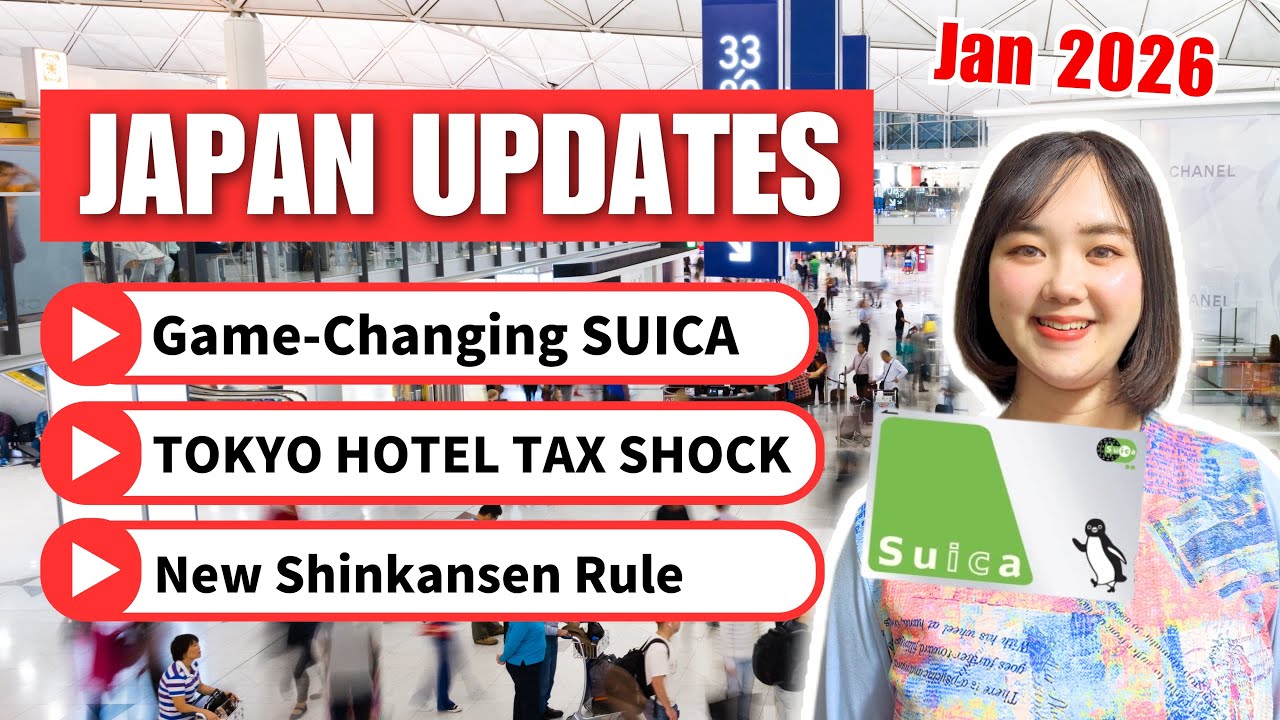
JAPAN HAS CHANGED | TOP 9 New Things to Know Before Traveling to JAPAN 2026
Hi, I’m Meg from Tokyo. In this video,
I will share the top nine new things you should know before traveling to Japan in
late 2025 and early 2026. Here, I’ll cover key updates like upcoming Suika changes, the
new year shinkansen reservation only period, and record-breaking tourist numbers. We
also offer private tours in Tokyo, Osaka, and Kyoto. So, feel free to contact us through the
link below. All right, then let’s go. Number one, Suika will change. JR East Japan has announced
that it will update mobile Suika and launch a new code payment service called Tepe starting
in fall 20126. This is an important update for anyone planning to visit Japan multiple times or
live here long-term. If you’re unfamiliar with Mobile Suika, please check out this previous video
first. There are four main points you should know. First, Teepe will be integrated directly into the
existing mobile and mobile Pasmo apps. There’s no need to install a new app or create a separate ID.
You’ll be able to use code payments right from the home screen of the app you already use. The fact
that Suika and Pasmo will now be connected through the same code payment system is also a significant
change. Second, it will support higher payment amounts. Previously, transportation IC cards
had a charge limit of 20,000 yen. But with Tepe, you can charge up to 300,000 yen, which means you
can use it for purchases that exceed 20,000 yen. Third, money transfer and charging functions
will be enhanced. You’ll be able to send your Teepe balance to family and friends and transfer
balances between mobile Suika and mobile Pasimo. Fourth, it will integrate with online payments and
local campaigns. This is a campaign style service aimed at people living in Japan, so it’s not
really relevant for travelers. As I mentioned in a previous video, the Suika Penguin is graduating
and now mobile Suika itself is evolving. It will be interesting to see just how convenient life
becomes with Tepe once it launches. Number two, Tokyo Hotel Tax Hike. In Japan, a lodging tax
may apply when staying at hotels or Rioan ins. This tax is collected by the hotel or Rioan and is
often included in the total accommodation fee. The rules for this lodging tax are set to change
significantly in Kyoto and Tokyo. In Kyoto, the lodging tax is expected to increase starting
in March, potentially reaching up to 10,000 yen, approximately $64 per person per night. Meanwhile,
in Tokyo, the tax is currently not applied for stays under 10,000 yen, and a flat 200 yen
is charged for stays of 15,000 yen or more, regardless of the actual room rate. However,
going forward, the tax-free threshold will be raised from 10,000 yen to 13,000 yen. And for
stays above that amount, a flat 3% lodging tax will be applied to the room rate. For example,
a 15,000 yen room would incur 450 yen in tax, while a 100,000 yen luxury hotel room would
see 3,000 yen added as tax. In other words, it’s easier to think of it this way. The more
expensive the hotel, the higher the lodging tax you pay. Implementation is scheduled for
fiscal year 2027, so it’s still a little way off. However, if you have a luxury hotel you’ve
always wanted to stay at, going before the new system starts might be a bit more economical
than in the future. Number three, record-breaking tourists. By 2025, the number of visitors to
Japan is projected to exceed 40 million. So, what does this mean for you? In short, Japan is
becoming a great value but very crowded country. With the yen remaining weak, Japan still looks
cheap when converted into dollars or euros. However, this also means that popular areas
and peak seasons will see even bigger crowds, higher hotel prices, and reservations that are
harder to get. So, here’s what I recommend. Try to visit famous tourist spots on weekdays
whenever possible. Then, on weekends, when many Japanese people also travel, focus on lesserk
known areas or local neighborhood walks instead. For example, you could visit Asakusa, Tokyo
Skytree, and Shibuya altogether on a weekday and then spend the weekend exploring old
downtown areas or local hotring towns where there are fewer crowds. By simply shifting your
travel days, destinations, and timing like this, you can significantly reduce crowd stress and
enjoy your trip to Japan much more. Number four, measures for trash bin shortages. In Japan
today, the issue of there not being enough trash cans is often discussed. The background to
this is that after the 1995 subway siren attack, placing trash cans in public spaces came to
be seen as a security risk and their numbers were gradually reduced. As part of this trend,
the number of trash cans and the places where they’re installed have also decreased in train
stations and at convenience stores. To be honest, convenience stores and restaurants also have
their own reasons for not wanting to provide many trash cans. People who aren’t customers often
bring trash from outside and dump it there without permission. On the other hand, with the increase
in inbound tourism, cases where people simply throw trash on the street because they can’t find
a trash can in the first place have become more noticeable. This problem is particularly severe in
the busy nightlife districts of Tokyo and Osaka. In response, Shibiaward has launched new counter
measures to reduce littering in busy areas. It has introduced a policy that requires convenience
stores, takeout restaurants, and vending machine operators to install trash cans and manage them
properly. Violators can face fines of up to 50,000 yen, and a new 2,000 yen fine has been introduced
for individuals called littering. It’s a slightly stricter rule than before. New measures have also
started in the Domori area of Osaka. It might sound a bit old-fashioned, but they’ve installed
trash bins with automatic compactors on weekends and holidays to prevent overflowing garbage
from spilling out onto the streets. Many people associate Japan with the image of clean streets.
But behind the scenes, there are ongoing efforts like these rules and new initiatives to keep the
cityscape clean. Number five, busy season alert. End of December to early January is a time of
nationwide travel in Japan as many people return to their hometowns or go on a vacation. Foreign
tourists should keep a few important things in mind during this period. First, transportation
tends to be very crowded. The Shinkans and bullet trains, local trains, buses, and airplanes
are all heavily congested, and even cabs and cars are likely to get stuck in traffic jams.
Accommodation prices are also higher than usual, so booking in advance is especially important.
This is also the time of year when department stores and other commercial facilities sell lucky
bags called fukubukuro. These are similar to large-scale annual sales and are extremely popular
because they offer great deals on merchandise. As a result, stores and other surrounding areas can
very crowded. Additionally, many Japanese people visit shrines and temples during the new year, a
custom known as hats moldi. This event draws large crowds every year, especially at famous shrines
and temples, so visitors should be prepared for heavy congestion and exercise caution when
you visit. New Year’s in Japan is a unique culture experience, but careful planning is key
to navigating the crowds and making the most of your trip. Number six, safety tips for winter in
Japan. Here are four simple points to keep in mind to safely enjoy winter in Japan. First, infectious
diseases like flu and corona virus. Japan’s winter air is extremely dry, so it’s a prime season
for colds and flu outbreaks. Wash your hands frequently, and if you’re worried, wear a mask
or use throat loenes to protect your throat. Masks and throat lozenes are easily available at
Daiso, a 100 yen shop chain. You can find Daiso in many shopping malls and station buildings
nationwide, so keep an eye out for one. Second, slips and falls due to snow and icy roads.
In Hokkaido and other snowy areas, roads and stairs can get extremely slippery. Choose shoes
with good traction and walk slowly and carefully, especially on stairs and station platforms. Also,
driving without snow tires is very dangerous, so if you plan to rent a car, make sure to check
this in advance. Third, delays and cancellations in public transportation. Japanese trains are
famous for their punctuality, but in winter, snow, strong winds, and icy roads can cause flights and
trains to be delayed or cancelled. On top of that, outbreaks of flu or corona virus can lead to
driver shortages, which may result in bus and train service being suspended. Especially when
you’re traveling from Tokyo to other areas by Shinkansen or limited express trains, try not to
pack your schedule too tightly. If you allow a little extra time, you’ll feel much more relaxed.
Fourth, be mindful of sudden temperature changes known as heat shock. In Japan, your room
can be warm, but hallways or bathrooms can suddenly feel very cold. Most standard hotels
have reliable heating and air conditioning, so it’s usually not a big problem. However, in
older Rioan in or homestyle accommodations, there can be big temperature differences between rooms.
When taking a bath, don’t jump straight into very hot water. Instead, slowly ease your body into the
bath. Number seven, Tokyo Winter Lights. Starting in November, here are three must-see winter
eliminations in Tokyo. First, Tokyo Mega Idomi at Oi Racecourse. It runs November 1st, 2025 to
January 11, 2026 and opens only on non-ra nights. The bus tracks transforms into a glowing garden.
Unlike many free lights up, this one charges admission weekdays 1,000 p.m. for adults, 500 p.m.
for children with higher prices on weekends and holidays. Next, the classic Marunoji illumination.
From the area around Tokyo station down Marinoji Nakadori, about 1.2 kilometer of trees simmer
in Champang Gold. The season runs November 13, 2025 to February 15, 2026. It’s perfect to
slot in before or after shopping and dinner as a quick evening stroll. Lastly, Raongi Kayaka
illumination from November 4th to December 25, 2025. Enjoy the signature snow and blue view.
An arrow of light stretching straight with Tokyo Tower in the background. Number eight, Kyoto
luggage rule. When visiting Kyoto, one of the first things many travelers wonder is whether to
get around train or bus or taxi. I think using the train is generally the better option whenever
possible. But in Kyoto, many of the main tourist spots are not easy to reach by train alone, which
is why so many visitors end up using the bus. Buses are affordable and convenient, especially
if you’re not traveling solo or as a pair. But keep in mind that buses in Kyoto can get extremely
crowded, and since they stop at multiple locations along the way, it often takes much longer to reach
your destination compared to taking a taxi. If you are traveling with family or in a group or
if your budget allows, taking a taxi will make your trip much more comfortable. It saves time,
reduces stress, and allows you to enjoy tourist spots at a more relaxed pace. That said, if
you still plan to use the bus to save money, there are a few important things to keep in
mind. First, don’t bring large suitcases or bulky luggage. On busy routes, drivers may refuse
boarding if your luggage takes up too much space. Also, if you miss a bus, the next one might
not come for 30 minutes or more. So, be sure to allow extra time in your schedule. Kyoto
city has been trying to address these issues, but due to a shortage of fast drivers, it’s
difficult to increase the number of buses in operation. So, if you’re planning to visit Kyoto,
I highly recommend planning your itinerarally in advance and moving around with a clear schedule
to make the most of your trip. Number nine, new Shinkansen rule. There’s a thing to keep in mind
when using the Shinkansen, especially if you’re planning to travel between Tokyo and Osaka, where
Osaka and Fukuoka from late December to early January. Normally, there are two types of seats
on the Shinkansen, reserved seats and non-reserved seats. Non-reserved seats are free seating areas
where you can sit in any available spot as they don’t have assigned seat numbers. However, during
crowded sections, you might not be able to find a seat. Reserved seats, on the other hand, allow
you to book your seat in advance. The fair for reserved seats is usually about 500 to 1,000 yen,
higher than non-reserved seats, but it guarantees you a place to sit during the peak season from
December 27th to January 5th. Unreserved seats are not available on the Shinkansen Noi. This means
that if you don’t reserve a ticket in advance, you might not be able to board the train. So
planning ahead is essential. If you are unable to secure a reservation for the noomi, you can
consider alternative trains like the Hikari or Kodama. While these trains take longer to reach
their destinations, the fair difference compared to the Noi is minimal. There is another rule
when riding the Shinkansen. On trains like the Nomi and the Hikari, if your luggage is larger
than 160 cm in total when you add up the length, width, and heat, it’s best to book a seat called
seats with an oversized baggage area in advance. The luggage space is right behind the last row of
seats, and only people with a reservation can use it. If you bring a big suitcase without booking,
you will have to pay an extra 1,000 on the spot. Up until now, some people without reservations
use this space without permission, which caused problems. Since July 2025, a new oversized baggage
compartment has been introduced on a trial basis. It’s free to use and works on a first come, first
serve basis, so there’s no guarantee you will get the spot. That’s why making a reservation online
ahead of time is still the safest option. For more details, watch my Shinkansen travel guide
video. I explain everything step by step. That’s all for today. Don’t forget to subscribe and
hit the like button. See you at the next video. [Music]
Planning a trip to Japan in late 2025 or early 2026?
This video covers the most important Japan travel updates you need to know, including major rule changes, cost increases, and travel tips that will directly affect your itinerary, hotel bookings, and transportation plans.
We explain how SUICA will change with the introduction of a new code payment system, what the New Year Shinkansen reservation-only period means for traveling between Tokyo, Osaka, and Kyoto, and why record-breaking tourist numbers are making Japan more crowded than ever. You’ll also learn about the Tokyo hotel tax hike, upcoming lodging tax changes in Kyoto, and how rising costs may affect where and when you should stay.
This guide also covers practical Japan travel tips many visitors overlook, such as trash bin shortages and new rules in busy areas, peak travel season alerts, winter safety tips, Tokyo winter illuminations, Kyoto luggage rules, and updated Shinkansen baggage regulations. These are essential things to know before traveling to Japan, especially for first-time visitors planning trips to Tokyo, Osaka, and Kyoto.
If you’re working on your Japan itinerary, choosing a hotel, checking entry requirements, planning transportation, or simply want to avoid common travel mistakes, this video will help you travel Japan more smoothly and confidently.
We also offer private tours in Tokyo, Osaka, and Kyoto, so if you’re looking for a local guide or a customized travel experience, feel free to contact us through the link below.
Time Stamp
0:00 Opening
0:28 1. SUICA will Change
2:10 2. Tokyo Hotel Tax Hike
3:42 3.Record Breaking Tourists
4:52 4. Measures for Trash Bin Shortages
6:45 5. Busy Season Alert
8:07 6. Safety Tips for Winter in Japan
10:16 7. Tokyo Winter Lights
11:25 8. Kyoto Luggage Rule
13:01 9. New Shinkansen Rule
📍 Our Private Tour
https://www.meglog-trip.com
📍 Please check out my SNS, promotion request, collab!
https://linktr.ee/meglogtokyo
🎌 Planning your Tokyo trip? Check out these useful links!
🏨 Book your hotel in Japan here
・Expedia → https://expedia.com/affiliates/meglog_travel/japan
📶 Get your SIM Card
・Ninja WiFi → https://ninjawifi.com/en/sp?pr_vmaf=mnb6Qq9X72
Use coupon code: MEGLOG20 for a discount
・Mobal Japan → https://www.mobal.com/?source=3430
🎫 Get your Japan Rail Pass (JR Pass)
https://click.jrpass.com/aff_c?offer_id=19&aff_id=1521
🗼 Book fun activities such as TeamLab in Japan
Use promo code MEGLOG3 for 10% off
https://www.meglog-trip.com/activity
🚅 Book your Shinkansen (bullet train) tickets here
https://www.japan-bullettrain.com/?via=meg
🚖 Book your airport taxi in Japan – Easy & reliable
https://www.airport-taxi.tokyo/?via=meglog
*If you book through these affiliate links, I may earn a small commission — at no extra cost to you. Thank you for your support! 😊
🔔 Don’t forget to LIKE, COMMENT & SUBSCRIBE for more Japan travel tips!
https://youtube.com/@MegLog_JAPAN?feature=shared
#TokyoTravel #japanupdate #travel #JapanGuide #BestAreasToStay #TokyoHotels #LocalTips
Please note as follows:
*The prices might be different from this video upload.
(価格は当時のものですので、変動する場合があります。)
*Business hours might be different from this video uploaded as well.
(営業時間も当時のものと異なる場合があります。)
*We do NOT take any responsibility or liability for any damage or loss caused through our video.
(当動画によって生じたいかなる不利益、損害に関しても一切の責任を負いません。)
13 Comments
Wanna explore Japan *with a frindly local guide*?
http://meglog-trip.com
🏨Our Recommended Hotels
https://www.meglog-trip.com/post/tokyo-hotelguide
📍Travel Q&A Free Community:
https://www.facebook.com/share/g/17MceLsd7U/
🤝Youtube Membership
https://www.youtube.com/channel/UCfgqUta3gU5NTK_jE84BxMQ/join
Hello, Miss Meg. I hope you and your baby are healthy. 🩷
I don't mean to ask a lot of you, but I hope to move to Japan next year. Would it be possible for you to make a video on important information for people hoping to live in Japan?
I appreciate all the videos you make and all the hard work you put in, please don't feel pressured.
Always good advice maybe one day I will have enough time to visit Japan
Hello Meg~san and baby! Thank you for your useful video 😊
I hope foreign visitors will be careful of bears while sightseeing. Well, if you're in the city, you don't need to worry for now. I hope the bears hibernate soon!
Thank you for the great advices!
Meg Thank you so much for all your tips we always watch your videos for what's up in our favorite area in the world Japan
But with the ongoing political tensions with Japan and China, isn’t there a lot less Chinese tourists in Japan?
Very useful information! Does the new Suica app still only work on Apple iphone? I found that tapping my Visa card worked on half of the trains.
Jeez, the payment options there are wild.. heard kumamoto prefecture, and soon others there will discontinue use of suica card and use bank card and phone instead.. 面倒くさい..
what's next ?
Have to use an iPhone for suica and other payments there for tourists, apart from online multi-currency debit card
🍀🍀🍀🍀🍀🍀🍀🍀🍀🍀🍀🍀🍀🍀🍀🍀🍀🍀🍀🍀🍀🍀🍀🍀🍀
Nihon ichiban
its been less than 2 weeks since i've left japan. i wanna go back already.