
Disclosure: I write from Japan and check Japanese sources and official announcements for the stories I publish. This article was drafted with AI assistance and reviewed and fact-checked by me.
Start with a small, strange fact. On 19 February 2026, Ippodo Tea — a Kyoto house founded in 1717, one of the most respected names in Japanese tea — posted a notice to its customers. From 1 March, it would discontinue five of its everyday teas: its premium hojicha, its genmaicha, more hojicha in other forms.
None of them is matcha. All of them were killed by matcha.
The notice explained why, in the driest possible language: producer prices for matcha’s raw leaf had risen 2.6 times in a year, making shaded tea fields so much more profitable that growers were pulling up the everyday teas to plant for matcha — and even then, there wasn’t enough. In Kyoto’s auctions, machine-picked tencha (the leaf matcha is milled from) averaged ¥14,141 per kilo for the 2025 crop. Bancha, the everyday leaf, averaged ¥1,225. One of those numbers explains the other.
If you’ve walked into a tea shop in Kyoto or Tokyo recently, you’ve seen the other half of the story: handwritten signs. Two tins per customer. Marukyu Koyamaen, grinding tea in Uji since 1704, stopped selling its matcha in 100g and larger packs entirely — only small 20g and 40g cans, while stock lasts. Ippodo capped purchases per customer. The world’s matcha didn’t get more fashionable. It ran into a wall.
The wall has a shape, and it’s five years thick
Matcha begins as tencha: tea bushes shaded under canopies for weeks before harvest, then de-stemmed, de-veined, and stone-milled at roughly 30–40 grams per hour. It is the most labour-intensive product in Japanese agriculture, and it was always a sliver of it — about 7% of Japan’s tea output.
The world, meanwhile, decided it wanted matcha lattes. Demand multiplied in about eighteen months, driven by café culture and social media. Supply cannot answer on that clock. New fields take roughly five years to produce, so plantings made in response to today’s prices reach shelves around 2030. First-harvest quality fell even as volume rose — hand-picked Uji tencha volume dropped roughly 40% across 2024–2025 on heat and erratic rain during the shading window, and Japan’s tea-farming workforce has been shrinking and ageing for thirty years. Prices set new records twice: Kyoto’s auction average for machine-picked tencha hit about ¥17,250 per kilo in the 2026 season, another record a year after the last one, and Japanese tea prices, once reset, historically do not come back down.
So the shortage isn’t a bubble or a marketing stunt. It’s a five-year pipeline meeting an eighteen-month craze, and the ration signs in Kyoto are what that looks like from inside Japan.
What the shortage is quietly teaching
Three conclusions fall out of the numbers, and they run against most of what the internet says about matcha.
The first is about labels. “Ceremonial grade” has no legal definition in Japan. When tencha costs what it costs now, a suspiciously cheap vivid-green powder at scale is either old stock, blended, or not from where the label implies. The houses under genuine rationing are the market’s honesty signal: they limit you because they will not dilute.
The second is about freshness. Real matcha oxidises after opening. In a shortage, the instinct is to hoard — and hoarding is exactly wrong. A small tin finished within the month is worth more than a bargain kilo going stale in a cupboard, while shops in Kyoto ration at two tins per customer.
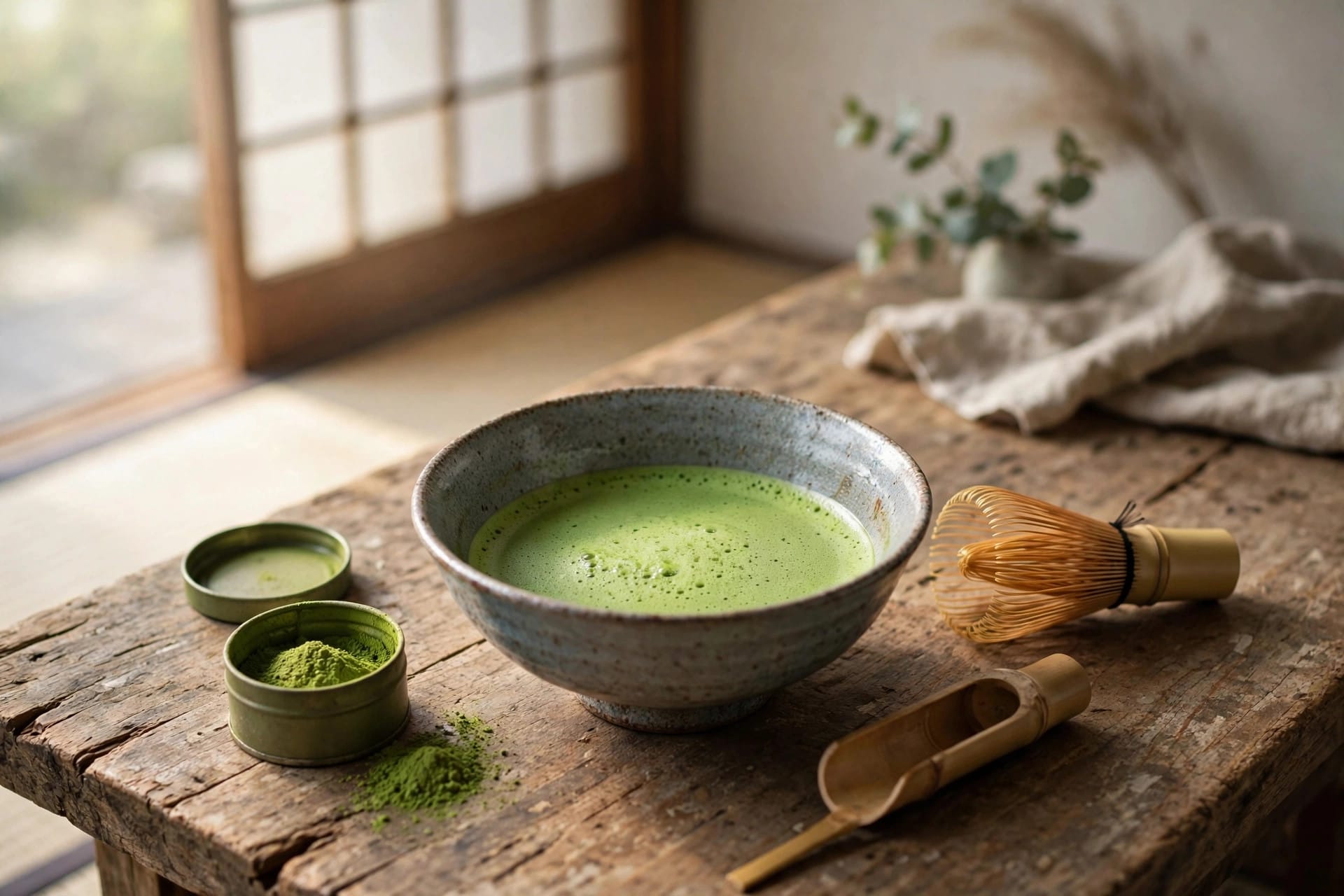
The third is about what lasts. The bamboo whisk, the bowl, the scoop — the tools of the tea ceremony don’t depend on this year’s harvest. Harvests fail and recover; a well-made whisk is a decade of mornings. There is a reason searches for matcha kits have been climbing even as the powder itself gets scarcer.
Bottom line
Japan is producing more tencha than at any point in its history — about 3.2 times the 2014 volume — and it is still not enough, because the world changed its order faster than a shaded tea field can grow. Ippodo is discontinuing ordinary teas to protect matcha. Old houses are rationing. The next real relief arrives around 2030, one five-year-old tea bush at a time.
Until then, the green gold rush has a simple shape: the real thing exists, it’s rationed, and the everyday teas Japan actually drinks are disappearing to make room for it. Tell me in the comments — when did matcha stop being a quiet tea and become a craze where you live?
If this story made you think, a heart helps other readers find it — thank you for reading.
AloJapan.com