

The Band of the Coldstream Guards, the musical ensemble of the British Army’s oldest regiment in terms of continuous service, completed its concert tour of Japan in early October 2026, the year marking the centenary of the birth of Queen Elizabeth II.
The band has played an important role in cultural diplomacy. In October 2013, it gave concerts across Japan as part of the Japan400 celebrations, marking 400 years of relations between the two countries.
According to the UK Ministry of Defence website, the band’s latest tour “aims to strengthen ties between our nations through cultural diplomacy.” The ministry also describes Japan as a cornerstone of the UK’s approach to the Indo-Pacific, a region of growing global importance.
 The band visiting the Japan Air Self Defense Force Central Band in Fuchu City. (UK MOD ©Crown Copyright 2026)
What Audiences Heard
The program combined well-known British music with performances by local collaborators. It included Elgar’s “Pomp and Circumstance” (music often heard at graduation ceremonies), the hymn “Amazing Grace,” and a selection of Scottish folk songs.
Special collaborators included bagpipers from The Royal Regiment of Scotland, soprano Mai Tsugumi of the Japan Ground Self-Defense Force, and selected members of the Central Band of Japan.
 Sporano Mai Tsugumi of JGSDF Central Band performing “Amazing Grace.” (UK MOD ©Crown Copyright 2026)
The band also performed “Yagibushi,” a popular traditional folk song and dance associated with festivals in Gunma and Tochigi prefectures. Percussionists wore happi coats while band members shouted kakegoe, energetic calls used to maintain the rhythm and build excitement.
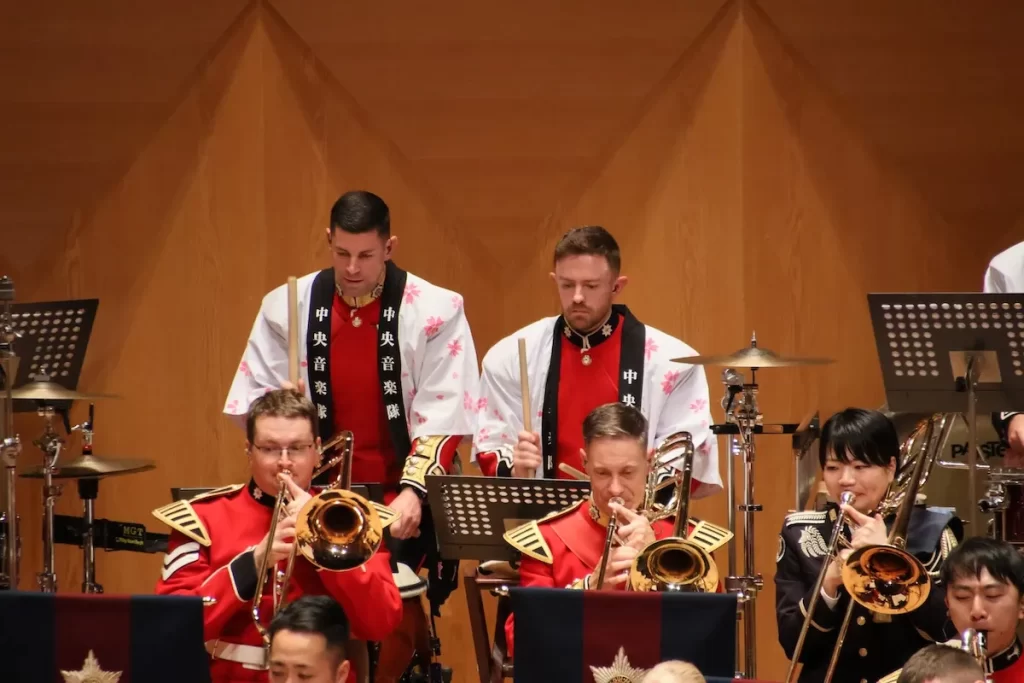 Percussionists performing in happi coats on taiko drums, in “Yagibushi.” (UK MOD ©Crown Copyright 2026)
The tour took the band to concert halls in several parts of Japan, including Tokyo Opera City Concert Hall, Yokohama Minato Mirai Hall, and Ota Civic Hall in Gunma Prefecture. In addition to the concerts, the musicians took part in cultural exchange events with Japanese students.
A Band with a Global Reach
Since 1945, the band has performed across North America, Europe, Japan and Australia. In 1960, it began a series of three-month coast-to-coast tours of North America.
In 1994, it attracted international acclaim for performing at the Olympic stadium in Sarajevo during the conflict in the Balkans.
Over the past 20 years, tours of Asia have become a regular feature of its calendar, generally taking place every two to three years.
 The band performing in Tokyo on tour in 1986. (UK MOD ©Crown Copyright 1986)
The musical relationship between the band and Japan has also developed through performances in the UK. During Emperor Naruhito’s state visit to Britain in June 2024, the band performed the J-pop hit “Mela!”
 The band parading during Emperor Narunito’s State Visit in London, June 2024. (UK MOD ©Crown Copyright 2024)
Japanese music has also become part of the repertoire performed during the Changing of the Guard ceremony in London. Among the pieces played are T-Square’s “Omens of Love,” Godiego’s “Galaxy Express 999,” and Joe Hisaishi’s “My Neighbour Totoro,” reflecting the growing cultural exchange between the two nations.
At home, the band takes part in some of the UK’s biggest ceremonial occasions, including Trooping the Colour (the monarch’s official birthday parade), the Remembrance ceremonies at the Cenotaph, the Festival of Remembrance, the Household Division’s Beating Retreat, state visits, the London Olympics and the Queen’s Diamond Jubilee celebrations.

From Cromwell’s Army to the Royal Guard
The Coldstream Guards were formed in 1650. Their first commander, George Monck, was a general in Oliver Cromwell’s New Model Army, which fought for Parliament against the king during the English Civil War.
After Cromwell’s death, England descended into political turmoil. On 1 January 1660, Monck marched his troops south from the Scottish border town of Coldstream to London, giving the regiment its name. His march helped pave the way for the restoration of the monarchy, and Charles II subsequently took the throne.
In recognition of his service, the new king made Monck a Knight of the Garter, one of England’s oldest and most prestigious honors. The Star of the Garter became the regiment’s cap badge, which its soldiers continue to wear today. In 1661, the regiment joined the Household Troops, whose role is to serve and protect the monarch.
 The Star of the Garter, the symbol of both Coldstream Guards regiment and the band. (UK MOD ©Crown Copyright 2026)
How the Band Began
The band’s history can be traced back to a Royal Warrant (an official order issued by the monarch) signed by Charles II on 3 January 1685. It authorized a small group of musicians to be attached to the Foot Guards in London.
These early musicians were not soldiers. Instead, officers hired them on a monthly basis to provide music for the Changing of the Guard at St James’s Palace, a ceremony that is still performed in London today.
In 1785, the musicians were invited to perform at a river excursion to Greenwich but declined, explaining that it conflicted with their “several respectable and private engagements.”
The officers subsequently approached the Duke of York, the regiment’s colonel, to request the establishment of a permanent band of enlisted musicians.
He agreed and sent twelve musicians from Hanover, Germany, under the leadership of Music Major C. F. Eley. The band comprised two oboes, four clarinets, two bassoons, two horns, a trumpet and a serpent, an early, snake-shaped bass instrument. Its official formation date is 16 May 1785.
 The band at Changing of the Guard outside Windsor Castle, 1937. (UK MOD ©Crown Copyright 2026)
Tragedy and Endurance
The darkest day in the band’s history came on 18 June 1944, when a German flying bomb struck the Guards Chapel in London during Sunday morning service.
 The bombing of The Guards Chapel in London, 1944. (UK MOD ©Crown Copyright 2026)
The band was playing at the time. Six of its members, including the Director of Music, were killed, along with more than 120 members of the congregation.
Today, more than three centuries after its first musicians were hired to play at St James’s Palace, the band continues to travel the world, bringing people together through music.
RELATED:
Author: Japan Forward
Continue Reading
AloJapan.com