
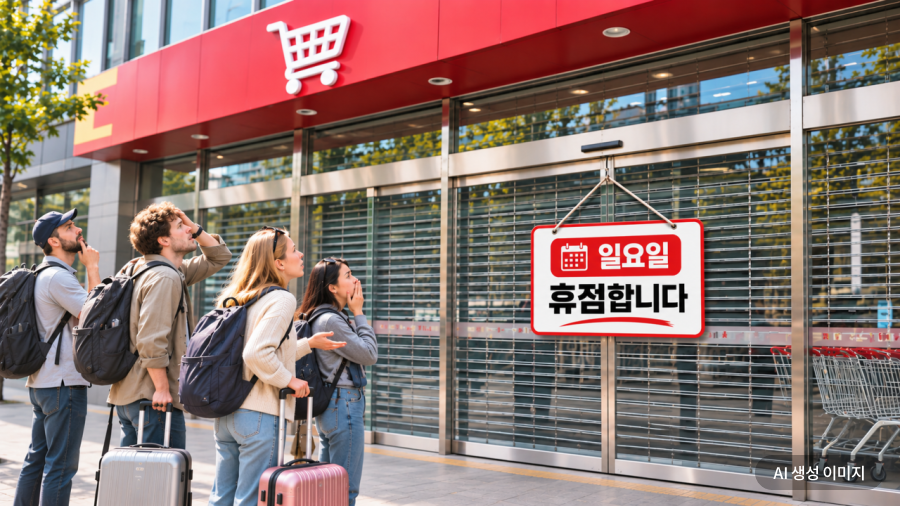
Foreigners Flocking in Record Numbers… Big-Box Stores Become Popular K-Food Shopping Destinations
With the number of foreign tourists visiting Korea already surpassing last year’s full-year total and surging to a record high, big-box stores, popular destinations for K-food shopping, are failing to capture their spending because of mandatory holiday closures. Calls are growing for big-box stores in special tourism zones to be exempted from mandatory closure rules so they can meet demand from foreign tourists looking for K-food products such as ramen, seaweed and snacks.
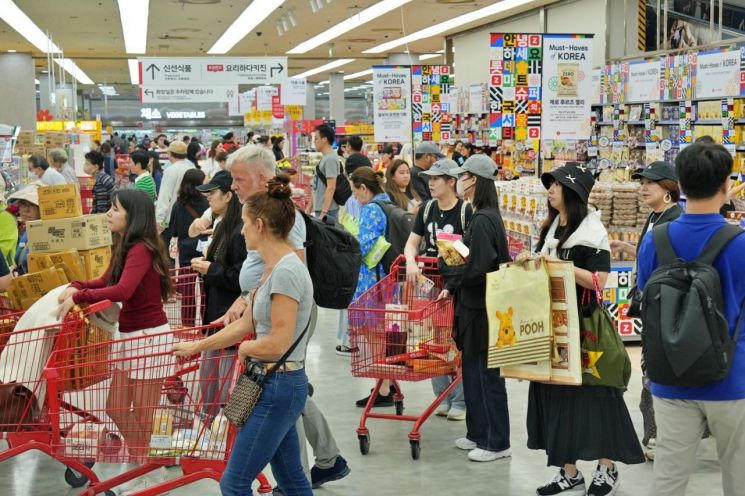
A view of the Lotte Mart Zettaplex Seoul Station store.
원본보기 아이콘
Foreign Sales Soar in Special Tourism Zones… Stores Open on Sundays See 4.5 Times the Sales of Regular Locations
According to the retail industry on November 5, foreign customer sales at Lotte Mart’s five stores in special tourism zones rose 50% year on year from the beginning of this year through October. Foreign customer sales accounted for 6% of sales at these stores in 2024 and 8% last year, before climbing to 10% this year.
At E-Mart stores in special tourism zones, sales differed markedly from those at regular locations. This year, average sales to foreign customers at E-Mart’s 10 stores in special tourism zones were 4.4 times those at regular stores. The gap has widened from 2.6 times in 2023 and 3.1 times the following year. The difference was even greater on Sundays, when stores open twice a month. This year, average sales to foreign customers at E-Mart stores in special tourism zones were three times those at regular stores on weekdays, but 4.5 times as high on Sundays when they were open. The number of foreign customers was also three times that of regular stores on weekdays and 4.7 times as high on Sundays.
Special tourism zones are areas where regulations related to tourism activities are eased and concentrated support is provided to encourage foreign tourists to visit. They were introduced under the Tourism Promotion Act in 1993, and five locations – Jeju, Gyeongju, Seorak, Yuseong and Haeundae – were designated for the first time the following year. A total of 37 zones have since been designated across 14 cities and provinces nationwide, including Myeongdong in Seoul and Haeundae in Busan.
원본보기 아이콘
Special Zones Created to Attract Tourists Are Losing Foreign Shoppers Because of Mandatory Closures
However, critics say that big-box stores in special tourism zones are failing to capture foreign shoppers’ demand because they are also subject to mandatory holiday closure rules. The current Distribution Industry Development Act restricts late-night operations at big-box stores and quasi-large-scale stores to protect workers’ health and local small retailers, and requires stores to close on two public holidays each month. Big-box stores in special tourism zones are subject to the same rules.
As a result, calls are growing to allow major shopping facilities in special tourism zones to operate on Sundays to attract tourists and encourage them to stay longer and spend more. From 2018 through last year, shopping accounted for 51% of foreign tourists’ spending in Korea, the largest share. This is why critics say that, in addition to increasing the number of tourists, it is important to create an environment where they can conveniently purchase goods.
One in Four Foreign Tourists Shops at Big-Box Stores… Japanese Tourists Lead at 40.2%
Big-box stores have become a major shopping channel for foreign tourists. According to the 2025 Foreign Tourist Survey, 23.6% of foreign tourists who spent money on shopping in Korea said they had visited a big-box store. Based on multiple responses, this figure was close to that for downtown duty-free shops (26.6%) and higher than the figures for convenience stores (21.1%) and traditional markets (20.5%). The share of Japanese tourists who visited big-box stores was 40.2%, while the figure for Taiwanese tourists was 39.4%. The figures for Vietnamese and Thai tourists were also high, at 37.0% and 35.3%, respectively.
Critics also say the government’s policies to attract tourists are at odds with regulations on big-box store operations. The government has set a target of attracting 30 million foreign tourists by 2029, while the Seoul Metropolitan Government has set goals including 30 million foreign tourists and average spending of 3 million won per person under its “3·3·7·7 Tourism Vision.” However, foreign tourists with fixed departure dates lose the opportunity to shop if big-box stores are closed, as they may not be able to return.
K-Food Is a Hit with Foreign Tourists… Small Suppliers Also Expected to Benefit
Foreign tourists’ shopping also contributes to sales for domestic suppliers. According to Lotte Mart, foreign customers tend to buy gifts for acquaintances or food to eat after returning home toward the end of their trips. Based on sales volume from January through October this year, Orion’s “Bichobi Korea” and “Bichobi Strawberry” ranked first and second among popular products. Seaweed soup ramen, jelly and honey butter almonds were also among the top sellers.
At E-Mart, jelly, chocolate, ramen, coffee, tea, seaweed crisps, nuts and tumblers were also popular items. Foreign customers also seek out dried persimmons, roasted seaweed and seasoned pollack roe seaweed. Big-box stores are serving as a channel for introducing Korean food products to consumers overseas. The Korea Chain Stores Association expects that more shopping opportunities for tourists will also help boost sales for small and medium-sized businesses that supply products to supermarkets.

원본보기 아이콘
Sunday Operations Should Be Allowed… National Assembly Pushes Bill to Exempt Special Tourism Zones from Mandatory Closures
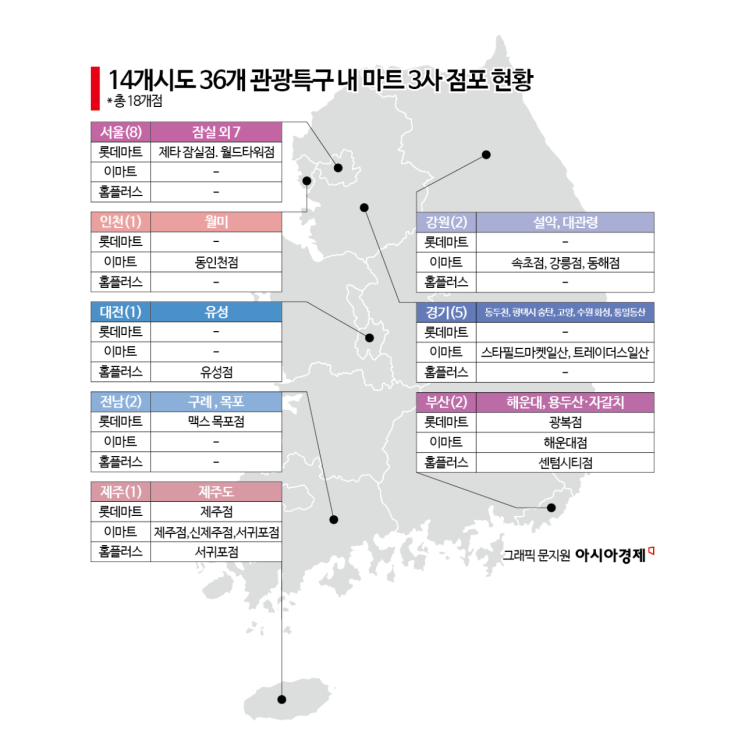
A bill to address the issue is being pursued in the National Assembly. Park Jeong-hoon of the People Power Party sponsored an amendment to the Tourism Promotion Act on June 8 that would exempt big-box stores in special tourism zones from mandatory closure rules. The proposal would add an exemption to the act’s provision on “special cases under other laws.” The exemption is expected to cover 18 big-box stores in special tourism zones nationwide: five Lotte Mart stores, 10 E-Mart stores and three Homeplus stores. That represents about 5.4% of the 336 stores operated by the three chains, according to figures compiled by the Korea Chain Stores Association in August. The stores are located in areas with tourism demand, including Jamsil in Seoul; Haeundae, Yongdusan and Jagalchi in Busan; Jeju Island; and Seorak and Daegwallyeong in Gangwon Province.
Cho Chun-han, a professor at Gyeonggi University of Science and Technology, said, “As foreign spending is injecting vitality into Korea’s retail industry, easing mandatory closure rules for big-box stores in special tourism zones is a step in the right direction.”
Meanwhile, according to the Ministry of Culture, Sports and Tourism, as of October 27, the number of foreign tourists visiting Korea had surpassed last year’s record annual total of 18.94 million. If the current trend continues, the figure is expected to exceed 20 million and reach 23 million this year.
Reporter
Lim Hyeseon lhsro@asiae.co.kr
subscribe icon subscribe
Edit
Kim Yumi ymkim91@asiae.co.kr
© The Asia Business Daily. All rights reserved. Unauthorized AI training and use prohibited.
AloJapan.com