
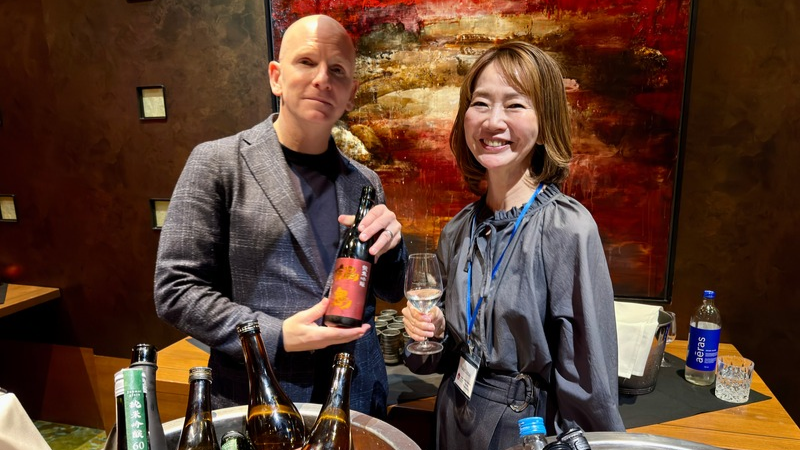
 Ki Modern Japanese + Bar’s Sake Samurai Michael Tremblay and JNTO Toronto’s Executive Director Yuka Suzuki.(Jennifer Bain/Open Jaw)
Japanese forest bathing (shinrin-yoku) needs no explanation, but how about volcanic sand bathing (sanamushi)?
Wearing a cotton yukata robe, you’ll lie in a shallow seaside trench as an attendant buries you up to your neck in hot volcanic black sand. After 10 minutes, you’ll brush yourself off, shower and then go soak in hot springs.
This intriguing activity might lure your clients to Ibusuki on the southern Japanese island of Kyushu.
“I have done this, and it was a very, very interesting experience,” Kyushu Tourism Organization Manager Simon Metcalfe said 30OCT in Toronto.
 Sake Samurai Michael Tremblay teaches Kyushu event guests about sake and shochu. (Jennifer Bain/Open Jaw)
“It’s quite heavy on your chest, and so it really helps to improve your circulation and opens up all your pores and you’re sweating, and it’s really, really good for you. I really recommend that if you get a chance to come to Kyushu, I hope you do.”
Metcalfe was part of a delegation here to woo Canadians to Japan’s southern gateway. Open Jaw joined about a dozen tour operators and travel advisors for the presentation, sake and shochu tasting and networking dinner at Ki Modern Japanese + Bar.
Emceed by Shin Kawai from Japan Communications with a toast from JNTO Toronto’s Executive Director Yuka Suzuki, the evening kicked off with a good laugh when Metcalfe taught us to pronounce the region’s name by showing the letter “Q” plus an image of a running shoe.
 How do you pronounce Kyushu? A handy guide. (Jennifer Bain/Open Jaw)
Slightly larger than Vancouver Island, Kyushu is home to 13 million people and has seven prefectures, but more importantly it has 17 active volcanoes and is Japan’s largest hot spring region.
“A lot of people come to Kyushu to see these active volcanoes and to go a bit closer,” Metcalfe explained. “And so, unlike somewhere like Yellowstone, where the people visit their volcanoes, in Kyushu we have people living with these volcanoes.”
Volcano cycling (with electric mountain bikes) and sandbathing (a geothermal wellness experience) are top lures. So are learning bushido (the samurai’s way) from a samurai master, taking the luxury train 36+3, and doing a samurai visual effects and manga workshop.
 Saby Choudhury serves at the Kyushu event at Ki Modern Japanese + Bar. (Jennifer Bain-Open Jaw)
Kyushu is for clients who’ve done the Golden Route and explored Tokyo, Kyoto and Osaka, and now crave somewhere less crowded.
“They want to go back and go a little bit deeper next time and see a more immersive sort of experience — go into nature, do some hiking, do active activities, meet the locals, have a cultural experience,” Metcalfe said.
On 2NOV, the 17-room Aso Retreat HONO opens, featuring a private onsen in every room. Next summer, the 28-room KAI Ureshino by Ushino Resorts will open, promising ryokan-style luxury, private onsens, and Japanese gardens in every room. So will 119-room BEB5 Mojiko by Hoshino Resorts and the 192-room Ace Hotel Fukuoka.
Airlift is key, and Yukihito Arima from the passenger development division at Fukuoka International Airport Company spoke to that.
“Looking ahead, we have to establish a direct flight between North America and Fukuoka, especially with Air Canada,” he said pointedly, causing more chuckles since Air Canada’s Viktor Spysak was in the crowd. “To make this happen, we need more travellers from Canada visiting Kyushu. So we hope you will work with us to create and promote travel packages to this wonderful region, Kyushu.”
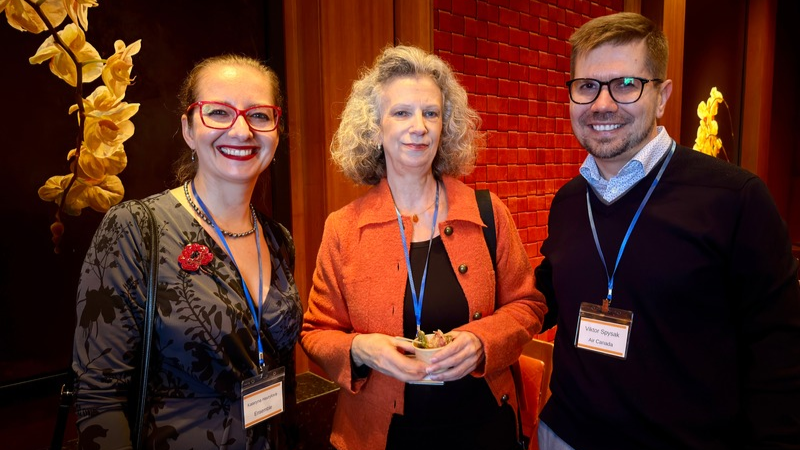 Kateryna Havrylova, Direct Travel’s Pam McKay and Air Canada’s Viktor Spysak. (Jennifer Bain/Open Jaw)
Fukuoka International Airport (FUK) is Japan’s fourth largest airport by passenger traffic after Tokyo Haneda (HND), Tokyo Narita (NRT) and Osaka Kansai (KIX). It handles 28.4 million passengers a year (19.3 million domestic and 9.1 million international).
There are no non-stop flights between North America and the Kyushu region, but last year 420,000 people still travelled between the two areas. Of the top 10 places passengers are coming from, Vancouver (YVR) ranked 7th with 23,254, and Toronto (YYZ) ranked 10th with 12,872.
It takes just five minutes to get from FUK to Fukuoka’s city centre. “So less transfer time, more vacation time,” said Fukuoka International Airport Company’s Naoki Ishida.
The most important number to share, he said, is that there are 24 daily flights connecting FUK with Okinawa, a subtropical archipelago with beaches, coral reefs, white sand and clear blue water. Flights are just 105 minutes.
“With Fukuoka as a gateway, your clients can enjoy both in one journey,” Ishida said. “So they can enjoy food, hot springs, culture, nature, things like that, in Kyushu, and then experience subtropical beaches, marine activities and the unique culture of Okinawa.”
 Fukuoka International Airport’s Yukihito Arima with Kensington Tours’ Jacqueline Grossman and Dan Silva. (Jennifer Bain/Open Jaw)
Among those at the event was Asia specialist Pam McKay from Direct Travel, who saw Japan really begin to take off with travellers in 2019 when Canada-China relations became strained. She’s headed to Japan for the 20th time this month to join ACTA’s International Destination Conference in Yokohama.
McKay has yet to visit Okinawa, but has already been to Kyushu — “a place that first-time travellers will rarely go to. It’s usually second, third or fourth-time travellers.”
Dan Silva, Product Manager with Kensington Tours, said Canadians love Japan and are exploring different regions. Kensington’s dozen itineraries are starting points for custom trips.
It just launched a marketing partnership with the Kyushu region and has been doing everything from webinars and agent/destination expert training to social media and an email campaign.
“We’re really promoting and creating more awareness for them,” said Jacqueline Grossman, Kensington’s VP of Marketing & Partnerships. “It’s the first time they’ve had a campaign with a tour operator, so we’re all looking forward to seeing the results.”
AloJapan.com