

MGM Japan’s Ed Bowers tells iGB he understands the risks of pioneering casino gambling in Japan as well as the potential rewards.
MGM Japan president and CEO Ed Bowers doesn’t hide from concerns about introducing casino gambling to the world’s fourth largest economy in an integrated resort with the world’s highest price tag.
“There’s a lot of trepidation about being the first to have this very large casino in Japan, and the issues it could bring, and we understand all of this,” Bowers tells iGaming Business in MGM’s Osaka office. Amid the uncertainty, there’s also excitement locally that, after perennially being cast as Japan’s second city, Osaka will finally be first at something.
Already more than a decade in the making, MGM Osaka is building toward a late 2030 opening. A partnership between MGM Resorts International and Japan financial services conglomerate Orix Group, the estimated ¥1.5 trillion (US$9.5 billion at current exchange rates) integrated resort is rising on Yumeshima island, site of World Expo 2025, generally perceived positively across Osaka.
Well connected
An Osaka subway station, partially funded by MGM Osaka and opened in January last year for Expo visitors, perches on the doorstep of the IR site. The railroad arm of Kintetsu Group, among 22 mainly local investors holding a collective 12% of MGM Osaka, plans train service linking Yumeshima directly with Nara, a popular tourist destination 45 kilometers (28 miles) to the east. A ferry and cruise ship terminal and bus depot are also on the drawing board.
 yumeshima station will serve as the gateway to mgm osaka on the manmade island in Osaka Bay.
MGM Osaka, with longtime Orix executive Nobuki Watanabe as chairman and Bowers as CEO, is Japan’s largest current construction project. The 49 hectare (122 acre) site looks the part with a steady stream of concrete mixers and workers moving to the beat of pile drivers knocking some 3,600 support columns into the artificial island’s soil. Across the site, Bowers says, work continues to mitigate liquefaction and stabilize the ground for construction.
IR floor space will total 780,000 square meters (8.4 million square feet), according to the July 31 update of the area development plan (ADP) for the IR, produced annually by Osaka City, Osaka Prefecture and MGM Osaka, and published solely in Japanese.
Grading on a curve
Steel girders sprouting from the ground outline the arc of MGM Osaka’s largest building, eventually rising 27 stories containing two hotels and the casino. The IR overall is projected to have 2,500 guest rooms, more than 20% of them suites measuring 105-150 square meters, in three hotels.
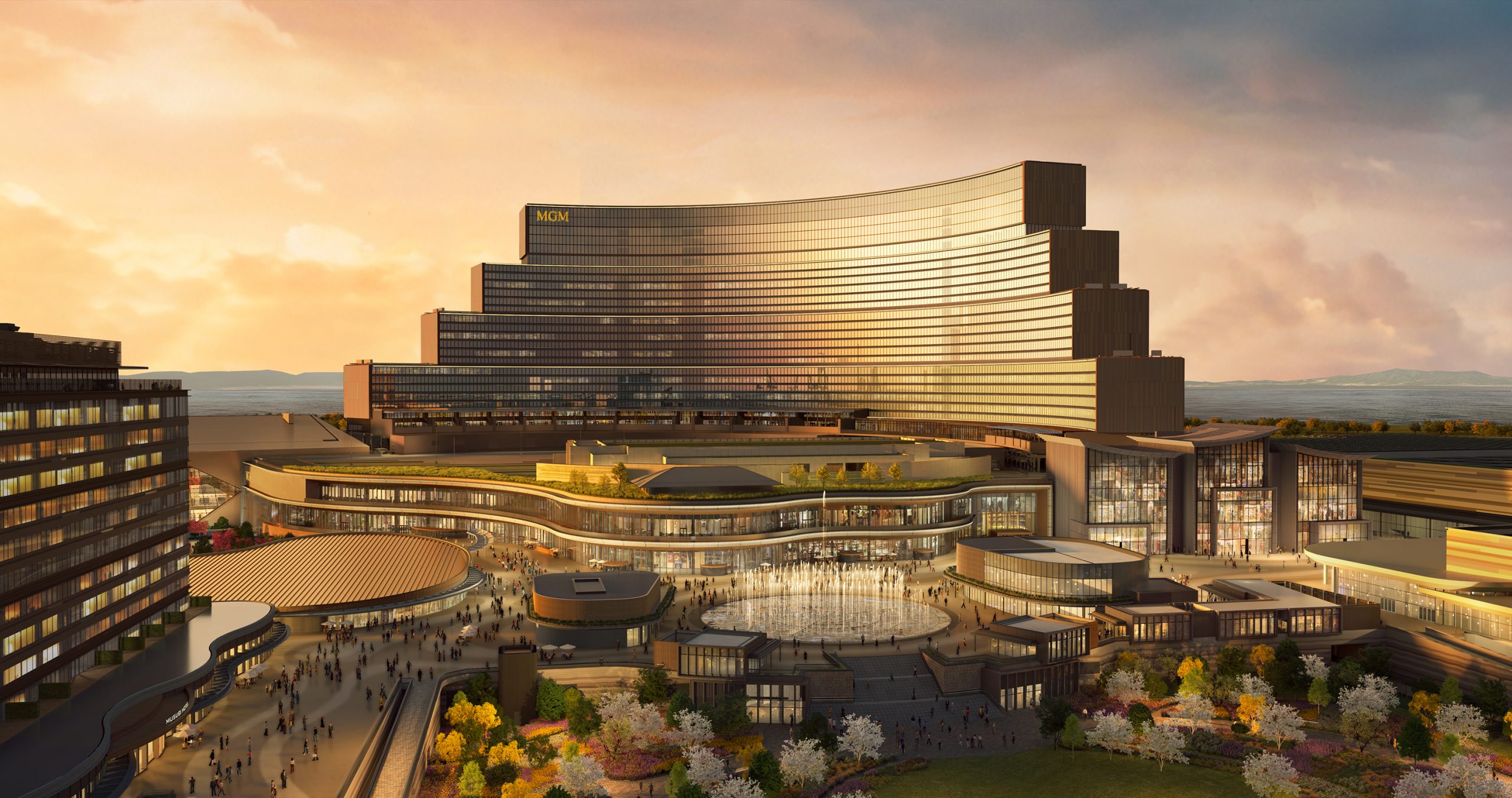 a rendering of mgm osaka. the complex will offer 2,500 hotel rooms, ample conference facilities and comprehensive tourist services. the casino will occupy just 3% of floor space.
MGM Osaka will have one of Japan’s largest MICE (meetings, incentives, conventions, exhibitions) facilities with 400,000 square feet (36,171 square meters) of conference space and 330,000 square feet of exhibition space, plus a 3,500 seat theater. Accommodation and MICE floor area allocations are mandated by IR regulations and embedded in the ADP.
“There’s a certain amount of overseas MICE events they want us to do,” Bowers says, and he’s confident MGM Osaka can deliver. “We know how to run MICE.” The ADP calls MGM “the largest MICE operator in Las Vegas, generating annual accommodation demand for 2.5 million rooms, hosting over 9,000 shows and events annually.”
‘Tourism multiplier’
Tourist facilities are also mandated, though requirements are “less specific,” Bowers says. “You must have a tourism attraction center, and it has three functions. There’s a concierge function, explaining about things that are in Japan. The second function is that you have the ability to purchase stuff, tickets to go somewhere, for an event or whatever it is. Then the third function is we can send you there. The translation of the Japanese word they use is a ‘tourism sending facility.’ So the idea is that this concierge can give you something [to do] and send you there.
“In my view, that is really at the heart of the Japanese IR, that one thing. If you think about Singapore, Singapore said we want you to create this great facility that’s going to attract people to Singapore, period. What Japan said is that we want you to attract people to Japan, but then we want you to send people to other parts of Japan as well… From a policy standpoint, I think this is the biggest thing that Japan is focused on, that the IR becomes a tourism multiplier.”
Japan reached 42.68 million international arrivals last year and is on pace to top 41 million this year despite Iran war headwinds and political tensions that reduced mainland China arrivals by 56.7%, some 3.8 million, through August, according to Japan National Tourism Organization statistics. Japan’s official tourism policy still aims for 60 million arrivals by 2030, but it’s been adjusted this year to address overtourism places like Kyoto, 63 km northeast of Yumeshima, and aim for higher end visitors.
“We’re honor-bound to think about how we can work with Japan to make sure that we are focused on their tourism policies, because tourism policies are at the heart of what it is that we have to do for Japan,” Bowers says. “The quid pro quo is we get a casino, which is where we’ll make all our money.”
Gambling with Japanese characteristics
Gaming facilities are limited to 3% of total floor area, 23,400 square meters for MGM Osaka. Japan nationals must pay a ¥6,000 entry fee per visit, valid for 24 hours, and are limited to three visits in seven days and 10 visits in 28 days.
Updated ADP estimates put IR annual revenue at ¥520 billion, gaming revenue, accounting for ¥420 billion, or US$2.65 billion. That’s roughly equivalent to last year’s GGR at Sands China’s Venetian Macao complex, including the Plaza/Four Seasons. Bowers expects half of revenue from Japanese customers.
“As Japan’s first and only casino, MGM Osaka carries more than its own business case,” Osaka-based Hogo managing partner Chris Wieners says. “How it operates will shape how regulators, local governments and the public view any future IR.”
“From government and economic sector point of view, we want to emphasize merits of the IR,” Osaka International Business Promotion Council planner Pham Thanh Trung says. “But from a citizens’ point of view, we face a lot of uncertainties, especially related to hosting the first casino in Japan.”
‘Virgin and vulnerable’
A longtime Osaka resident originally from Vietnam, Pham adds, “Japan is completely virgin and vulnerable to casinos. People do not know how to live with a casino in the city.”
 In 2019, Yumeshima had a container terminal and a lot of vacant land.
While it doesn’t have casinos, Wieners notes, “Japan already has a large gaming culture through pachinko and amusement venues.” That culture registered ¥8,874 billion in legal betting last year on racing from boats to bicycles, including US$22 billion on horse racing, nearly 20% of the global total. There are even entertainment casinos, where players purchase chips and play casino games, but cannot exchange their chips for real money.
The Carter Group CEO Dominic Carter recounts 2019 findings from the firm’s Japan market research arm showing “the casino itself was not really seen as ‘gambling’ in the way Japanese think of pachinko. Pachinko was a habitual, slightly downmarket vice. A casino had a glamorous, almost James Bond image and was seen as a special occasion. That distinction matters for who the domestic customer is likely to be and how often they come.
“On responsible gaming, problem gambling was clearly recognized as a major downside risk. But Japanese consumers tend to place responsibility first on the individual, and second on regulators to do their job properly. I’d expect that view to shape how the public judges MGM’s responsible gaming efforts.”
Osaka ready to lead
“To its huge credit, Osaka wants to lead Japan and possibly lead the world in its efforts on problem gambling,” Bowers says. “They want to be a leader in defining what responsible gambling is and dealing with problem gambling.
“We’re going to have a strong responsible gambling program, somewhat based on what we do in the US using a program called Game Sense. Osaka is developing its own Osaka Addiction Center, and so we’ll be very joined up with government policy here.
“I think, frankly, Osaka is going to end up with a best practice approach and framework for how to gamble responsibly, and that’s going to be a first. That is something that is not fully recognized, and sometimes, people don’t necessarily want to talk about it, but Osaka City is taking their obligations very seriously.
“They want an IR, they want the entertainment, and they’re happy with a casino. But they’re also taking their obligations [seriously] to make sure that people are safe, and we’re working with them on that. I think the rest of Japan then will look at Osaka and say, ‘Well, why aren’t we doing this?’”
Yumeshima: Japanese for Cotai?
East Asia seemingly stumbled on a formula for activating underutilized large public tracts: build an integrated resort. Las Vegas Sands’ Venetian Macao sparked the transformation of Cotai from unwanted swamp to the most lucrative casino hub on earth. Singapore echoed that play with Genting’s Resorts World Sentosa.
Japan is trying the tactic on Yumeshima, a man-made island in Osaka Bay largely ignored by the general public before last year’s World Expo attracted 25.58 million visitors. Japan’s first IR MGM Osaka is due to open on Yumeshima in 2030.
“I don’t think it makes sense to compare Cotai with Yumeshima,” National University of Singapore integrated resort expert Lee Kah-Wee says. “Cotai was reclaimed, divided and developed largely by the casino concessionaires themselves. There was no official plan for the area; an earlier one was thrown out once the casino companies came in.
An island, a plan…
“That is not the case at Yumeshima – there is an official plan – the authorities have laid out the land-use for each plot, there is a phasing strategy as well as a strategy for how to sell land for each phase, and an overall infrastructural plan to make sure the development in each phase connects with the other.”
In September, Osaka announced a US$595 million minimum price for the second phase 42 hectare plot adjacent to MGM Osaka, including part of last year’s Expo site. A third site, also adjacent to the IR will be offered at a later date. Theme parks and hotels feature in preliminary proposals.
Government directed development of a recreation and entertainment island sounds similar to Sentosa, off Singapore’s south shore. Recreational development on Sentosa began in 1972, RW Sentosa with Southeast Asia’s only Universal Studios theme park debuted in late 2009, but planners still struggle to weave Sentosa into the fabric of Singapore. Does Sentosa presage Yumeshima’s future?
“Sentosa is a slightly different creature,” Lee says. “It shares the similar difficulty of being disconnected from the main urban core, and yes, Genting spent a lot to make the connection more integrated. But it is also competing with another casino far more accessible by mass transit – Marina Bay [Sands] sits on a MRT station!”
Following the leader
To Lee, “The more meaningful comparison is between Yumeshima and Marina Bay.” Lee ought to know, since he wrote the book on the development of Marina Bay Sands on what was essentially wilderness despite its proximity to Singapore’s financial district.
“It is clear to me that the Japanese authorities did more than adapt the concept of the ‘integrated resort’ from Singapore. If you recall, the most critical aspect of this model is the cap on gaming floor area, an entry levy for locals, and the focus on MICE – all of which are present at MGM Osaka.
“What is also similar [is] the planning and development of Yumeshima. It may look underutilized now, but that is because the authorities are controlling the phasing of development across the island. To phase development means you have to be conscious of several important moving parts: Firstly, private capital. Since the development of Yumeshima will largely be privately funded, each phase must be financially viable for investors. If the land area is too big, you might not find developers with deep enough pockets and so on.
“Secondly, public authorities and planners need to work out how to time and connect these different phases together. This can mean when the train station will be operational, when existing land-uses will be phased out, how the new park will connect all the properties and create a new public realm, etc.”
At Marina Bay, the processes succeeded spectacularly, centered on an iconic IR. MGM Osaka and Osaka hope that a decade from now, everyone will compare Yumeshima to Marina Bay.

Muhammad Cohen is a former US diplomat and current iGB Asia editor at large. He has covered the casino business in Asia since 2006, most recently for Forbes, and wrote Hong Kong On Air, a novel set during the 1997 handover about TV news, love, betrayal, high finance and cheap lingerie.
AloJapan.com