


Chinoike Jigoku (Photo by Jun Sakahira/Stripes Japan)
It’s a place I always wondered about, but growing up in the Kanto Plain, it always seemed too far away and difficult to visit. But, as I picked up the pamphlet and read the cover, I knew I had made it: “Welcome to Hell!”
Yes, I was in Beppu City in Oita Prefecture! Located in the northeastern part of Kyushu, Japan’s third-largest and the southernmost of its four main islands, Beppu is the nation’s onsen capital. The city’s distinct onsen areas have their own unique characteristics and history.
According to Beppu City, there are 88 baths fed by famous hot springs, the oldest being traced back to the 8th century. The city challenges visitors to become a “onsen master” by trying out all 88 onsens.
Jigoku Meguri
Beppu offers not only an onsen bathing experience, but also a tour like no other called Jigoku Meguri. Jigoku literally means “Hell” in Japanese. According to Beppu Jigoku Association, this area has been feared as “Hell” because “the Jigoku zone has been emitting fumes, hot mud, and hot water for more than a thousand years, so it has a reputation as an abominable land that cannot be approached.”
Earlier this year, I took a trip to Fukuoka, which included baseball games and trying local delicacies with friends. Since I was in the area, I took a solo trip to Beppu in Kyushu. Despite my interest in this onsen city, I didn’t have enough time to try to become an onsen master on my short visit.
At the hotel, I saw a pamphlet saying “Youkoso Jigoku e,” literally meaning “Welcome to Hell.” That instantly caught my attention. I had heard of the Jigoku Meguri tour in the past, but I did not know much in detail and decided to give it a shot.
If you would like to take a fully guided tour, you can sign up with a local agency. I, like many other Japanese tourists, however, explored the Hells on my own, giving me the flexibility to explore the areas as long as I’d like and even take a dip in a bath or two if I wanted.
The Seven Jigokus:
Umi Jigoku
Oniishi Bozu Jigoku
Kamado Jigoku
Oniyama Jigoku
Shiraike Jigoku
Chinoike Jigoku
Tatsumaki Jigoku
The cheapest way to visit all the Jigokus is to purchase a Combination Ticket at any one of the seven Hells. Valid for the day of purchase and the following day, it’s a booklet containing a ticket for each Hell.
Five of them (Umi, Oniishi Bozu, Kamado, Oniyama and Shiraike) are in the Kannawa Onsen area and are clustered within walking distance. The other two, Chinoike and Tatsumaki, are in the Shibaseki Onsen area, a 15-minute car ride away from each other.
Some of the Jigokus have unique colors; Umi is literally like the sea with its cobalt blue pond, while Chinoike’s red clay color resembles blood, and Shiraike (white pond) is the color of milk. This Jigoku also has tanks for tropical fish such as piranhas.

Umi Jigoku (Photo by Jun Sakahira/Stripes Japan)

Umi Jigoku (Photo by Jun Sakahira/Stripes Japan)

Chinoike Jigoku (Photo by Jun Sakahira/Stripes Japan)

Shiraike Jigoku (Photo by Jun Sakahira/Stripes Japan)

Shiraike Jigoku (Photo by Jun Sakahira/Stripes Japan)
At Oniishi Bozu, the boiling gray mud resembles shaved heads (bozu in Japanese). Oniyama is simply the place’s name, but this is also called Wani Jigoku (crocodile hell). The hot springs heat makes it a suitable habitat for crocodiles. It is believed to be home to Japan’s first crocodiles. About 80 crocodiles live there today.

Oniishi Bozu Jigoku (Photo by Jun Sakahira/Stripes Japan)

Oniishi Bozu Jigoku (Photo by Jun Sakahira/Stripes Japan)
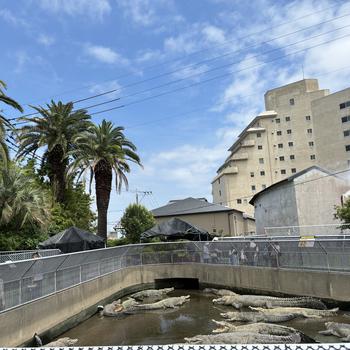
Oniyama Jigoku (Photo by Jun Sakahira/Stripes Japan)
Kamado was named after the practice of cooking rice with steam at the festival of nearby Kamado Hachimangu Shrine. Finally, Tatsumaki gushes hot water and fumarole at regular intervals (between 30-40 mins.) and lasts about 6-10 minutes. The intervals between eruptions are much shorter than those of Yellowstone National Park’s Old Faithful (ranging from 35-120 minutes, according to the park’s website).

Kamado Jigoku (Photo by Jun Sakahira/Stripes Japan)

Kamado Jigoku (Photo by Jun Sakahira/Stripes Japan)

Tatsumaki Jigoku (Photo by Jun Sakahira/Stripes Japan)
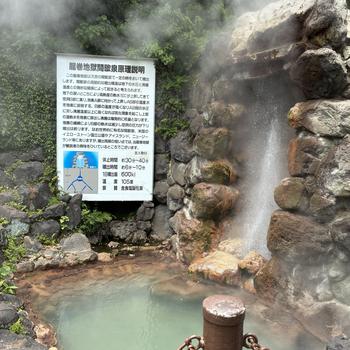
Tatsumaki Jigoku (Photo by Jun Sakahira/Stripes Japan)
My faves
Chinoike Jigoku, with its blood red color, was by far my favorite. The view of this spring and the fumarole are what I imagine Hell to look like. It had benches and a table that are shaped to look like the face and hands of oni (demons). In fact, demons representations are all over the place at Jigokus, making such places their lair.

Benches and a table at Chinoike Jigoku (Photo by Jun Sakahira/Stripes Japan)
I also liked Tatsumaki Jigoku, simply because you can feel the power of nature. I was lucky that the eruptions started right after I got there, but be sure to check the time before you visit. I also like the explanatory voice-over’s reference to Yellowstone. I visited Yellowstone National Park when I was a high school student and it still is my favorite place in the U.S. The scale of geyser at Tatsumaki is smaller than Old Faithful, but that was the first time to see the geyser in Japan and it brought back old memories.
Despite the colorful ponds and unique characteristics of each Hell, this is not a typical tourist destination that makes you say “wow” or “beautiful.” As I was hopping from one Jigoku to another, I felt a sense of uneasiness I had never felt when sightseeing. I felt like I was in, well… Hell.
Even if you are not a frequent visitor to onsen (hot springs) or sento (public bath), Jigoku Meguri offers interesting scenery and a good place to learn about onsen culture. If you are stationed in Sasebo or have a chance to visit Kyushu, I would highly recommend Beppu, especially if you’re looking to explore something new. The demons await your visit to Beppu’s hellishly relaxing hot springs!
Things to know
Cost: Combination ticket: 2,400 yen ($15)-adults, 1,200 yen ($7.50)-middle & elementary school students, 500 yen ($3.15) each for individual venues
*Entry is limited to one time only for each venue.
Hours: 8 a.m.-5 p.m., open all year round
Website: https://beppu-jigoku.com/index.php
Other info: *Umi, Chinoike, Shiraike, and Tatsumaki are designated as national scenic spots due to their diverse colors and forms.
*Footbaths are available at Umi, Chinoike, Oniishi Bozu and Kamado.

Kannawa Onsen (Photo by Jun Sakahira/Stripes Japan)

A statue of Aburaya Kumahachi (father of Beppu tourism) in front of Beppu Station. (Photo by Jun Sakahira/Stripes Japan)
Getting there
By car: If you rent a car, the seven hell hot springs are easily accessible from anywhere in Beppu. It is approximately 15-minute car ride from Beppu Station to Kannawa Onsen and 20 minutes to Shiraike Onsen.
A 2.5-hour drive from Sasebo Naval Base.
*Parking is free at all locations.
By bus (Kamenoi Bus): About 30-minute bus ride from Beppu Eki (Station) Nishiguchi to Kannawa. A bus runs every half an hour during daytime both ways on this route. Beppu Eki Mae to Chinoike Jigoku Mae route is about 30-minute bus ride, too, but there are less buses than the other route.
Cost: 400 yen-Beppu Eki Nishiguchi-Kannawa; 200-yen-Kannawa-Chinoike Jigoku Mae; 460 yen-Chinoike Jigoku-Beppu Eki Mae; half priced for elementary school students.
One-day pass in Beppu City is also available; 1,100 yen for adults, 900 yen for middle school-college students; 550 yen for elementary school students.
*Unlike major cities, there could be long delays on buses. You can also take a train. Chinoike Jigoku and Kamegawa Station are about 20-minute walk away, which was the route I took first. Kamegawa Station is two stations away from Beppu Station.
*Beppu is 2 hours away by a limited express train Sonic from Kyushu’s hub Hakata Station, Fukuoka.
*A plane ride from Haneda Airport, Tokyo-Oita is 1.5 hours. A bus ride between Oita Airport and Beppu Station is about 55 minutes long (1,600 yen each way).
AloJapan.com