

K-EnterTech Hub | Industry
Twenty key companies meet Japanese buyers as participants sign one contract and at least six MOUs
 Attendees after the opening ceremony, with NIPA’s Hyungkyu Lim at center. Photo: NIPA
South Korea’s National IT Industry Promotion Agency (NIPA) held Digital Business Partnership 2026 at Bellesalle Shiodome in Tokyo on October 28 to help Korean digital companies expand their Japanese business. Twenty key firms in security, content, education and other fields met Japanese customers and partners to discuss technology adoption and local projects, signing one contract and at least six memorandums of understanding. NIPA plans to deepen ties with Japanese companies and institutions to turn those business contacts into joint technology development, investment and joint ventures.
In his opening remarks, Hyungkyu Lim, head of NIPA’s Global Division, said the agency would broaden ties with major Japanese companies, public bodies and digital industry organizations. He said those relationships could build a foundation for cooperation extending beyond exports to joint technology development, investment and joint ventures.
Hosted by South Korea’s Ministry of Science and ICT and organized by NIPA, the buyer meetings ran from 10 a.m. to 5 p.m. on October 28. Japanese participants met Korean suppliers according to their technology and business interests. Financial terms and detailed conditions of the agreements were not disclosed.
Twenty key exhibitors by sector
Sector
Companies
Security
AI SPERA, COONTEC, F1 Security, NPCore, Penta Security
Life Tech
Archisketch, e-future, iPortfolio, MirrorRoid, Nuvilab, Pango GY, TheONIT
Digital Content
4BY4, PlayCurio, SKYWALK
Industrial AX
Trustay, CREPLE
AI SW Service
PNPSECURE, Korea Deep Learning, NdotLight
Sources: official event page and booth plan. Twenty featured companies in the buyer-matching program.
Lim described Japan as “a new market that Korean digital companies should consider first when expanding overseas.” Changes in Japan’s digital business environment are creating more opportunities for Korean suppliers, he said.

Attendees at Wednesday’s opening ceremony. The screen at right carried live AI interpretation. Photo: NIPA
NIPA has connected Korean companies with Japanese buyers through local matchmaking events. This year’s individual meetings and exhibition linked Japanese business needs with Korean technologies and services. Lim also asked companies operating in both countries to tell NIPA staff at the venue what support they need in Japan.
Japan’s digital services deficit and rising DX investment
Japan’s demand for digital services and growing investment in digital transformation help explain Korean companies’ interest in the market. Japan’s digital-related services deficit stood at ¥2.1483 trillion in 2014 and ¥6.6507 trillion in 2024. A May 2026 presentation by the Ministry of Economy, Trade and Industry puts the 2025 deficit at about ¥6.6 trillion. The main categories are computer services, royalties and license fees, and professional and management consulting services. The figures measure the difference between receipts and payments, rather than total payments for overseas services.
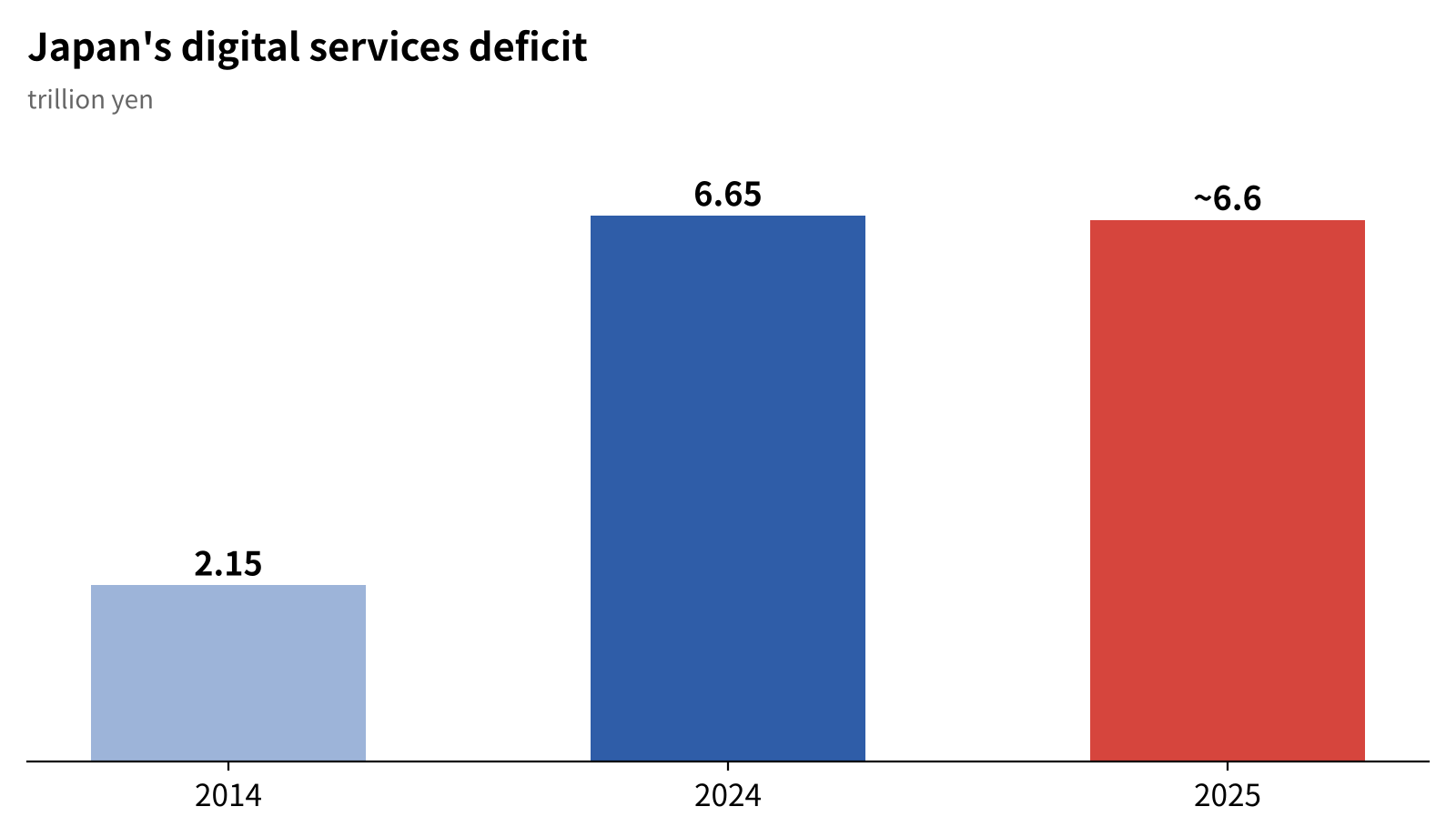 Sources: Mizuho Bank (2014); statistics cited in the original article (2024); Japan’s Ministry of Economy, Trade and Industry (2025). Figures vary with coverage and revision date.
Fuji Chimera Research Institute forecasts Japanese domestic digital transformation (DX) investment of ¥9.2666 trillion in fiscal 2030, about twice the fiscal 2023 level. Its fiscal 2030 forecasts include ¥2.9843 trillion for manufacturing, ¥1.1095 trillion for transport and logistics, and ¥964.4 billion for retail and food services. It also projects growth in the AI-agent market from an estimated ¥10.9 billion in fiscal 2024 to ¥140.8 billion in fiscal 2030.
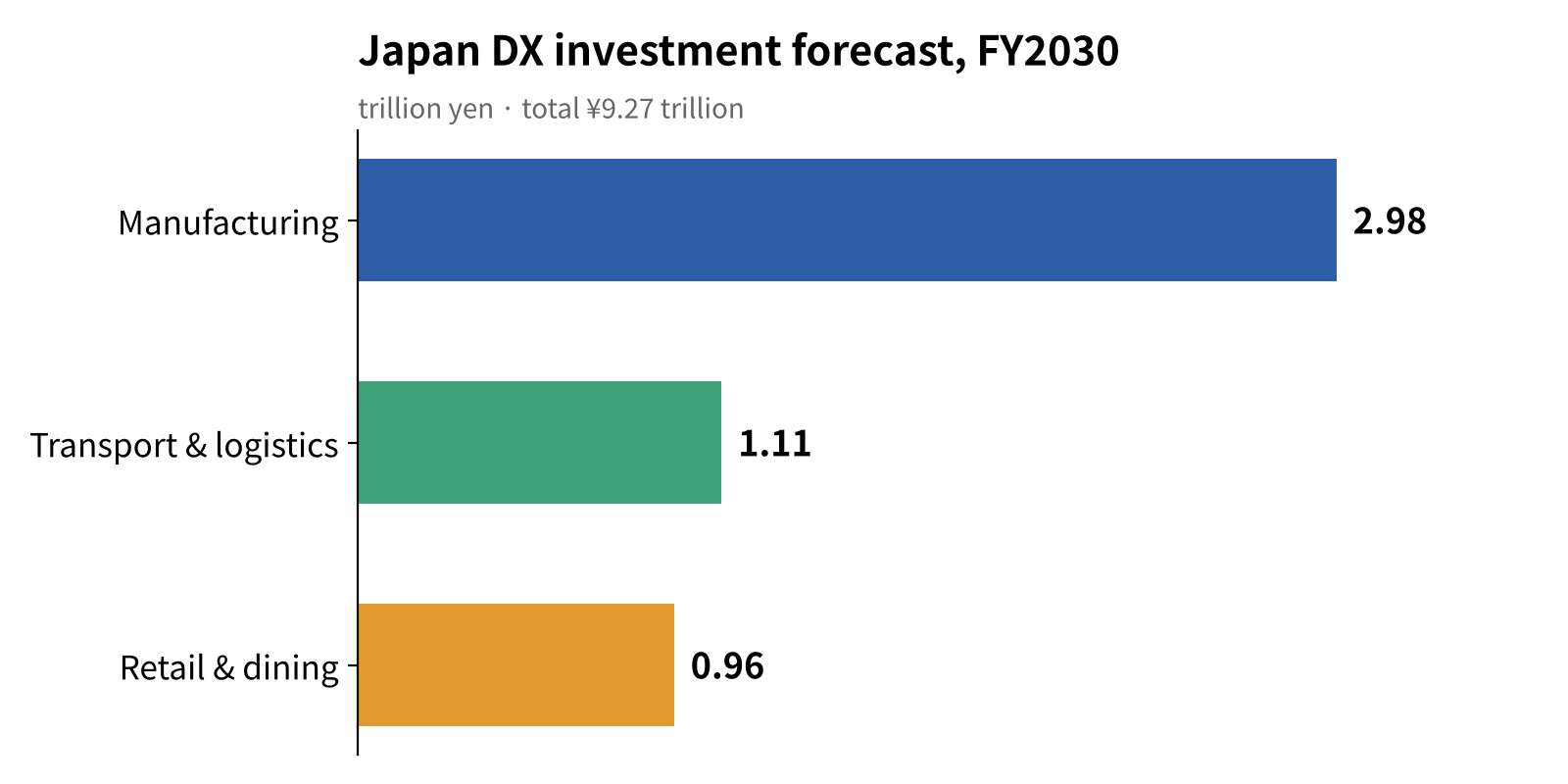
Source: Fuji Chimera Research Institute
As Japanese companies increase DX investment while relying heavily on foreign digital services, opportunities may broaden for Korean suppliers. Joint product development with local partners and services adapted to Japanese workplaces offer possible routes into the market.
MirrorRoid signs contract as security and software firms form ties
 Hyungkyu Lim, head of NIPA’s Global Division, opens the 2026 Digital Business Partnership at Bellesalle Shiodome in Tokyo on Wednesday. Photo: NIPA
MirrorRoid, a Korean developer of AI and XR services for beauty and tourism, signed a contract with Japan’s XRDive. The Japanese company develops XR and metaverse content, digital signage and AI solutions. MirrorRoid Vice President Yoo Je-jung and XRDive co-CEO Ryuichi Imagawa signed the agreement at the opening ceremony.
At least six MOUs were signed across security, biometrics, education technology and property technology. On stage, COONTEC signed with Japanese B2B sales agency Sekatsuku, while TheONIT, developer of the VPASS palm-vein authentication system, signed with JJ Co. iPortfolio partnered with DTP Education, and Trustay with Jo & Company. Financial terms and detailed conditions were not disclosed.
Type
Korean company
Field
Japanese partner
Contract
MirrorRoid
AI/XR beauty & tourism DX
XRDive
MOU
COONTEC
Security
Sekatsuku
MOU
TheONIT
Biometrics
JJ Co.
MOU
iPortfolio
Edtech
DTP Education
MOU
Trustay
Proptech
Jo & Company
Agreements signed on stage at the opening ceremony. Source: NIPA
Trustay supplies its nocktown housing platform to 2 million households in Korea. At the exhibition, it demonstrated AI analysis of apartment-complex CCTV footage to detect fires and falls in real time and automate property-management tasks.
 A meeting at the Trustay booth on Wednesday. Photo: K-EnterTech Hub
Delegation to visit earth eyes and Tokyo Innovation Base
On October 29, the delegation is scheduled to visit earth eyes in Hamamatsucho, Minato Ward. The Japanese company develops security solutions using AI camera video analysis. Discussions will cover ways for Korean AI security companies to expand their business models in Japan and pursue joint commercialization of technology from both countries.
An afternoon visit is planned to Tokyo Innovation Base (TIB) in Marunouchi, Chiyoda Ward. Led by the Tokyo Metropolitan Government, the startup hub includes fabrication facilities where hardware startups can build prototypes.
NIPA also runs a separate Level 3 program under its 2026 Global SaaS Marketplace initiative. Operating in Fukuoka and Tokyo from September to November, it covers five stages: company selection, identification of Japanese customers, tailored advance matching, local business engagement, and follow-up negotiations. Proofs of concept, MOUs and contracts are intended outcomes of the final stage.
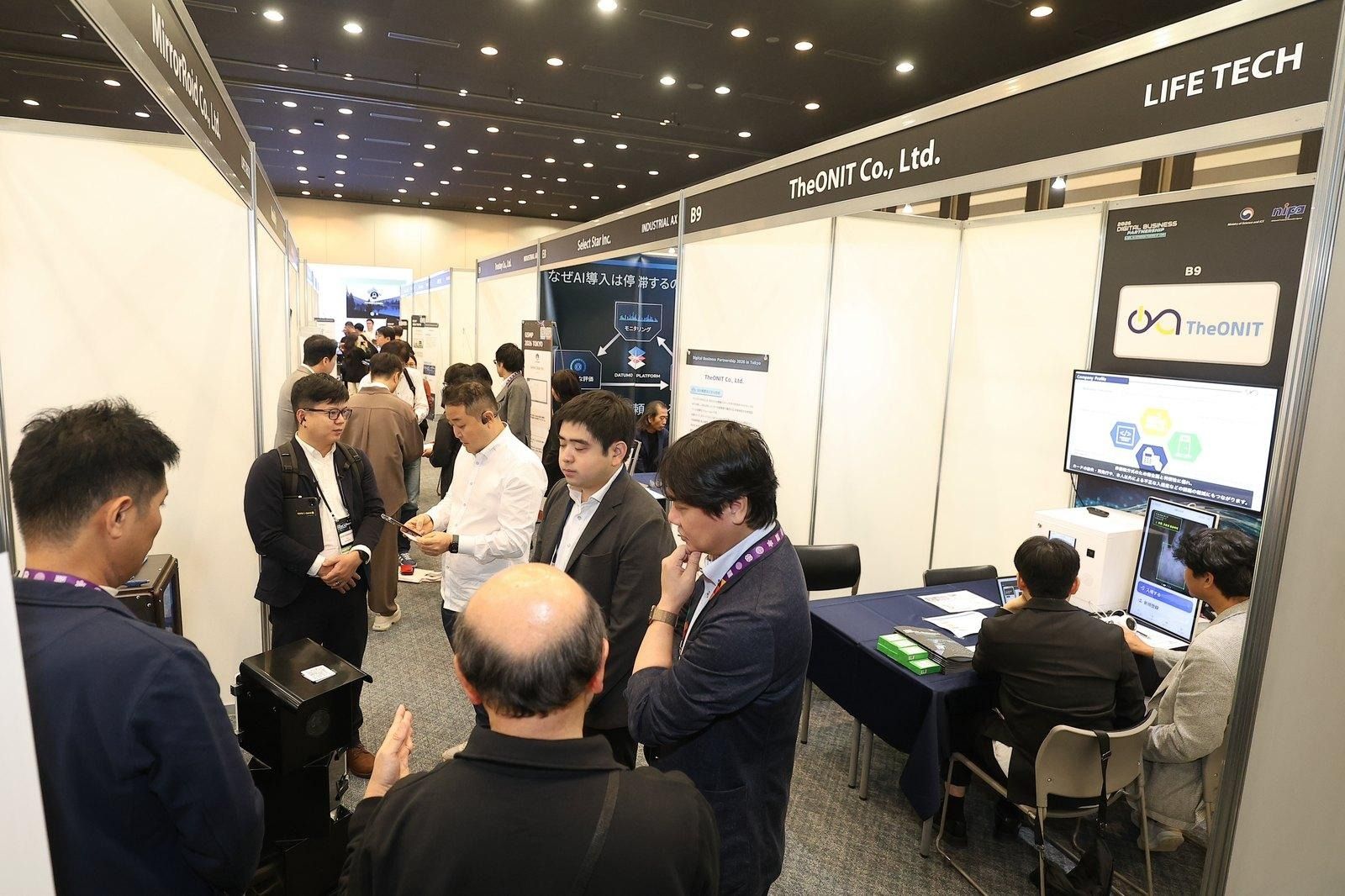
Visitors crowd the MirrorRoid and TheONIT booths on Wednesday. Photo: NIPA
Exhibitors also included Penta Security, AI SPERA and 4BY4, developer of the AI PIXELL video enhancement solution. They discussed potential local uses of their security and media technologies with Japanese customers and partners.
Turning the agreements into operating projects will require follow-up negotiations over testing, costs and each partner’s responsibilities. The scale and detailed terms of the one contract and at least six MOUs have not been disclosed. For NIPA and the participating firms, the next task is to translate the demand identified in Japan into technology adoption and joint development.
Quotations are based on an on-site recording of Lim’s remarks in Korean, translated by K-EnterTech Hub.
Reporting notes
The official buyer-matching page features 20 companies. The original supplied materials give a separate total of 37 participants; its coverage is not established by the public event page. One contract, at least six MOUs and the October 29 itinerary are based on on-site reporting and supplied materials.
AloJapan.com