


Small “ryokan” inns line the streets of Kurokawa Onsen in Minamioguni, Kumamoto Prefecture, as seen on Sept. 14, 2026. (Mainichi/Yuichi Utsunomiya)
MINAMIOGUNI, Kumamoto — Kurokawa Onsen in this southwestern Japan town draws more than 1 million visitors a year, but the town’s population continues to decline, leaving the popular hot spring resort grappling with severe labor shortages.
Kurokawa Onsen surged in popularity in the 1960s before falling into decline. It eventually made a comeback after introducing a bathing pass that allows visitors to make the rounds of hot spring baths. Now, people here are building on that experience as they explore ways to secure the resort’s future.
About a two-hour drive from the city of Fukuoka, 30 inns cluster north of Mount Aso in Kumamoto Prefecture, near the border with Oita Prefecture.

Minami Nakai, head chef at the French restaurant Kazane, poses with a dish of roasted venison in Minamioguni, Kumamoto Prefecture, on Sept. 14, 2026. (Mainichi/Yuichi Utsunomiya)
“This is roasted venison. We add the umami of black garlic and serve it with aged fresh peppercorns,” said Minami Nakai, 28, head chef at the French restaurant Kazane, which officially opened in October on a small hill near the hot spring district.
Nakai trained for about 4 1/2 years at Lature, a renowned Tokyo restaurant that earned one Michelin star for nine consecutive years. She moved to the area after hearing that a skilled chef was being sought. She makes bacon from locally hunted wild boar and uses 30 varieties of local vegetables.
Five establishments in the area, including Kazane, operate with a coordinated look featuring black as the dominant color. Collectively known as “Au Kurokawa,” they were built by Takamichi Otonari, 56, who runs Okunoyu, a “ryokan,” or traditional Japanese inn, in the resort.
“We had no choice but to get chefs to move here from outside the town,” Otonari said.

Takamichi Otonari, head of the local tourism association who is promoting the separation of lodging and meals, is seen in front of Okunoyu, the ryokan he runs, in Minamioguni, Kumamoto Prefecture, on Sept. 14, 2026. (Mainichi/Yuichi Utsunomiya)
For years, local businesses have struggled with labor shortages and long working hours for employees. Minamioguni has a population of only about 3,700. Although the area is a popular tourist destination that attracts many international visitors, the town’s population has fallen to roughly half its level in the 1950s.
Finding local chefs in their 30s and 40s, their prime working years, is extremely difficult, and recruiting part-time workers is no easy task either. Operating an inn with a limited workforce can mean grueling hours for chefs and other staff, stretching from early morning until night. Many properties are forced to limit reservations despite having vacant rooms because they lack the capacity to provide meals for every room. Searching for a way to address the labor shortage, Otonari came up with the idea of separating lodging from meals. If meals could be served outside the inns, it would reduce the burden on their staff. It would also prevent properties from having to turn down reservations for vacant rooms simply because they could not provide meals.
Since two Au Kurokawa restaurants serving meat dishes made with Kumamoto pork and beef began operating last fall, previously unused rooms have been made available under lodging plans that include breakfast and dinner outside the inns, boosting revenue. Separating lodging from meals is common overseas and is therefore likely to appeal to international travelers as well.
Encouraging guests to go out for meals could also bring more vibrancy to the hot spring district. Guests have more dining options, making multinight stays more attractive as well. Operating the restaurants as independent establishments also makes it possible to recruit skilled chefs from around the country, which could help increase the town’s population.
The Japanese restaurant Shoryu began trial operations in August, around the same time as Kazane. Its owner, Shinji Tohara, 50, previously ran a two-Michelin-star Japanese restaurant in the city of Kumamoto.
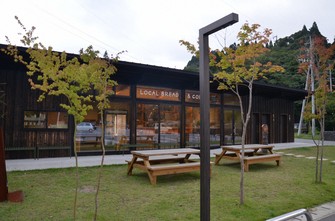
One of the Au Kurokawa establishments in Minamioguni, Kumamoto Prefecture, is seen on Sept. 14, 2026. (Mainichi/Yuichi Utsunomiya)
“I want to spend the rest of my career as a chef doing something that benefits society,” Tohara said of his decision to accept Otonari’s invitation.
He aims to create “the ultimate Japanese cuisine, without unnecessary human intervention.” He goes into the hills behind the restaurant to gather wild mountain vegetables and tree buds and uses soft water from the Tateiwa spring, about 10 kilometers away, to make dashi.
Despite its poor transportation links, Kurokawa Onsen became well known largely because of redevelopment efforts undertaken by a tourism ryokan cooperative in the 1980s. At the time, the late Tetsuya Goto, who headed the ryokan cooperative, came up with the idea of introducing a pass that allows visitors to bathe in the open-air baths of three inns. The initiative attracted widespread attention.
Otonari, who also heads the local tourism association, is now working to develop facilities that will serve as “Kurokawa Onsen’s kitchen,” while carrying on Goto’s vision of “operating the entire hot spring resort as a single ryokan.”
“I’d be happy if money circulated effectively within the community, creating more jobs and raising everyone’s wages,” Otonari said.

Shinji Tohara, owner of the Japanese restaurant Shoryu, is seen in Minamioguni, Kumamoto Prefecture, on Sept. 14, 2026. (Mainichi/Yuichi Utsunomiya)
He hopes that closer ties between chefs and the local community will allow Kurokawa to promote a new food culture together with local producers.
(Japanese original by Yuichi Utsunomiya, Kyushu Business News Department)
AloJapan.com