
K-food enters major retail chains such as Carrefour and Ocado
“Buldak Sauce” featured in French cuisine at the world’s largest food fair

View original image
K-food companies are stepping up efforts to tap the European market. As interest among Europeans in K-food and ingredients such as ramen, kimchi and sauces grows, exports are rising sharply, making Europe a new growth engine after China and the United States.
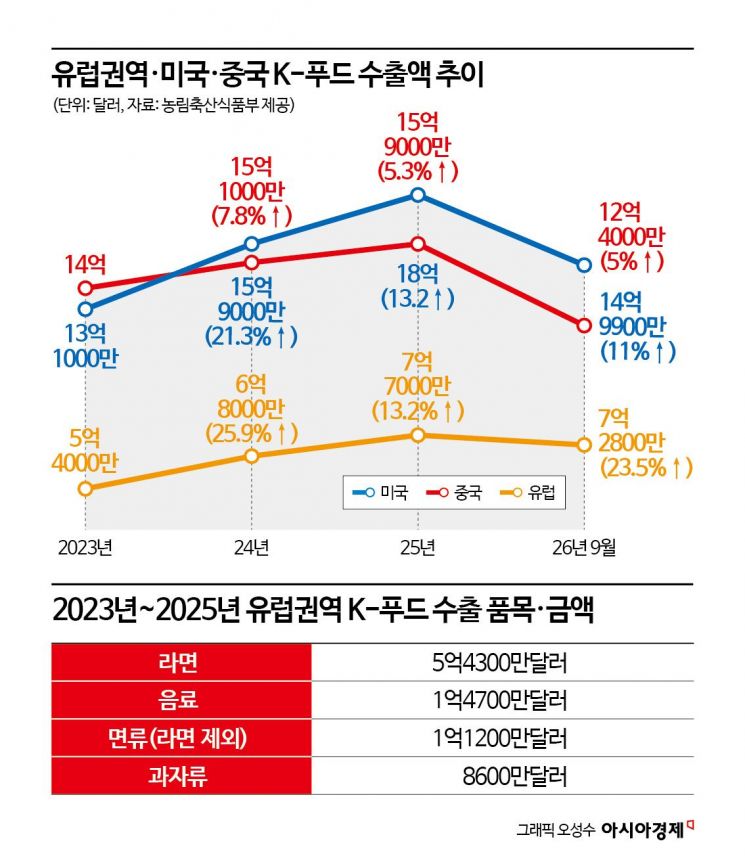
According to the Ministry of Agriculture, Food and Rural Affairs on Oct. 22, K-food exports to Europe totaled $728 million from January through September this year, up 23.5% from the same period a year earlier. The figure is approaching last year’s full-year total of $770 million.
During the same period, exports to the United States totaled $1.499 billion. Although the amount was far greater than exports to Europe, the growth rate of 11% was lower. Exports to China, the largest market for K-food, rose 5.3% to $1.51 billion.
View original image
Europe imposes some of the world’s strictest regulations on allergens, additives, pesticide residues, animal welfare and quarantine inspections for products such as poultry and seafood. However, exports of heat-treated poultry appear to have increased significantly since South Korea and the European Union (EU) concluded quarantine negotiations in 2023. South Korea’s food exports to Europe rose 25.9%, from $540 million in 2023 to $680 million in 2024. Demand surged as the global popularity of K-food spread to Europe, and the easing of quarantine restrictions further boosted exports.
Analysts also say Europe’s high cost of living has contributed to demand for Korean food. Consumer prices in Europe have been surging since the Iran war broke out in February, with the consumer price index (CPI) rising 3.8% last month to its highest level since the war began. Ramen was the largest Korean food export to Europe from 2023 through 2025, totaling $543 million. It was followed by beverages at $147 million and snacks at $86 million. Demand for ramen, a relatively inexpensive meal, has been particularly strong.
For this reason, South Korean food companies also view Europe as a new growth engine for K-food after the United States and China. Entering Europe, where strict food regulations create high barriers to entry, can be more than just a way to expand sales regions; it can serve as a key milestone in demonstrating a brand’s standing and competitiveness in the global market. In particular, under the EU’s single-market arrangements covering 27 countries, companies that establish themselves successfully in one country can readily expand into other member states. Since K-food exports have so far been concentrated in a handful of countries, including the United States, China and Japan, the potential for expansion has grown considerably.
K-food enters major European retail chains … and even gets its own factories

View original image
South Korean food companies have already moved beyond sales centered on Korean and Asian grocery stores, securing shelf space in major European retail chains such as Carrefour, Tesco and Aldi. Initially entering the market as Asian food products, they are now rapidly expanding into local retail channels with tailored strategies that reflect cultural characteristics and consumer trends.
CJ CheilJedang established a local subsidiary in 2018 and made a full-scale entry into the local market by acquiring German frozen-food company Mainfrost. Its products are now sold through major chains such as Carrefour in France, Ocado in the United Kingdom and Globus in Germany, and Bibigo products are available in 27 European countries. To meet rapidly growing demand for dumplings in Europe and standardize production quality, CJ CheilJedang is building a new K-food factory in Europe near Budapest, Hungary, with construction set to begin at the end of 2024.
Nongshim established a European sales subsidiary in Amsterdam, the Netherlands, in March 2025 and has since entered about 20 European countries. It is expanding its presence in mainstream local retail chains, including Tesco in the United Kingdom, Rewe in Germany, Albert Heijn in the Netherlands and Carrefour in France. Nongshim plans to expand sales of key products such as Shin Ramyun and introduce new products tailored to local tastes, with the goal of increasing sales in Europe to around $300 million by 2030. To that end, it will operate an export-only factory in the Noksan National Industrial Complex in Gangseo-gu, Busan, which is scheduled for completion this month. The factory will initially operate three production lines, adding annual capacity for about 500 million packs of ramen.
Daesang has a presence in 35 countries, including France, the United Kingdom, Germany and Poland. Its products are sold in major local supermarket chains such as Carrefour and Auchan. In particular, as demand for kimchi in Europe continues to grow, Daesang established a joint venture, Daesang ChPN Europe, in 2022 with ChPN (Charsznickie Pola Natury), a Polish company specializing in fresh fermented vegetables. The company is also pursuing plans to build a kimchi factory in Krakow, Poland, with the aim of producing more than 3,000 tonnes of kimchi annually by 2030.
Opening up sales channels at food fairs … Korean dishes featuring kimchi presented in France

View original image
Food companies are actively targeting trade fairs and similar events to increase contact with buyers at local retail chains and with consumers. Major South Korean companies, including Nongshim, Samyang Foods, Samlip and Binggrae, took part in SIAL Paris 2026, the world’s largest food exhibition, which opened the previous day, Oct. 21, showcasing their key brands and new products to European consumers.
During the exhibition, Nongshim opened a Shin Ramyun bunsik pop-up store along the Seine in Paris, serving Shin Ramyun prepared in the style of Hangang Ramyun to introduce Korean ramen culture to local consumers. Samyang Foods also set up separate brand spaces for Buldak Ramen and Tangle. Samlip targeted overseas buyers and local consumers with Samlip Hoppang as its flagship product. Binggrae introduced its signature Banana Flavored Milk to the European market for the first time.
The Korea Food Industry Association, in partnership with La Liste, a global gastronomy evaluation organization, held a culinary event called “The Korean Pantry.” Six South Korean food companies participated, presenting special dishes that reinterpreted their signature products using French culinary techniques. The offerings included kimchi gazpacho made with Sempio Foods’ Yeondu and Pulmuone’s kimchi; a noodle dish combining Ourhome’s Haenam seaweed pesto, Sempio Foods’ perilla oil and Pulmuone’s tofu noodles; and a salad tart featuring Samyang Foods’ Buldak Sauce and Pulmuone’s tofu tenders.
Hot Picks Today

“After Sleeping Well with Strangers”… Who Is the 24-Year-Old Woman Who Won 19 Million Won?
“The European market has long been considered difficult for South Korean food companies to enter because of stringent export requirements, including country-specific labeling rules and food customs procedures,” an industry official said. “Recently, as the spread of Korean culture has led to growing interest in K-food, particularly among Millennials & Gen Z, translating into actual purchases, the European market has rapidly emerged as an attractive export destination for South Korean food companies.”
This content was produced with the assistance of AI translation services.
© The Asia Business Daily. All rights reserved. Unauthorized AI training and use prohibited.
AloJapan.com