

Thinking Tokyo for a vacation? Over 2 million Americans do annually based on tourism data. They, like most visitors to Japan’s busiest metropolis, come with a yen for culture, entertainment, food and the unique Tokyo drift that can be as fast and furious as Shibuya crossing when the lights flip green or as serene as a stroll through Meiji Shrine.
But the price of vacationing in the world’s largest metropolitan area can add up fast. Three days at Tokyo Disneyland and DisneySea, alone, will easily set a family of four back about ¥350,000, or roughly $2,200 U.S. when adding up just the basics. And while comparing America’s Disney parks with the ones in Japan can be a fantasmic exercise — their queue for Indiana Jones Adventure blows ours away — the ROI might not justify the pan‑Pacific splurge when other options exist.
 Buddhist ruins dating back more than a millennium rise from the landscape along horseback riding trails through Aso’s sweeping grasslands. (Photo by David Dickstein)
Cue Kyushu. Southwest of Tokyo, closer to South Korea than much of the country, it’s an island where Mount Aso’s volcanic highlands, coastal hot‑spring towns and one of Japan’s most dynamic cities offer a version of this layered nation that feels rich.
Kyushu (visit-kyushu.com) has long been a favorite among domestic travelers, yet it remains under the radar for many Americans who default to Tokyo — and, for that matter, Kyoto and Osaka, which also eat up a traveler’s budget fast. The island’s terrain, shaped by volcanic basins, steam vents and forested slopes, gives it a dramatic character rarely found in Japan’s marquee destinations. Towns built around hot springs still feel rooted in tradition, and rural stretches reveal a side of Japan defined more by scenery than by sightseeing checklists.
Fukuoka, Kyushu’s largest city, pairs with the island’s rural sweep to form a city‑country combo that delivers Japan’s energy and heritage at a friendlier price point than the current and former capitals. Besides first‑time visitors to Japan, the city tends to resonate with travelers who’ve already explored the big three, and are now looking for greater depth — a point underscored by Radu Cernia, general manager of The Ritz‑Carlton, Fukuoka, widely considered the city’s most luxurious stay.
Kyushu’s seven prefectures each bring a distinct flavor to the island. Fukuoka anchors the north as a food‑driven metropolis with efficient transit, waterfront neighborhoods, luxury hotels, Ginza‑level shopping and cultural depth, while Nagasaki blends coastal scenery with layered history. Kumamoto and Oita deliver the volcanic drama, and Kagoshima, at the southern tip, carries a subtropical edge. Distances between them are short, and the Kyushu Shinkansen and a network of limited‑express rail service — along with the Seven Stars in Kyushu luxury excursion train — make it simple to pair city days with onsen towns, where mineral‑rich hot-spring bathing is part of daily life.
Most Americans reach Kyushu by flying into Tokyo or Osaka on JAL, ANA, United or American, then connecting onward to Fukuoka, the island’s main gateway. The city’s international airport, rail links and hotel options make it a natural base before heading into the island’s interior, and nowhere is the scenery more dramatic than in the Aso region.
Centered around one of the world’s largest volcanic basins, Aso and neighboring prefectures are defined by open meadows, steaming vents and highland contours that feel worlds away from Japan’s urban corridors. It’s an area built for slow drives, quiet inns and days shaped by the landscape itself — a contrast that underscores why Kyushu rewards travelers who venture beyond its gateway city.
 Visitors participate in a ritual inside Kokuzo Shrine, a key sacred site in Teno where the Shinto hall was rebuilt in the Edo period after a fire. (Photo by David Dickstein)
One of those highlights is Teno, a village with a history stretching back more than two millennia. The community sits amid sweeping meadows and quiet hillsides and centers on Kokuzo Shrine, among the region’s most important sacred sites. The Shinto hall was rebuilt in the Edo period after a fire, though its grounds still hold the massive trunk of the ancient Great Cedar of Teno – a sacred stump if ever there was one.
Steamy and secluded Aso Uchinomaki Onsen, the basin’s main hot‑spring town, adds a restorative counterpoint. Ryokans such as Sozankyo (sozankyo.com/en) highlight the area’s long onsen heritage with mineral‑rich baths fed by natural springs and access to both private and public soaking areas. The not‑so‑bashful will appreciate the latter.
 A private outdoor bath accompanies this room at Sozankyo, a ryokan in the Aso Uchinomaki Onsen hot spring. (Photo by David Dickstein)
Takanosho (takanosho.com), with its separate cottages each equipped with an indoor bath, reinforces Uchinomaki’s reputation as a quiet base for slow travel, while Sakura no Yado (hpdsp.jp/sakuranoyado/en), a 150-year-old traditional folk house, offers a pair of quirky two‑level units that are more like townhomes. The tiny dining room may not be on Michelin’s radar, but it’s star worthy. What comes out of the little kitchen is inventive, gorgeous and honors the local ag industry in ways that make this true event dining in a unique and intimate setting.
 A beautifully plated seafood course is served at Sakura no Yado, a folk house whose tiny kitchen turns out inventive dishes tied to the region’s agricultural heritage. (Photo by David Dickstein)
Another foodie experience is found at Tarutama Onsen on the southern side of the Aso caldera, where an age‑old steam‑cooking method relies on geothermal vents to cook baskets of local vegetables and eggs. This isn’t your grandfather’s shabu‑shabu; it’s closer to your great‑great‑great‑great grandfather’s.
 Visitors can steam baskets of ingredients with natural geothermal heat at Taratama Onsen, a popular stop that satisfies both curiosity and hunger. (Photo by David Dickstein)
Aso City’s Uchinomaki district, home of more than 100 spring sources bubbling underneath, also serves as a gateway to the region’s conservation efforts. The Grassland Conservation Center explains how the landscape has been maintained through controlled burning and community stewardship. Horseback riding across these open fields offers a rare chance to appreciate the basin’s vastness and walk past thousand-year-old Buddhist markers.
 Takachiho Gorge is easily explored on foot, with a riverside trail that winds beside sheer basalt walls. (Photo by David Dickstein)
Crossing into Miyazaki Prefecture, southeast of Aso, Takachiho Gorge offers stunning natural beauty with almost equally stunning ease. A flat path follows sheer basalt walls carved by ancient lava flows, with viewpoints that highlight waterfalls and emerald water. Nearby Tadewara Marsh opens into broad wetlands lined with Japanese iris, star lily, primrose, violets and azaleas depending on the season. It’s one of the basin’s most pastoral spots and a calm counterpoint to Aso’s volcanic contours.
 A condemned former school, preserved as a ruin on the Earthquake Museum grounds, retains the structural damage left by the 2016 Kumamoto disaster. (Photo by David Dickstein)
The region’s relationship with nature has always been shaky, shaped by frequent small tremors and periodic major shocks, most notably the 2016 Kumamoto earthquakes, which altered roads, hillsides and parts of the basin. One of the most visible reminders is a fallen bridge on the outskirts of Aso, intentionally left in place as a memorial. Less than two kilometers away is a notable earthquake museum that incorporates a condemned former school into its complex. The site’s gravitas carries even more weight since the 6.8 quake that struck in July and caused collapsed homes, landslides and disrupted roads across Kumamoto Prefecture. Reports indicate that operations across the prefecture have largely returned to normal.
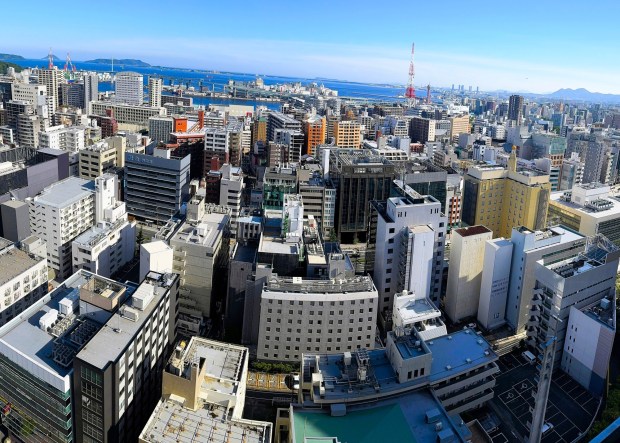 A view toward Hakata Bay from The Ritz Carlton, Fukuoka, in a city that has much of what Tokyo is known for except the exorbitant high cost of vacationing. (Photo by David Dickstein)
After days shaped by open countryside, meadows, onsen villages and Aso’s blessings and curses from Mother Nature, Fukuoka provides a polished urban finish. The city’s efficient transit, waterfront districts, luxury hotels and food‑driven neighborhoods make it an easy base at both the start and end of a Kyushu itinerary.
The city’s hotel scene includes The Ritz‑Carlton, Fukuoka, a standout luxury tower with 167 rooms that run about half the price of its Tokyo counterpart. Opened in 2023, the centrally located hotel (ritzcarlton.com) boasts one of the finest executive lounges in the industry and perhaps the city’s best hotel-restaurant in Genjyu, a multi‑concept gem on the 18th floor where teppanyaki is approached with an omakase‑style focus on pacing, premium ingredients and precise, theatrical technique. The experience is anchored by rare wagyu beef from Nagasaki’s remote Iki Island, prized for its delicate marbling and refined depth of flavor, and complemented by premium produce sourced almost entirely from Kyushu.
Nearby, the 203-room One Fukuoka Hotel (onefukuokahotel.jp) offers more streamlined luxury and a lower‑priced stay, starting at around $415 a night compared to roughly $570 at the Ritz-Carlton. A 192-key Ace Hotel with Seattle roots is slated to open next year, adding a contemporary option to the city’s lodging landscape.
Fukuoka balances food, culture and easy urban exploring within walking distance or a short subway ride. Ohori Park provides one of the city’s most popular green spaces, while Kushida Shrine carries centuries of history. The dining scene stretches from fine restaurants to street food at the many yatai, and Tenjin Chikagai adds a long underground mall lined with shops, cafes and direct links to surrounding neighborhoods. Modern shopping complexes and the waterfront around Momochi round out the mix, reinforcing why Fukuoka works so well as a base at both the start and end of a Kyushu itinerary.
That holds true for cruise itineraries as well, with the Fukuoka area increasingly positioned as a growing gateway for ships calling on Kyushu. Azamara, Celebrity, Oceania, Royal Caribbean, Seabourn, Windstar and other major cruise lines have scheduled stopovers in 2027, and beginning in August 2028, the 930-guest Viking Neptune (vikingcruises.com) will include Fukuoka on her new 15-day Japan Discovery itinerary sailing round trip from Tokyo.
As port schedules confirm, the number of ships calling on Kyushu peaks in the high seasons of spring and fall when the destination yields a comfortable mix of mild temperatures and lower humidity. A day in port makes for an easy introduction, but it’s a tease of how much the island offers. And few parts of Japan reward that extra time more than Kyushu, whose landscapes, traditions and pace set it apart from the country’s more familiar stops.
AloJapan.com