
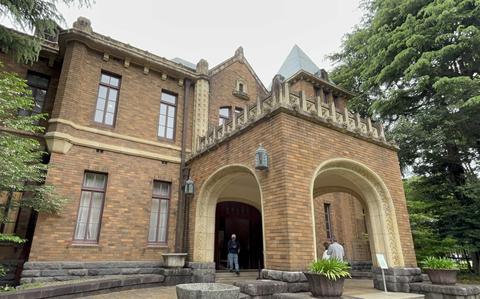

Former Residence of the Maeda Family (Photo by Takahiro Takiguchi/Stripes Okinawa)
About a 20-minute walk from Shimokitazawa, you’ll find Komaba’s quiet, tree-lined residential streets. It’s hard to imagine that this area in southwestern Tokyo was once where Edo Era shoguns would hunt wild game with their tamed hawks perched upon their arm.
Today, the shoguns and hawks are gone, but the vast park remains, inviting visitors to enjoy a stroll or a stop inside two of the local museums showcasing artifacts of bygone eras.
Former Residence of the Maeda Family
One of the museums is the Former Residence of the Maeda Family, a part-British Chador and part-traditional Japanese-style mansion, offering a glimpse into the 1930s lifestyle of an aristocrat.
During the Edo Era, the Maeda Family was one of the most powerful feudal families that governed the area that is now part of modern-day Ishikawa Prefecture. During the Meiji Restoration, the family was granted the title of marquis by the emperor. Marquis Toshinari Maeda, the 16th head of the Maeda family and a general in the Japanese Imperial Army, built the mansion in 1936, just before WWII broke out. Toshinari was killed during a battle off the coast of Borneo in 1942.
With Japan’s surrender to the Allied Forces in 1945, the mansion and the field were confiscated. The building was used as the official residence by several commanders of Allied Forces before it was transformed into Tokyo Metropolitan Komaba Park in 1967. The mansion was designated as a National Important Cultural Asset in 2013, and it is open to the public as a legacy of Japan’s modern history, according to the residence’s website.
The buildings, interiors and gardens of the residence are a stunning example of how British and Japanese architectural style and aesthetics were blended. Elegant rooms with fireplaces and chandeliers preserved in their original condition transport visitors into a bygone era.

(Photo by Takahiro Takiguchi/Stripes Okinawa)

(Photo by Takahiro Takiguchi/Stripes Okinawa)
The residence garden is pristine and offers a peaceful escape from the city with its many pine trees, seasonal flowers and views of the pond and small river flowing through.
Japan Folk Crafts Museum

Japan Folk Crafts Museum (Photo by Takahiro Takiguchi/Stripes Okinawa)

Japan Folk Crafts Museum (Photo courtesy of Japan Folk Museum)

Komaba Park (Photo by Takahiro Takiguchi/Stripes Okinawa)
After visiting the residence, you can take a short walk to the Japan Folk Crafts Museum, which is also on the grounds of Komaba Park. This museum holds a vast collection of crafts from different periods and different regions around Japan and the world.
The museum was founded in 1936 and according to the museum’s website, its collection was inspired by Soetsu Yanagi, the first president of the museum, and his obsession with folk crafts and “the honest beauty” he found in the crafts made by unknown people throughout his travels.
Approximately 17,000 new and vintage folk crafts, including ceramic pieces, textiles and traditional clothing are displayed year-round.
Visitors can see ceramics and paintings from Korea’s Joseon Dynasty (1392-1897), antique ceramics from different regions in Japan, including Tamba and Imari, as well as clothing and items used by Ainu, an aboriginal ethnic group from Northern Japan. The woven textiles from Okinawa are also a must-see as they are highly acclaimed for their beauty, quality and cultural value.
Former Residence of the Maeda Family
Japan Folk Crafts Museum
Address: 4-3-33, Komaba, Meguro-ku, Tokyo
Hours: Tue. – Sun., 10 a.m. – 5 p.m.
Admission: Adults 1,500 yen, college and high school students 800 yen
Website: https://www.mingeikan.or.jp/
Phone: 03-3467-4527
AloJapan.com