
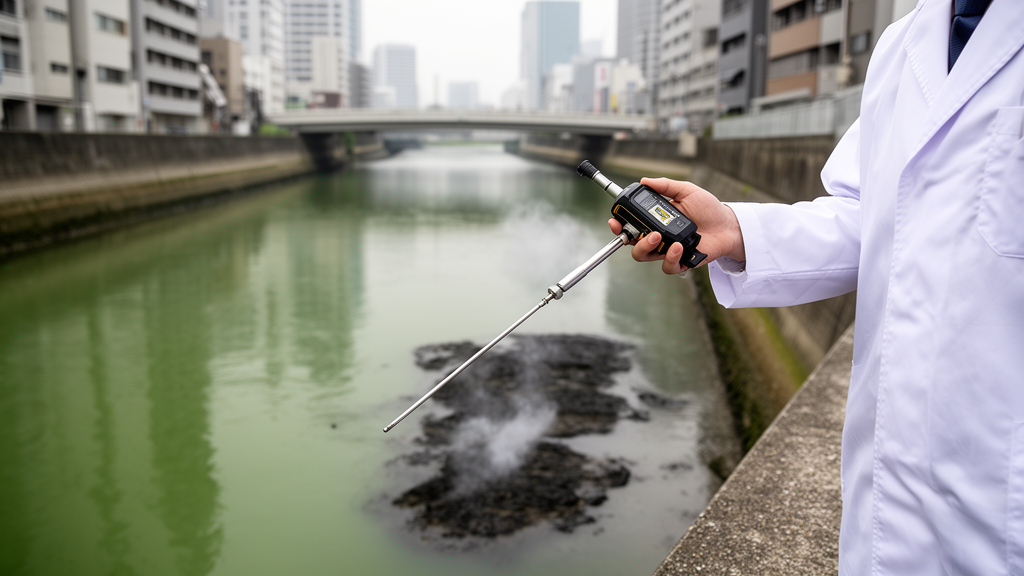
On summer mornings along the Shakujii River in northern Tokyo, a brown, buoyant film sometimes spreads across the water surface, releasing a sour pungent smell that residents have complained about for years. This scum, which forms when organic sludge deposited on the river bottom rises with anaerobic gas, is a persistent nuisance in the tidal reaches of small and medium-sized urban rivers across Japan. A new study published in Estuarine Management and Technologies has now combined months of hourly water quality monitoring with electronic nose technology to identify exactly when and why scum forms, and which odor compounds are responsible for the foul smell that accompanies it.
The research team, led by researchers studying the confluence of the Shakujii and Sumida Rivers, monitored salinity, dissolved oxygen, water level and rainfall at stations along both rivers from August to October 2017. The Shakujii River, a 25.2-kilometer waterway with a watershed of 61.6 square kilometers, drains a densely urbanized area served by 154 combined sewer outfall chambers that discharge domestic and storm water runoff. The Sumida River estuary, which flows through the deltaic lowland of central Tokyo into Tokyo Bay, receives fresh water from several tributaries including the Shakujii, and roughly 60 percent of its flow comes from treated sewage water. By tracking these parameters at ten-minute intervals, the researchers could link the hydrodynamics of the tidal estuary directly to the appearance of scum at the water surface.
Scum coverage was measured visually using a fixed video camera operated by the Kita City Office, which monitors the water surface upstream of the tidal area. The researchers divided a 25-meter by 20-meter section of the river into 100 grids of 2.5 by 2 meters and identified the percentage of scum in each grid every hour. This approach allowed continuous documentation of scum episodes, verification of resident complaints, and evaluation of how alternative management practices affect odor impacts. The data, collected from June to October 2017, were then classified according to dissolved oxygen ranges to compute the probability of scum occurrence under each condition.
The results revealed a clear relationship between oxygen depletion and scum formation. Under anoxic conditions, when dissolved oxygen fell between 0 and 1 milligram per liter, the probability of scum reached 75 percent. The probability dropped to 24 percent at dissolved oxygen levels of 2 to 4 milligrams per liter, 22 percent at 4 to 6 milligrams per liter, and only 12 percent when oxygen exceeded 6 milligrams per liter. Scum coverage was consistently higher when salinity was below 1 practical salinity unit and dissolved oxygen was below 6 milligrams per liter. These findings suggest that maintaining dissolved oxygen at or above 5 milligrams per liter for Class B and C rivers, or 7.5 milligrams per liter for Class A rivers, could substantially inhibit scum generation.
Rainfall emerged as the main precursor to scum episodes. From September 20 to 26, 2017, scum appeared three days after heavy rainfall totaling 64.75 millimeters, with hourly coverage ranging from 0.5 to 12.9 percent. The pattern is consistent with earlier observations that scum tends to appear two or three days after rainfall, when organic matter washed in from combined sewer systems is decomposed by microorganisms, consuming oxygen and generating the anaerobic gas that lifts sludge from the river bottom. During the study period, dissolved oxygen in the Shakujii River dropped from 5 to 1 milligram per liter within 12 hours after rainfall on September 18, and from 6 to 1 milligram per liter over 24 hours from September 23 to 24, likely because oxygen was consumed for the decomposition of organic matter.
The tidal dynamics of the estuary added another layer of complexity. Salinity in both rivers increased during neap tide and decreased during spring tide, a common estuarine condition. Saltwater from Tokyo Bay formed a stratified salt wedge during neap tide that flowed landward through the Sumida River and caused salinity intrusion into the Shakujii River. Notably, the researchers observed two salinity peaks for one semidiurnal tidal cycle in the Shakujii River, whereas the downstream Sumida station showed only one peak. The second peak in the Shakujii was attributed to residual salinity retained at the confluence, where the riverbed reaches its deepest elevation of minus 5.36 meters Arakawa Peil. When the tide turned from ebb to flood, a pressure wave pushed this retained saltwater upstream, carrying unoxygenated water with low dissolved oxygen into the tidal reach where scum is mainly generated.
Topography played a decisive role as well. The channel slope from the upstream to midstream Shakujii stations is nearly zero, and the upstream station faces a steep wall that prevents water transit during high tide. These features promote stagnant water conditions that are conducive to scum generation. Higher salinity also brings higher hydrogen sulfide, generated from the reduction of sulfate in seawater, which inhibits methane formation and produces stronger odor but less scum. Good estuarine mixing, the researchers conclude, is therefore favorable to avoid scum formation, and facilitating the proper transit of saltwater could diminish the problem.
To characterize the odors themselves, the team employed a Fragrance and Flavor Analyzer, an electronic nose machine that passes gas samples through ten metal oxide semiconductor sensors. Each odorous component produces a characteristic resistance change expressed as vector values, which are compared against nine calibrated reference gases to determine the similarity index and strength of each odor component. The machine generates an analog value of the odor index, which was converted into the actual olfactory sense through a regression equation. Human panelists performed simple olfactory measurements following the Ministry of the Environment method, comparing odor samples diluted with nitrogen against pure nitrogen to determine odor concentration, which was converted to the odor index as the logarithm of that concentration.
The odor analysis identified organic acids and hydrogen sulfide as the primary odor components of sediment in the Shakujii River, accounting for 14.2 percent and 14.4 percent respectively, followed by ester, sulfur and aldehyde compounds. In the Sumida River sediments, organic acids at 4 percent and sulfur at 1 percent were prominent but far weaker. The Shakujii River sediment exhibited the highest odor index of 25.5 and showed a 62.43 percent similarity with the scum sample, indicating that the bottom sediment is the likely source of the foul odor. The scum itself had the highest odor index of 27.8 and an odor concentration of 597.7, with panelists describing a sour pungent smell. The odor components resemble those from sanitary sewage discharged by combined sewer systems during heavy rainfall, with organic acids derived from automobile emissions and anthropogenic sources such as wood, agricultural waste and fossil fuels, and sulfur compounds coming from sulfur-containing organics in wastewater from restaurants, households and other facilities.
The study offers a template for addressing scum and odor issues in urban estuaries worldwide. Although measured gas concentrations may not precisely reflect human olfactory perception, the correlation of electronic nose results with human smell tests provides a reliable and repeatable method for identifying odor sources. The researchers recommend facilitating proper estuarine mixing, improving river topography where possible, and strictly implementing sewer discharge controls, especially during rainfall periods. As highly developed countries continue to struggle with river odor even when water quality standards are met, and developing countries may face the same problems in the future, the integration of on-site hydrodynamic monitoring with electronic nose technology offers new insights into how scum forms in actual river locations and how policy enforcement could enhance river water quality.
Subject of Research: Factors controlling scum formation and odor identification using an electronic nose in the tidal Shakujii and Sumida Rivers, Tokyo
Article Title: Factors affecting scum formation and the use of electronic nose to identify fundamental odor properties in urban estuaries
Article References: Casila, J. C., Okuyama, R., & Yokoyama, K. (2024). Factors affecting scum formation and the use of electronic nose to identify fundamental odor properties in urban estuaries. Estuarine Management and Technologies, 1(1), 39-56. https://doi.org/10.3897/emt.1.119588
Image Credits: AI Generated
DOI: 10.3897/emt.1.119588
Keywords: scum formation, electronic nose, urban estuary, dissolved oxygen, salinity intrusion, hydrogen sulfide, Tokyo rivers, odor monitoring, Factors, affecting, scum, formation
AloJapan.com