
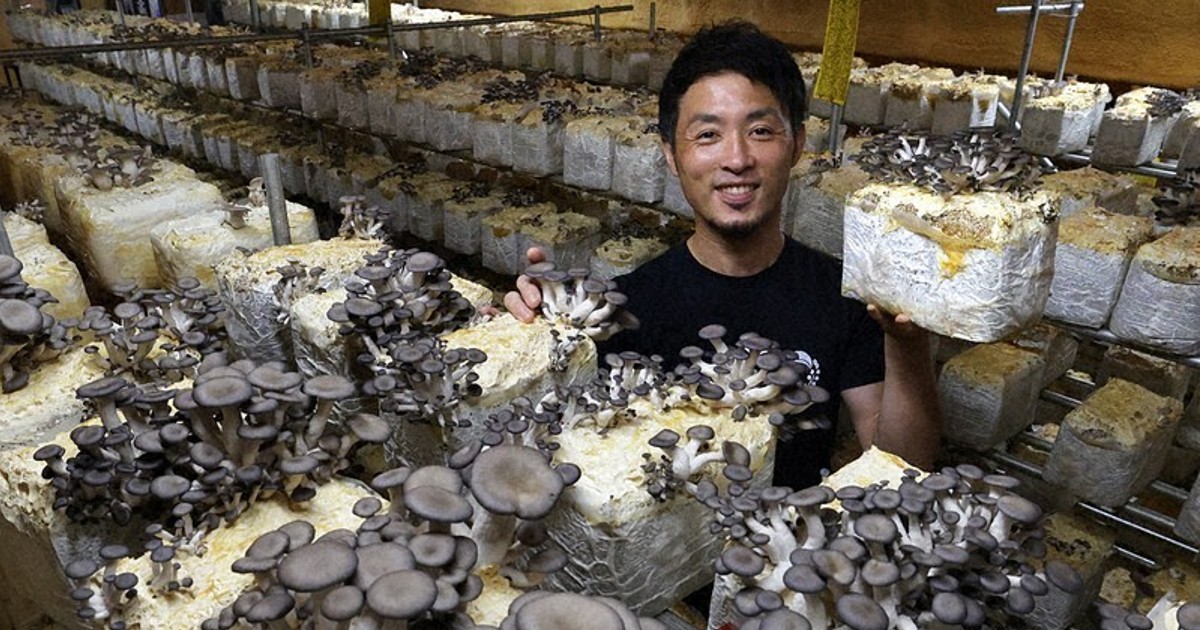

Hiroki Kurahashi is surrounded by oyster mushrooms in a mushroom greenhouse in Kyoto’s Fushimi Ward on Sept. 13, 2026. (Mainichi/Takeshi Nishimura)
KYOTO — A farmer in Kyoto is growing mushrooms from used coffee grounds collected from hotels and restaurants in the city, turning discarded waste into fertilizer for food served at hotels and restaurants in Osaka and Kyoto.
Hiroki Kurahashi, 41, head of RE:ARTH in Kyoto’s Fushimi Ward, mixes the collected coffee grounds with sawdust and other materials to make mushroom substrate, which he uses to grow mushrooms.
After coffee beans are brewed, their volume changes very little, and in many cases, the grounds are simply thrown away. More than 10 million metric tons of coffee beans are consumed worldwide each year, including about 400,000 tons in Japan, meaning that nearly the same amount of coffee grounds is discarded.

Used coffee grounds collected from hotels and restaurants are seen in Kyoto’s Fushimi Ward on Sept. 13, 2026. (Mainichi/Takeshi Nishimura)
Coffee grounds retain many nutrients and can be used as fertilizer for crops, but their cell walls are hard, preventing plants from accessing those nutrients directly. Turning them into fertilizer takes time and effort. Mushrooms, on the other hand, have a strong ability to break down organic matter, enough to turn fallen leaves into leaf mold. This makes coffee grounds useful for mushroom substrate, and the substrate left after cultivation can also be used as fertilizer for vegetables.
Kurahashi’s path began with an experience in South Africa in 2009, when he was studying there as a graduate student. Nature was being destroyed in the name of development. In the city, disputes over expensive goods never ceased. “What exactly are true civilization and development?” he wondered.

Hiroki Kurahashi, far left, poses with women who took part in a self-reliance support program in Harare, Zimbabwe, in November 2014. (Photo courtesy of RE:ARTH)
He returned to Japan without reaching a conclusion and was working on his thesis when he was impressed by the concept of “zero emissions,” advocated by people including Gunter Pauli, a Belgian environmental activist and former adviser to the president of United Nations University. The idea is to keep the economy moving by making full use of “waste” and “byproducts.”
After completing graduate school, Kurahashi went to Hungary to attend a summer school at which Pauli was one of the lecturers, and learned about the work of Chido Govera, a Zimbabwean social entrepreneur. Drawing on her own experience as an orphan who grew up in poverty, Govera was working to grow mushrooms using coffee grounds and other materials in an effort to achieve zero waste. Inspired by her work, Kurahashi flew to Zimbabwe to visit her and took part in a local program for orphans and women in 2014. He deeply agreed with the idea underlying the program: “In a society where they do not have to struggle with having enough to eat, people are more tolerant of others, and the economy also keeps moving.”

Hiroki Kurahashi stands in front of his second mushroom greenhouse in Kyoto’s Fushimi Ward on Sept. 13, 2026, in this photo taken from a drone. (Mainichi/Takeshi Nishimura)
Soon after returning to Japan, Kurahashi tried making the substrate he had learned to make in Zimbabwe. But due to the differences in climate, no mushrooms grew, and the substrate simply became covered in blue mold. Wanting to relearn cultivation methods, he began working in mushroom cultivation for the first time in Nantan, Kyoto Prefecture, in 2016, and acquired the know-how. About 1 1/2 years later, he launched RE:ARTH and began taking on mushroom cultivation as a business. During this period, he learned the Japanese method of preparing substrate, which involves sterilizing it, inoculating it with spawn in a sterile environment and sealing it.
Kurahashi rented farmland in Kyoto’s Fushimi Ward and succeeded in growing shiitake mushrooms on substrate made with coffee grounds in 2019. He then tried cultivating oyster mushrooms, which became his main product, and succeeded. In 2020, he built a greenhouse dedicated to mushrooms to meet requests from wholesalers for a year-round supply of oyster mushrooms, which normally grow only in winter.
In 2022, he began selling his product under the name “Mushroom Revolution: Oyster Mushrooms.” He also began providing the substrate left after mushroom cultivation to nearby farmers free of charge. From “garbage” to food, and then to soil for growing vegetables. A food cycle involving coffee grounds and mushrooms has quietly begun to take hold in Kyoto. “What defines garbage? In the end, it comes down to human convenience. Coffee grounds are no longer garbage if people simply understand how to use them,” he said.

Hiroki Kurahashi collects containers filled with used coffee grounds from a hotel’s refrigerated storage room in Kyoto’s Shimogyo Ward on Sept. 18, 2026. (Mainichi/Takeshi Nishimura)
According to a Family Income and Expenditure survey conducted by the Statistics Bureau of the Ministry of Internal Affairs and Communications, Kyoto has ranked first for many years in coffee purchases in rankings covering Japan’s prefectural capitals and government-designated major cities. “That is precisely why I think it is meaningful to promote the idea of recycling coffee (grounds) from Kyoto,” Kurahashi explained.
Mushroom cultivation requires air conditioners to run constantly to maintain the proper temperature. “Eventually, I want to cover the greenhouse roof with solar panels so that we can also produce our own electricity,” he said.
(Japanese original by Takeshi Nishimura, Osaka Photo and Video Department)
AloJapan.com