


Yebisu Garden Place (Photo by Takahiro Takiguchi/Stripes Japan)
We’re here for you
At Stars and Stripes, we believe the purpose of our community papers, magazines, special supplements, websites and social media platforms is to help you, the military community, make the most of your time while being stationed in the Pacific. We take our job seriously and know that our first-hand experiences are how we can bring you the best tips, directions and recommendations for exploring off base.
This summer, our team including Korea writer Hyemin Lee and Okinawa writer Shoji Kudaka, gathered at our Tokyo headquarters to spend time brainstorming and discussing ways to make sure you’re getting the information you need. For one week, our page designers, web editors and writers talked storytelling and presentation with you in mind.
This year, Hyemin, Shoji, their fellow writers Takahiro Takiguchi and Luis Samayoa from mainland Japan, and their editor, Denisse Rauda, brainstormed their perfect half day trips in Tokyo. The four writers partnered up and they spent an entire day exploring Tokyo. Last week, we published a 4-page spread about Shoji and Luis’ trip to Shinjuku. This time, they’re taking you to their other half day trip at Yanaka Ginza.
Tokyo has an incredible public transit system, so getting around to multiple locations is a breeze. We hope after reading this, you’ll get some travel inspo and plan your own fun trip! And don’t miss the following editions where Hyemin and Takahiro take us to two other great spots!
– Chris Carlson, Publishing and Media Design Manager

Illustrations of PMD writers and an editor (From left to right): Shoji Kudaka, Takahiro Takiguchi, Denisse Rauda, Hyemin Lee and Luis Samayoa. (Illustrations by Yukiyo Oda/Stripes Japan)

Denisse Rauda (Illustration by Yukiyo Oda/Stripes Japan)

Takiguchi Takahiro (Illustration by Yukiyo Oda/Stripes Japan)

Shoji Kudaka (Illustration by Yukiyo Oda/Stripes Japan)

Hyemin Lee (Illustration by Yukiyo Oda/Stripes Japan)

Luis Samayoa (Illustration by Yukiyo Oda/Stripes Japan)
—–
Ebisu
Tokyo’s high-end town developed historical Yebisu brewery.

Japan map (Illustration by Stripes Japan)

Tokyo map (Map by Stripes Japan)
In the heart of the metropolis, Ebisu is known as one of Tokyo’s most popular districts, where modern buildings, world-renowned restaurants and luxury hotels coexist with abundant greenery.
My co-worker from Korea, Hyemin, and I decided to visit this town which has a mature, sophisticated atmosphere.
Although Ebisu is known as an upper market district today, it was originally developed as a brewery town.
In 1890, Japan Brewery Company (today’s Sapporo Breweries) built a factory on the site where the current Ebisu Station stands to produce Yebisu Beer. As its production increased, the brewery needed a shipping station near the brewery, which eventually led to the establishment of the station, according to the website of Yebisu Brewery Tokyo.
So, the brewery came first and the station and its neighboring town followed afterward.
You may wonder why the town/station and the beer brand are spelled differently as “Ebisu” and “Yebisu.” According to the website, dating back to the Edo Period (1603-1867), the Japanese vowel “e” was written as “ye” by Portuguese missionaries. When the brewery released Yebisu Beer in 1890, it adopted this older spelling. Other examples include the Japanese currency “Yen,” instead of “En.” Even after Japanese eventually standardized the spelling of “e” for the town and station names, the beer brand kept using the traditional spelling.
To pay tribute to the historic brewery that shaped Ebisu into the high‑end district it is today, we headed to Yebisu Garden Place, built on the former site of the brewery.
From Ebisu Station, we walked along the moving walkway known as the Ebisu Skywalk for about seven minutes.
From the walkway end point, Yebisu Garden Place’s castle-like red brick buildings and pavilion welcomed us. The landmark complex features an impressive clock tower, a 167‑meter‑tall office tower, chic restaurants and cafés, bars, beer‑brewery museum, spacious event hall, cutting‑edge movie theater and Japan’s first photographic art museum.
The eye-catching location is even a draw for photographers using it both as a focal point and backdrop for model portraits.
After passing through the tree‑lined path, along the European-style buildings from Clock Square, we arrived at Center Square. Visitors can relax under the large green roof of the Center Square. This open-airy space with benches is a great place to take a break or enjoy lunch.
Yebisu Brewery Tokyo

Yebisu Beer brewing kettles (Photo by Takahiro Takiguchi/Stripes Japan)

Beer is JOURNEY (Photo by Takahiro Takiguchi/Stripes Japan)
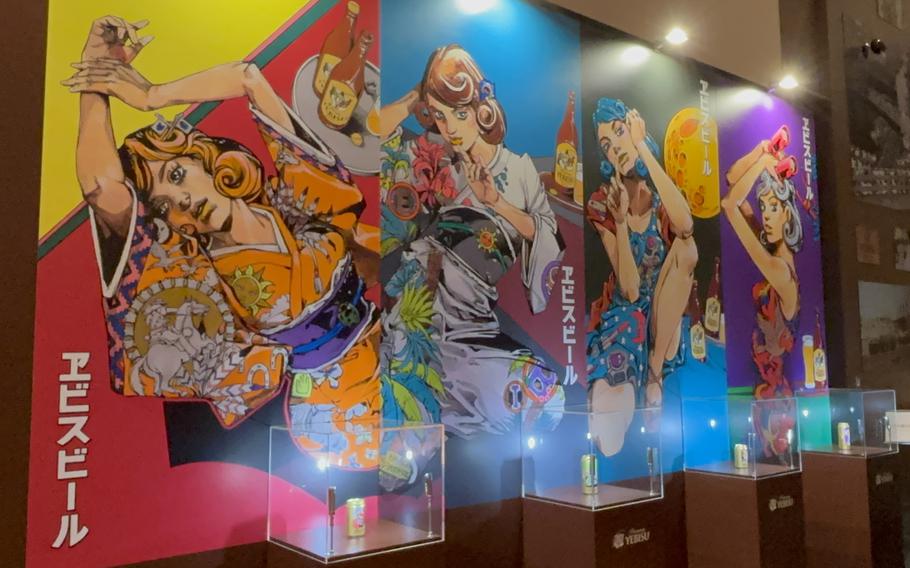
JoJo’s Bizarre Adventure-themed Yebisu Beer. (Photo by Takahiro Takiguchi/Stripes Japan)
Take a long escalator down to enter the Yebisu Brewery museum, café and shop. Book a one-hour guided tour in advance to learn about the brewery’s history and sample two types of freshly brewed beer (or you can choose another option of non‑alcoholic beer and soft drinks) after exploring the exhibits.
Unfortunately, we were unable to join the brewery tour because it was fully booked that day, but we were still able to explore the history and products through various artifacts in the brewery museum free of charge. The exhibits include vintage bottle designs, old posters and even manga and magazines that have featured Yebisu Beer. Don’t miss the large brewing kettle on display, because it was once actively used in the factory.
Be sure to drop by its tasting salon to sample several varieties of Yebisu Beer and pick up some exclusive brand items available at the museum shop. I tried the special tasting set for 1,700 yen to sample the brewery’s extremely smooth and flavorful premium beer.
Tokyo Photographic Art Museum
After spending some time familiarizing ourselves with the history of the beer brewer, we headed to other side of the complex to enjoy some art at the Tokyo Photographic Art Museum.
The museum, which was established in 1995 as a public museum specializing in photography and moving images, houses a collection of 38,759 works from Japan and abroad, including many by renowned photographers, according to the museum’s brochure.
Frankly speaking, I had never imagined that an exhibition of hundreds of mere photographs could be as fun as visiting a fine art museum. But while checking out the wide range of photographic works, from monochrome and color to news photos and abstract works in the quiet, uncrowded gallery, I felt as if I were traveling through different times and spaces. Perhaps it was because photographs convey a stronger sense of realism than drawings but helped me to immerse myself in each moment captured through the lens.
The museum has various exhibits simultaneously throughout the year. Check the schedule in advance before your visit.
From day to night in Ebisu
Our leisurely post-lunch walk around the sophisticated complex gave us a taste of how the old and new coexist in this lively district.
Though during the day Ebisu might seem like it belongs to the officer workers, it is a good time to visit to enjoy the daytime activities and then stick around to enjoy Ebisu’s post-work attractions including a lively izakaya and diverse dining scene.
Grab a drink and some tasty yakitori skewers at one of the many izakayas in Ebisu Yokocho, an old-style indoor shotengai. Or, if you’re seeking something a level or two up from casual dining, check out one of the many impressive restaurants serving high-end sashimi, yakiniku, western or Japanese fine dining.
Whatever ambiance you’re looking for, Ebisu is sure to have it.
– Takahiro Takiguchi
Follow the yellow mug road

Yebisu mug road (Photo by Denisse Rauda/Stripes Japan)
As Takahiro mentioned, Ebisu has a long history as a brewery town. These days, it is also a watering hole for the area salarymen and beer lovers. Serving as a nod to this history, or perhaps as a guiding path, you’ll find dozens of streetlamps shaped like beer mugs leading the way from JR Ebisu Station to Yebisu Garden Place.
These retro, bright yellow streetlamps reminded me of the Kiss-shaped lamps I saw one summer when I visited Hershey, Pennsylvania. They’re a sight to see and a quirky reminder of the district’s early existence. Cheers!
– Denisse Rauda
—–
Read rest of their stories at the links below:
AloJapan.com