
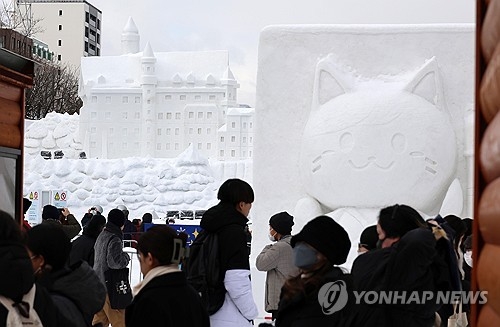
![Sapporo Snow Festival. [Yonhap News]](https://wimg.mk.co.kr/news/cms/202610/12/news-p.v1.20261012.22d0afb5da5f429f9726735f3cabc860_P1.jpg) 사진 확대 Sapporo Snow Festival. [Yonhap News]
사진 확대 Sapporo Snow Festival. [Yonhap News]
The Asahi Shimbun reported on the 12th that Sapporo City, Hokkaido, Japan, could face financial collapse within the next 20 years due to large-scale urban redevelopment and new facility projects.
According to the newspaper, Sapporo City’s recently announced “future financial management” estimate shows that the city’s real government bond ratio based on the 2025 settlement of accounts is about 3.5%. However, it will rise sharply from 2026, falling to a “debt-permitting organization” (18%) that requires government permission to issue local bonds in 2034, and a “fiscal consolidation organization” (25%) that seeks to rebuild by planning an expenditure reduction plan in 2037.
In 2043, it was expected that it would be difficult to avoid the designation of a de facto bankrupt “financial regeneration organization” (35%) that promotes reconstruction under state involvement.
The main reason for Sapporo’s fiscal deterioration is the balance of construction bonds. The city’s construction bond balance is expected to increase from about 740 billion yen (about 6.3 trillion won) in 2026 to 1.2 trillion yen (about 10.1 trillion won) in 2039.
The fiscal adjustment fund, which has been covering the revenue shortfall, is also expected to be completely depleted by 2031, with its balance of 78 billion yen as of 2026.
To make matters worse, a series of large-scale projects are also waiting. First, about 60 billion yen will be invested, including land purchase costs, in new MICE facilities that aim to start construction in 2031. About 97.3 billion yen will also be spent on redevelopment around Odori Park and Sapporo Station.
In addition, the Hokkaido Shinkansen extension charge, the construction cost of an underground tunnel in the center of Sapporo, the reconstruction of the main building of the City Hall, which was built in 1971, and the renovation cost of old schools and municipal houses are overlapped.
As a result, the city has already started to curb expenditures by setting an upper limit on each department’s budget requirements for 2026 and reducing office expenses by 15% and policy expenses by 10% compared to the previous year.
AloJapan.com