

A child studies an array of bonsai trees while an elderly man
tends to the display beside him. Around them, visitors weave
through food stands as enthusiastic volunteers serve plates of
tempura, while others fold origami envelopes. Nearby, the smell
of grilled meat carries between booths as families gather around
tables across the grounds of the Placer Buddhist Church’s 59th
Annual Food Festival, held Sept. 26th in Penryn, California.
The festival, in many respects, serves as a microcosm of a
community that materialized more than a century ago in the
foothills surrounding Loomis. By the early 1900s, Japanese
immigrants had become an integral part of Northern California’s
fruit industry, working and eventually leasing or owning a
substantial share of its farmland. Concurrent with the growth of
those farms came Japanese-owned businesses and community
institutions, including the former Japantown along Penryn Road
and the Placer Buddhist Church.
By 1924, Loomis alone had five fruit packing houses, and during
the 1930s and ’40s, seven operated there alongside another 15
throughout Placer County. A 1942 federal report on
Japanese-operated farms in Placer County described most as
relatively small operations of 20 to 50 acres, primarily
concentrated around Loomis, Penryn and Newcastle. Yet they formed
part of a formidable agricultural apparatus: By the 1940s, the
Loomis fruit district was shipping roughly 4,500 train cars of
plums each summer, according to the Loomis Basin Historical
Society.
“All the farming families migrated here from Japan,” said an
elderly church volunteer selling traditional shaved ice, called
kakigōri, at the festival. “They started their farms, and the
thing that brought them together was the church.”
A century of upheaval
After the outbreak of World War II, the incarceration of Japanese
Americans across the country disrupted those agricultural
beginnings. The following decades brought different strains: crop
disease, the closure of local packing houses, consolidation among
produce retailers and an ebb in the number of descendants willing
to take over family farms.
The latter reflects a broader trend across American agriculture,
which has long grappled with an aging population. According to
the U.S. Department of Agriculture’s 2022 Census of Agriculture,
the average American farmer was 58.1 years old, and those under
35 accounted for just 9 percent of the total number of farmers
nationally.
“For a lot of the families, the kids went to college and then
found professional jobs like engineers and doctors,” the church
volunteer said. “They don’t have to work in the packing houses
like we did.”
For Tosh Kuratomi, whose wife’s family owns Otow Orchard in
Granite Bay, that generational deficit in workers hits close to
home. His wife’s family has farmed the same Placer County
property for more than a century, weathering crop disease and a
rapidly changing agricultural economy. Her grandparents settled
on the property around 1910, Kuratomi said, with the earliest
deed bearing the family business name dating to 1911. What began
with cash crops like strawberries eventually expanded to grapes
and fruit trees, some of which have stood for more than 100
years.
During World War II, Kuratomi’s in-laws were incarcerated at Tule
Lake while another family stayed on the property. Because the
land was already held in the family’s name, Kuratomi said, they
were able to retain it as long as its property taxes were paid.

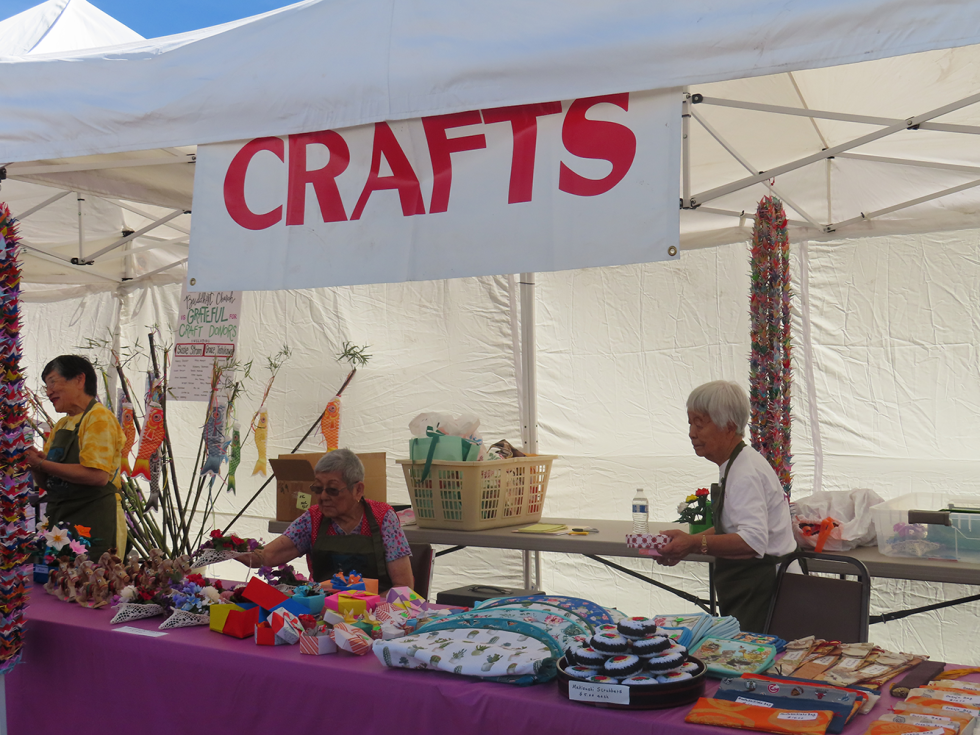
Handmade crafts line a booth at the Placer Buddhist Church’s 59th
Annual Food Festival in Penryn. (Photo by Adiva Mittal)
Growing up, Kuratomi remembers relatives referring to the
incarceration simply as “camp.” The word took on a meaning he did
not fully understand until he encountered it in a very different
context.
“When we were really little and we were going to go to Cub Scout
camp, I didn’t really want to go,” Kuratomi said. “I didn’t
realize it was a day camp and you did arts and crafts and stuff
like that.”
After the war, Kuratomi’s father-in-law returned to a farm that
had not weathered the years particularly well. He took a job
repairing radios and televisions in Sacramento while rebuilding
the orchard, eventually leaving that work once the farm could
again support him full time.
Meanwhile, the orchard’s resurgence coincided with a gradual
transformation of the industry around it. Pear blight prompted
the family to move away from pears, while the farm cycled through
plums, peaches, pluots and other fruit.
Kuratomi remembers hauling fruit to Loomis packing sheds and, in
the 1970s, driving peaches into Sacramento for a wholesaler who
distributed them to local grocery stores. At the time, customers
could recognize not only the type of fruit they were buying, but
the farm that produced it.
The packing houses once provided small growers with an economic
infrastructure that extended well beyond their individual
orchards. Farmers could harvest their fruit, deliver it to a
local shed and rely on that network to move it into larger
markets. Over time, however, Kuratomi watched that system lose
ground to larger agricultural regions capable of producing at
greater scale.
The retail side was changing, too. Even locally rooted grocers
increasingly operated as chains, buying produce in the volume
necessary to stock multiple stores rather than sourcing
individual boxes from nearby farmers. For small Placer County
orchards, the shift gradually diluted a market in which the
identity of the grower had once mattered to consumers.
“People would wait for our peaches,” Kuratomi said. “They’d say,
‘When are your peaches coming?’”
That model began to disappear as grocery retailers consolidated
and larger agricultural regions competed with Placer County
growers on volume and price. When the market became
oversaturated, growers sometimes received a biting instruction
from the fruit shed: “Don’t harvest, just leave it on the tree,”
Kuratomi recalled.
Additionally, Kuratomi acknowledges that selling the property
could leave the family with a handsome sum (likely more than the
roughly $1 million he once estimated) without the work required
to keep an orchard operating. For now, though, the family has
resisted that option, and one of Kuratomi’s children has
expressed interest in eventually taking over the farm.
Rooted in tradition
Back at the Placer Buddhist Church, that same tension between
change and continuity animates the festival.
Claudia Nakata joined the church around 1991. More than three
decades later, she still considers herself relatively new to the
community.
“I’ve been here, what, 30 years?” Nakata said. “And I’m still one
of the new people.”
For legacy members, she said, membership can transcend four (or
sometimes more) generations: great-grandparents, grandparents,
parents and their children.
Donated home goods, clothing, artwork, and household goods items
fill the festival’s thrift stall, with proceeds supporting the
Placer County Buddhist Church. (Photo by Adiva Mittal)
“It is kind of like one big family,” she said.
The agricultural origins of said “family” have not disappeared
entirely. Many church members are farmers or former farmers,
leaving the congregation with a unique skill set of practical
knowledge.
“Everyone knows how to drive a tractor,” Nakata said.
That becomes useful when the church needs to level a parking lot
or complete other work around the property. Where another
organization may call a contractor, Nakata said, the sangha can
often draw upon skills its members acquired through generations
of agricultural work.
To add on, other traditions such as the church’s support for the
Sierra Bonsai Club for decades, which provides space for meetings
and demonstrations like the one displayed at the food festival,
has stood the test of time. Club member Ray Williamson said this
relationship traces back to church members who brought the
practice with them from Japan.
“Bonsai was a tradition, so they continued it here,” Williamson
said. “That’s why I think they support our club, because we’re
part of their traditions.”
At Otow Orchard, Kuratomi describes a parallel communal
relationship. Small farmers who still have a few productive acres
sometimes bring him excess fruit, which he buys for the stand.
Produce that cannot be sold can instead make its way to food
banks and feeding programs.
Sacramento’s status as America’s self-designated “Farm-to-Fork
Capital” has made the relationship between agriculture and food
part of the region’s identity. Today, its dining scene includes a
dozen Michelin-recognized restaurants, including two with
Michelin stars. Seasonal tasting menus and the annual Tower
Bridge Dinner may be the sexy face of the respective
“Farm-to-Fork” and “Slow Food” movements, but the orchards,
growers and agricultural communities that ultimately have made
the movement possible often sit behind the branding used to
promote them.
“To me, that’s really secondary,” Kuratomi said. “It’s that
people just need to be connected to each other.”
–
Never miss a story: Get Comstock’s weekly newsletter delivered to your
inbox.
AloJapan.com