
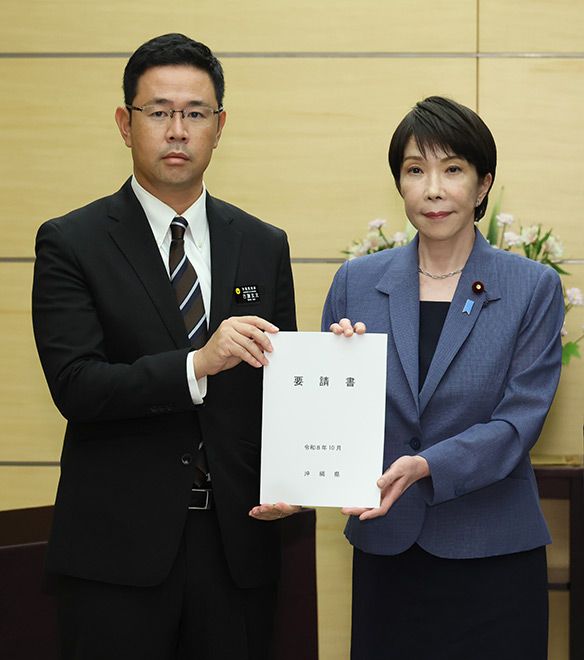
Prime Minister Sanae Takaichi on Oct. 7 promised to hold discussions with Washington after Okinawa Governor Genta Koja demanded stronger measures to prevent U.S. service members from committing crimes in the southern prefecture.
Meeting with Koja at the Prime Minister’s Office in Tokyo, Takaichi said she felt “strong anger” over the robbery-murder case in Naha in which a U.S. Marine was arrested as a suspect.
She agreed on the need for “effective and fundamental” measures to prevent a recurrence.
Although the Takaichi administration has responded swiftly to the case, the government has not suggested any new ways that can finally end the long-standing problem in Okinawa Prefecture.
The U.S. military imposed restrictions on its personnel in Okinawa Prefecture following the latest arrest. But these measures, which had similarly been taken following earlier crimes, are only temporary.
Devin Jacob Ballard, a 20-year-old lance corporal stationed at the U.S. Marine Corps Air Station Futenma in Ginowan, Okinawa Prefecture, was arrested Oct. 4 on suspicion of robbery-murder.
He was captured on camera entering a hotel in Naha with a 39-year-old local woman who was later found strangled to death, according to police.
Security camera footage showed him fleeing the hotel alone, they said.
The suspect has denied the allegations.
Foreign Minister Toshimitsu Motegi lodged a protest with U.S. Ambassador George Glass on the day of the arrest, while Takaichi called the case “extremely regrettable” the following day.
Okinawa Prefecture, which hosts about 70 percent of Japan’s exclusive-use U.S. military facilities, has been shaken by several high-profile crimes over the decades, including the 1995 abduction and rape of a schoolgirl by U.S. soldiers, a gang-rape case in 2012, and the 2016 killing of a woman by a former U.S. Marine working as a civilian base employee.
The latest incident occurred less than a month after Koja’s election as governor raised hopes in Tokyo for smoother relations with the prefecture.
Koja, for example, was seen as more open than his predecessors to the government’s plan to relocate the Futenma air station to Nago’s Henoko district in the prefecture.
Takaichi has repeatedly described the Japan-U.S. alliance as the cornerstone of Japan’s security policy and pledged to further strengthen its deterrence capabilities.
But now her government must confront a familiar challenge: how to respond to Okinawa’s concerns about crimes involving U.S. personnel while maintaining a military presence it views as central to regional security.
(This article was written by Ryo Aibara and Akari Sugiyama.)
AloJapan.com