

A declaration in the city of discovery
Picture a laboratory where an AI system scans thousands of papers, proposes a promising experiment, and helps researchers decide what to test next. Now picture that laboratory connected to scientific teams across several countries.
That is the kind of future behind a declaration unveiled in Kyoto, Japan, on October 4, 2026. The United States and 16 other countries endorsed the Kyoto Vision for a Golden Age of Science, a statement calling for wider use of advanced AI in research and new ways to fund and organize scientific work.
The setting was the annual Science and Technology in Society Forum, a gathering of researchers, business leaders and policymakers. The countries include Japan, South Korea, Singapore, Indonesia, Germany, the United Kingdom and the United Arab Emirates.
It is an ambitious guest list. It is also an ambitious idea: give scientists better access to AI tools, data, computing power and experimental facilities, then see what they can discover.
The declaration does not announce a shared laboratory or a joint budget. It sets a direction. Whether that direction produces new research programs will depend on what each government does next.
What the Kyoto Vision actually says
The one-page declaration has three main themes.
First, improve the institutions that support discovery. Second, integrate advanced AI into scientific work and expand researchers’ access to the tools they need. Third, invest in students, early-career researchers and people who can operate sophisticated equipment.
The document calls the technology “Super Intelligence,” or “SI.” In ordinary terms, much of what it describes falls under AI for science: systems that help researchers search literature, model complex processes, plan experiments and analyze results.
Its wording matters. The ministers say they endeavor to expand access and strengthen their scientific systems. They encourage collaboration and experimentation with funding models. They do not specify how much any country will spend or when a particular facility will open.
That distinction leaves room for cautious optimism. Seventeen governments have publicly supported a common approach. The hard decisions about budgets, access and implementation still lie ahead.
Why scientists care about speed
Science can move slowly even when the people doing it work at full tilt. A researcher may spend weeks reviewing earlier studies before choosing a question worth testing. An experiment might take days to set up, fail for an unexpected reason, and send the team back to the literature.
AI can help with parts of that cycle. It can organize large collections of papers, identify patterns in data and suggest candidates for further investigation. In some settings, it can work alongside automated instruments that run and measure experiments.
The Kyoto Vision points toward closed-loop discovery. In that approach, results from one experiment help determine the next one. The cycle repeats as researchers learn what works, what fails and what deserves a closer look.
Faster cycles could be useful in fields with enormous search spaces, such as materials science and biology. There is still a crucial human job: deciding whether a question matters and whether the evidence supports the answer. An AI-generated suggestion becomes a scientific finding only after researchers test it carefully.
A laboratory with more possibilities
Consider the search for a useful new material. Researchers might want one that withstands high heat, performs efficiently in an electronic device or has a particular chemical property.
There may be many possible combinations to investigate. Testing every one would be impractical. An AI model could help narrow the field. Scientists could then test selected candidates, feed the results back into their process and decide where to go next.
The same general pattern could help researchers study biological systems, though every field brings its own methods and limits. A model that spots a promising pattern has opened a door. It has not established that the pattern will survive a laboratory test or prove useful outside one.
This is why the Kyoto declaration’s emphasis on experimental facilities deserves attention. Computing power alone cannot complete every scientific task. Researchers also need instruments, reliable measurements and people who understand the substances or systems they study.
The compelling possibility is a tighter connection between ideas and evidence. AI may help produce more ideas. Well-equipped laboratories can tell us which ones hold up.
Why Kyoto brings many countries into the picture
The declaration’s endorsers span Asia, Europe, the Americas, the Middle East and Oceania. Alongside the United States and Japan are Argentina, Bulgaria, Chile, Cyprus, Germany, Greece, Indonesia, Italy, Kazakhstan, South Korea, New Zealand, Poland, Singapore, the UAE and the UK.
That breadth gives the announcement a wider story than any one company’s model launch. Countries have different research strengths, institutions and priorities. They also face different obstacles to obtaining computing resources, scientific data and specialized equipment.
For the Asian participants, Kyoto provides a prominent setting to help shape the conversation. Japan hosted the meeting. South Korea, Singapore, Indonesia and Kazakhstan joined the endorsement. Their involvement shows that AI for science is being discussed across a range of national research systems.
The statement does not say those countries will build one shared platform or follow identical policies. It offers a common vision that each government can pursue through its own programs.
That may sound less dramatic than a new machine unveiled onstage. For science policy, shared language can be a useful first step. It gives researchers and officials a clear set of proposals to examine.
Better grants could matter as much as better models
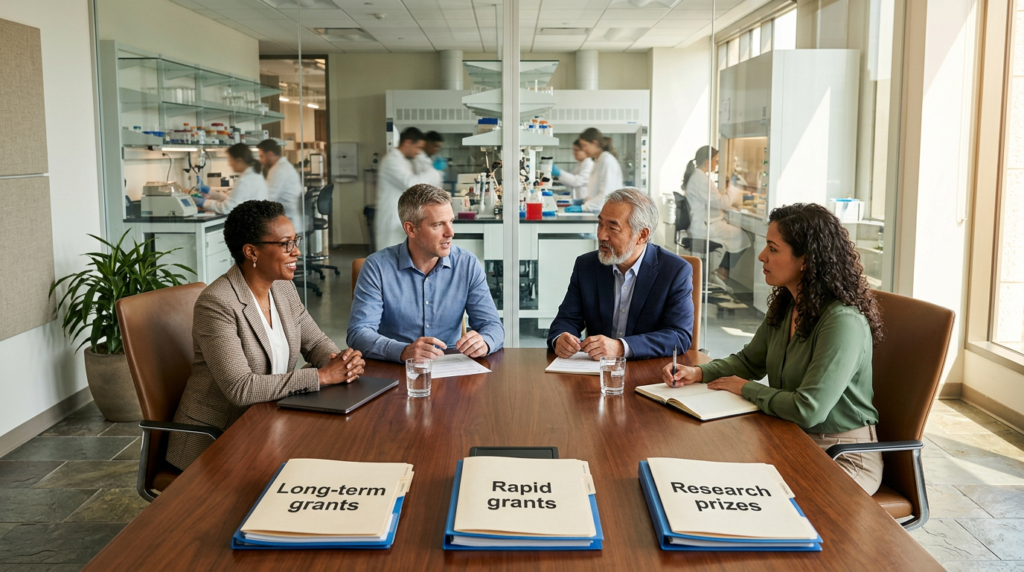
One of the document’s most interesting ideas has nothing to do with a chatbot. The ministers discuss how research gets funded.
They note the value of a mix of long-duration awards, rapid grants, prizes and challenges. Each serves a different purpose. A quick grant might help a team investigate a timely lead. A longer award might give scientists room to pursue a difficult question that needs years of work. A prize can invite several groups to tackle a defined problem.
The Kyoto Vision also welcomes metascience: the use of evidence to study and improve how science itself operates. Which funding approaches produce valuable work? What slows researchers down? How can institutions support rigorous studies without burying teams in paperwork?
AI tools may help scientists work faster, but administrative delays can still hold a project back. The declaration recognizes both sides of that problem.
It does not tell governments which grant system to adopt. It encourages them to test different approaches and learn from the results. That is a practical idea—provided future programs measure whether the changes actually help.
Research needs people who know the instruments
The vision gives a prominent place to young researchers and technical talent. It calls for early investment in promising students, more hands-on training, and opportunities such as joint doctoral programs and fellowships.
There is a good reason for the emphasis. Scientific equipment takes skill to operate and maintain. So do data systems and AI workflows. If an automated instrument produces an odd result, someone must understand whether the finding is exciting, the setup needs adjustment or a sensor has gone wrong.
That expertise rarely comes from reading a manual once. People gain it through practice, mentorship and repeated encounters with real experiments.
The declaration also encourages researchers to gain experience across scientific environments. A biologist, a computing specialist and an instrument technician may see different parts of the same problem. Working together can reveal questions none of them would have asked alone.
If governments want wider access to AI-powered science, training will have to reach beyond the teams that build models. The next generation of discovery will need people who can connect software to the physical work of research.
Access is the question beneath the excitement
An excellent AI tool cannot help a scientist who cannot use it. The Kyoto Vision therefore calls for broader access to models, scientific data, computing infrastructure and experimental facilities.
That is a substantial ambition. Research teams need different combinations of resources. One might have good laboratory equipment but limited computing capacity. Another may be able to analyze large datasets yet struggle to obtain the measurements needed to check a result.
Access also has to mean more than receiving a login. Researchers need suitable data, dependable tools, technical support and enough time to learn how to use them well. The declaration lists the ingredients, while leaving their delivery to future national decisions.
This is one place to watch for concrete progress. Governments could announce programs that let more researchers use computing facilities. Institutions could establish training partnerships or share access to equipment. Funders could support work that connects AI predictions to experiments.
Those examples are possibilities, not measures announced in Kyoto. The declaration’s success will become easier to judge when countries publish specific programs and researchers can say whether access has improved.
The United States already has a related effort
The Kyoto statement arrives alongside existing national programs. In the United States, the Department of Energy’s Genesis Mission brings its 17 national laboratories together with universities, industry and other partners to pursue AI-assisted research.
The department has described projects involving scientific data, advanced computing, AI systems and experimental facilities. That makes Genesis a useful example of the sort of infrastructure the Kyoto Vision discusses. It is a US program, though, rather than a new project created by the 17-country declaration.
Companies are active in this area too. Google DeepMind has said it is providing scientists at the US national laboratories access to its AI for science tools, beginning with its Co-Scientist system. The company describes that system as a way to develop and refine research hypotheses.
Such efforts show why the Kyoto discussion is timely. Researchers and governments already have tools to evaluate and programs to build on. The declaration asks participating countries to think about how those capabilities could become more useful across the scientific enterprise.
A vision still needs rigorous evidence
There is an appealing energy to the idea of quicker discovery. There is also a familiar scientific rule: exciting results need checking.
The Kyoto Vision explicitly calls for reproducible, transparent science. It says research should communicate error and uncertainty, undergo unbiased peer review, and treat negative or null results as valuable contributions. Those points apply whether an idea came from a person, an AI system or a collaboration between them.
Suppose a model proposes a new explanation for an observation. Researchers still need to inspect the data and methods. Other teams may need to repeat the experiment. If the idea fails, documenting that result can keep others from heading down the same unproductive path.
This matters even more when tools can generate candidate ideas quickly. A flood of suggestions is useful only if scientists have the means to sort them.
The declaration presents AI as part of a stronger research process. Its attention to integrity gives governments a standard against which to assess future programs: do they help scientists produce findings that other people can examine and trust?
A statement, with no shared price tag
The announcement is significant, but its practical limits are straightforward.
The White House says the United States and 16 other countries endorsed the vision. Japanese reporting from Kyoto also described the 17-country announcement. The published declaration sets out goals for institutions, AI access and talent.
It does not set a collective spending target. It does not identify a vendor that every country must use. It does not establish a joint international laboratory or give a deadline for reaching the goals.
That leaves the participating governments considerable freedom. It also makes the next stage more important than the signing moment. Will national agencies fund new research access? Will they test quicker grant processes? Will universities and laboratories gain the people and equipment needed to put AI-assisted work into practice?
Independent coverage has drawn attention to that gap between a common vision and funded action. The fair reading is that Kyoto has produced an agreement on direction. The scale and effect of what follows remain open questions.
What to watch after the photographs
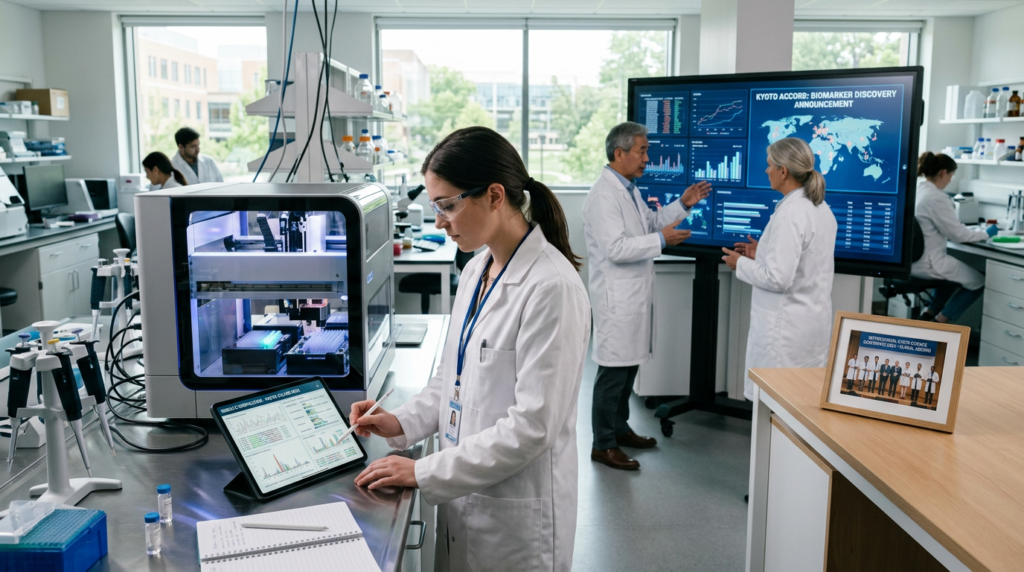
Declarations make a good photograph: officials together, a title on the page, a promise of discoveries ahead. The useful test comes later.
Watch for named programs, budgets and eligibility rules. Watch for researchers gaining access to computing resources and experimental facilities. Watch for training opportunities that let early-career scientists work across disciplines. Most of all, watch for published results that can be reproduced.
The Kyoto Vision gives governments three connected tasks: improve the systems that support research, make advanced AI useful to scientists, and invest in the people who will do the work. None is simple. Together, they could change how quickly a good idea reaches a well-designed experiment.
For now, the 17-country endorsement is a starting point. It shows broad interest in using AI to help science move forward and in making the research process itself work better.
The next discovery will still require a scientist willing to ask a sharp question—and the time, tools and evidence to find out whether the answer is real.
Sources
The Kingy Brief
Get future Kingy Brief editions.
Source-checked AI changes, original tests and one practical thing to try.
Free · Choose your subjects · Double opt-in · Unsubscribe anytime
Regular sending is paused; no restart date is set.
Privacy policy
Load subscription form
Sign up for future editions
AloJapan.com