

Dhaka:
Bangladesh may have a timely opportunity to rebuild its Japanese tourism market
as geopolitical disruptions limit travel options elsewhere in Asia and Japanese
travelers look for new destinations, according to Md Masud Hossain, Managing
Director of Bengal Tours Ltd.
Hossain,
whose company has specialized in the Japanese market for more than two decades,
said while talking to The Bangladesh Monitor that Bangladesh already has many
of the ingredients needed to attract Japanese visitors but needs a coordinated
promotional campaign before competing destinations regain momentum.
“I
started working with the Japan market from 1990-91, and Bengal Tours started
working from 1999. Japan has always been our main market,” Hossain
mentioned.
 Md Masud Hossain
He
claimed about 70-75 percent of Bengal Tours’ inbound customers are currently
Japanese. Yet the market remains far below its earlier potential. In 2025-26,
the company handled around 700 Japanese travelers, compared with more than
7,000 a year around 2012-13.
According
to Hossain, political instability, the 2016 Holey Artisan attack, the Covid-19
pandemic and subsequent political uncertainty repeatedly disrupted demand. Each
time, however, Japanese interest showed signs of returning. Now, he believes
the timing is different.
Unrest
in parts of the Middle East, continuing uncertainty in several traditional
destinations and limited travel options in countries such as Pakistan, Iran and
Iraq are prompting Japanese travelers to reconsider where they can go, Hossain
expressed.
His
counterparts in Japan are already asking for new Bangladeshi tourism products,
including destinations, cultural events and festivals that could be marketed to
Japanese customers.
“That
is why I think this is the right time to promote Bangladesh among Japanese
people,” he expressed. “If we start promotion now, we will see the
results after a year or two. So we should start now.”
A
market Bangladesh already understands
One
of Bangladesh’s biggest advantages is that Japan is not an entirely new market.
Hossain
said Japanese travelers have historically accounted for more than half of
Bangladesh’s leisure-tourism arrivals, making the country’s tourism operators
familiar with their preferences and spending patterns.
The
market is also relatively accessible geographically. Bangladesh is closer to
Japan than destinations in Europe or North America, while direct air links can
shorten travel time.
The
return of Biman Bangladesh Airlines’ Japan service is therefore particularly
important, Hossain further mentioned. He expects additional frequencies
and new aircraft to improve connectivity.
He
argued that Biman should eventually operate at least two or three weekly
flights to Japan, saying the route has previously demonstrated its ability to
generate group traffic.
“When
Biman stopped Japan flights, I lost groups totaling 150 travelers,” he
added. “We had tourists on almost every flight, with 10 to 15 people in
each group.”
Hossain
also sees an opportunity to create stopover packages for Japanese passengers
traveling through Dhaka to other destinations, including short two-night,
three-day programs.
Bangladesh
already has products to sell
Hossain
also claimed Bangladesh does not need to invent an entirely new tourism
proposition for Japan. Several established products are already suited to the
market.
The
country’s three UNESCO World Heritage Sites – Paharpur, the Sundarbans and the
Historic Mosque City of Bagerhat – are particularly attractive.
Bengal
Tours already sells a roughly seven-day itinerary combining those destinations
with Dhaka, and Hossain described it as one of the easiest Bangladesh products
to market in Japan.
Japanese
visitors are also interested in Buddhist archaeology, rural life, village
communities, wildlife, birdwatching and nature.
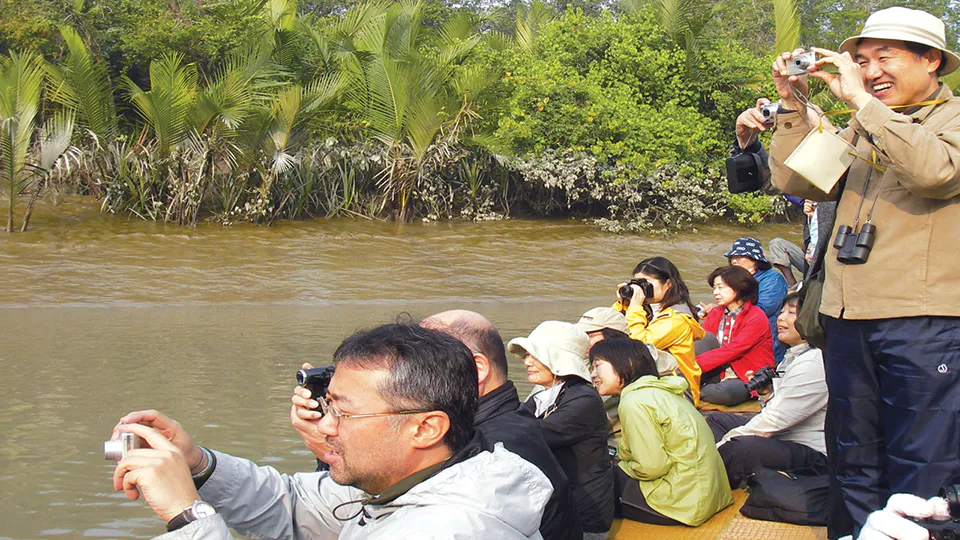 Japanese holidaymakers enjoying Bangladesh’s greenery from a boat
Sylhet
could become another important product, he also mentioned, although better
connectivity is needed. The Chittagong Hill Tracts also attract interest, but
security and operational challenges currently limit their use as a mainstream
tourism product.
Festivals
and cultural events could provide another avenue for growth.
Hossain
noted Japanese tour operators are increasingly asking about events around which
they could build specialized tours. He believes Bangladesh should begin with
established products before gradually expanding into river tourism and other
experiences as infrastructure and safety arrangements improve.
Price
remains a major obstacle
Despite
the opportunity, Bangladesh has a significant disadvantage: cost.
Hossain
further expressed a weeklong Bangladesh tour can be more expensive than
comparable trips to India, Nepal or Sri Lanka because both airfare and ground
costs are relatively high.
Air
connectivity is particularly important.
He
mentioned China Southern offers convenient daily connectivity but at relatively
high fares, while Cathay Pacific can offer competitive pricing but operates
fewer weekly flights. Biman has the advantage of nonstop service but limited
frequency.
Thai
Airways and Malaysia Airlines provide additional options, but longer transit
times can make them less attractive to Japanese travelers.
Hossain
believes Biman and the tourism industry need to work together on group fares
and packaged products. He also suggested promoting Bangladesh tour packages
through Biman’s inflight magazine and other passenger-facing channels.
“Biman
and us are both suffering because group prices are not being offered,” he
said.
Promotion
needs to move to Japan
For
Hossain, the biggest missing piece is not demand but marketing.
He
expressed Japanese tour operators frequently approach Bangladeshi companies
when they need information, but Bangladesh has rarely taken the initiative to
visit and cultivate those operators.
He
wants tourism authorities and private companies to jointly organize roadshows,
business-to-business meetings and familiarization trips for Japanese operators
that already sell neighboring destinations but do not yet sell Bangladesh.
The
strategy would need to recognize that Japan is not a single market. Some
customers spend USD 1,200-USD 1,400 on a weeklong trip, while others look for
packages costing around USD 400.
“We
need to prepare our products accordingly for all,” Hossain also claimed.
He
also wants Bangladesh to increase its visibility in Japanese media through
travel programs, broadcasters such as NHK and TBS, and influential travel
bloggers.
A
window that may not remain open
Several
developments are now creating favorable conditions for Bangladesh. Hossain
pointed to improving Bangladesh-Japan government relations, renewed activity by
Japanese businesses and the return of JICA volunteers who had previously left
after the Holey Artisan attack.
A
Japanese Globe-Trotter travel guidebook on Bangladesh is also being published
again after roughly a decade, another development he believes could help revive
awareness.
For
Hossain, these factors make the current period particularly important.
He
argues that Bangladesh has already identified its Japanese customers,
understands their preferences and has tourism products that can be sold to
them. What remains is a coordinated effort to put those products in front of
the right people.
“Japan
has always been positive regarding us,” he concluded. “So it is up to
us how much we are willing to grab them.”
AloJapan.com