
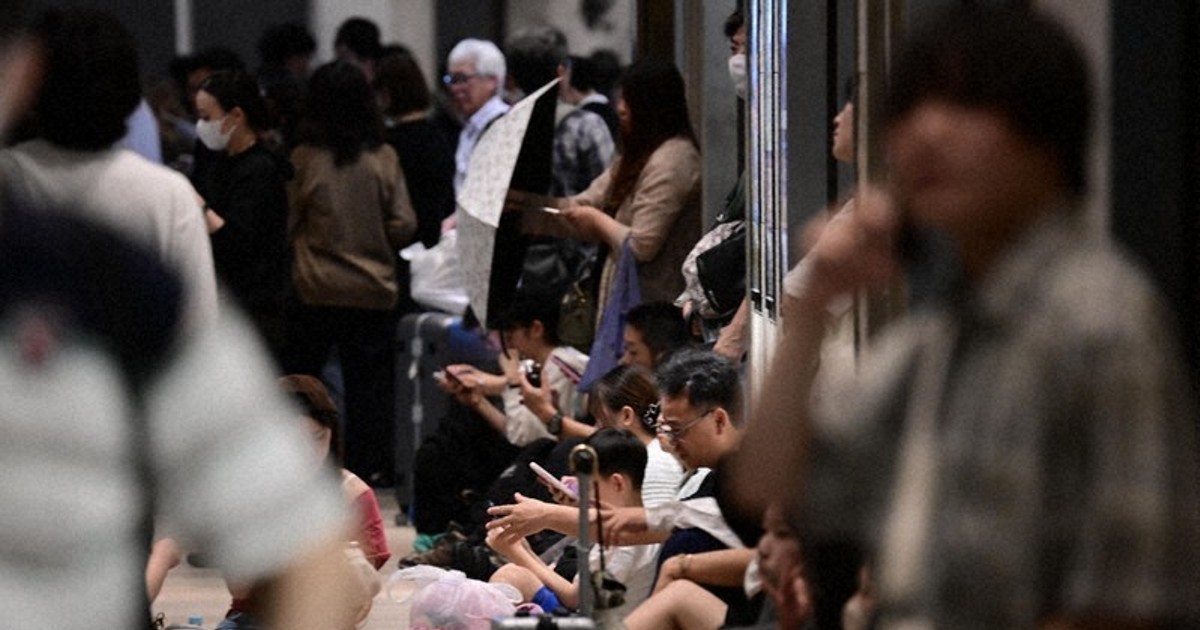

People sit inside JR Chiba Station after train services were suspended due to torrential rain in the city of Chiba’s Chuo Ward on Aug. 13, 2026. (Mainichi/Tatsuya Fujii)
CHIBA — One month has passed since torrential rain in Chiba Prefecture killed 13 people. Since then, intense downpours have continued to strike Japan, prompting the issuance of Heavy Rain Emergency Warnings, the country’s highest-level alert, in regions including Hokuriku and Tokai in central Japan.
How should people prepare for rainfall that authorities and experts say exceeds what had previously been anticipated?
Heavy rain that hit urban areas in Chiba and Aichi prefectures disrupted transportation networks and city functions, leaving many people stranded and unable to get home. Numerous vehicles were also submerged on flooded roads. The national government and disaster experts are urging people not to travel unnecessarily during emergencies.
An analysis of smartphone location data in the center of the city of Chiba during the Aug. 13 storm showed that people continued moving about even after an Emergency Warning was issued. The data, provided by Agoop Corp., a SoftBank Corp. subsidiary, was aggregated from users of certain smartphone applications and processed so that individuals could not be identified.
Traffic on major roads remained heavy during the hour from 5 p.m. on Aug. 13 before easing somewhat in the following hour. The city of Chiba issued an emergency safety assurance notice for some areas at 7:53 p.m., urging residents to take immediate action to protect their lives. However, after the rain weakened around 8 p.m., the movement of both vehicles and people increased. Travel between the city center and surrounding suburbs was particularly noticeable, and activity between midnight and 2 a.m. on Aug. 14 exceeded levels recorded during the same period a week earlier.
Junji Urata, an associate professor at the University of Tsukuba who specializes in evacuation behavior during disasters, said many people may have been driving to pick up family members or others.
“If the person you are trying to pick up is in a safe place and you are able to stay in contact with them, it is better to have them remain where they are and refrain from driving,” Urata said.
Nighttime driving during heavy rain poses risks because visibility is poor and cars can be inundated on roads in low-lying areas.
To prepare for situations in which people are unable to return home, the government recommends carrying food, water and backup batteries for mobile phones, and checking the locations of temporary shelters in advance.
Following the Chiba floods, authorities also urged drivers not to travel unnecessarily when Heavy Rain Emergency Warnings are in effect but instead wait in a safe location until conditions improve. People are advised to avoid underground facilities and underpasses, which can flood rapidly during intense rainfall. Keeping a hammer in a vehicle to break a window and escape in an emergency is also recommended.
Urata warned that “normalcy bias” often leads people to underestimate the danger they face and assume they will be safe, causing them to delay evacuation.
“Obtaining appropriate information and making sound decisions can be difficult while driving,” he said. “People should question their own assessment of risks and prioritize their own safety.”
(Japanese original by Yuta Hiratsuka, Chiba Bureau)
AloJapan.com