
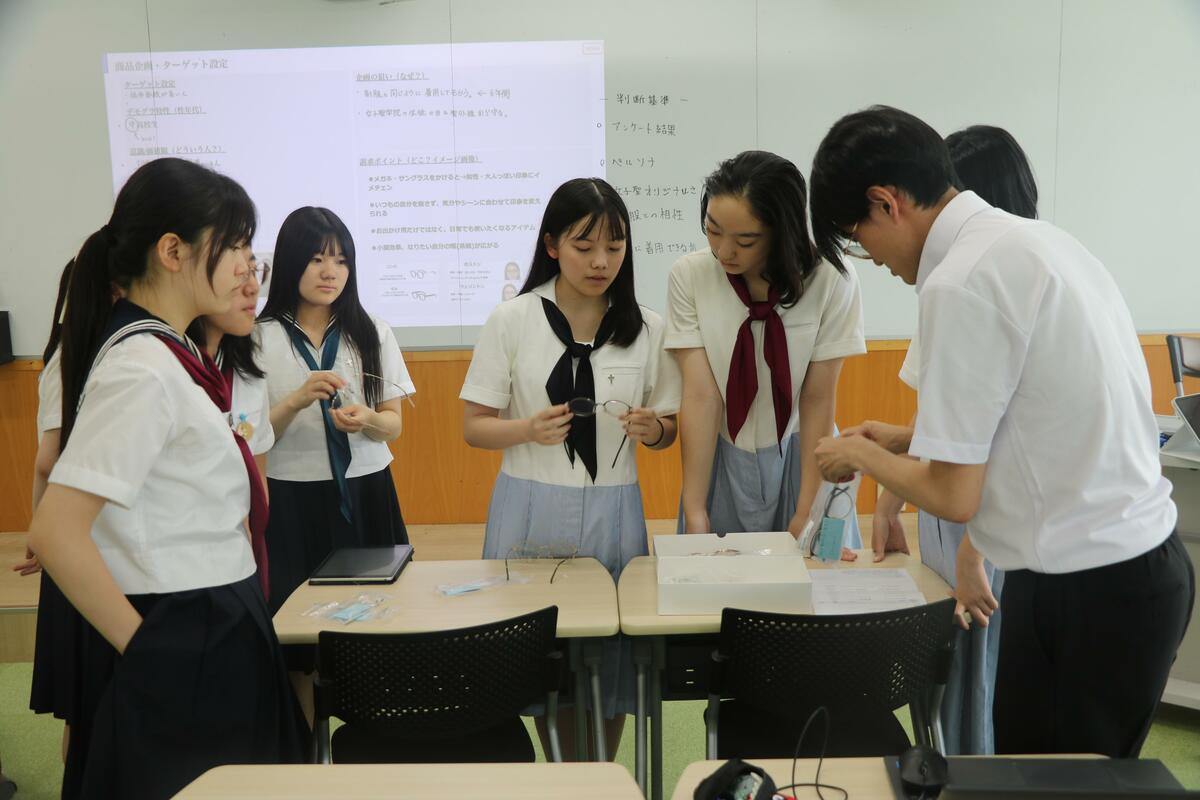
TOKYO – As strong August sunlight beat down outside, seven students at a private girls’ secondary school in Tokyo gathered around a classroom table, picking up and comparing several pairs of sunglasses to see which shapes and colors would best suit their school uniform.
The students, members of an industry-school project focused on protecting the eyes from ultraviolet rays, were helping develop an original pair of sunglasses for Joshi Seigakuin Junior & Senior High School as part of an effort to make eye protection a more routine part of school life.
For the students, one hurdle is the image sunglasses still carry in Japan, where they are often seen more as a fashion accessory or a way to stand out than as a means of protecting the eyes.
Despite the growing risk of eye damage from increased UV exposure, the rate of sunglasses use in Japan remains low, at 28.1 percent in 2026, far below rates of 60 to 70 percent in the United States and Europe, according to eyewear retailer Intermestic Inc. The figure for students in Japan aged 6 to 17 is even lower, at 15.8 percent.
A first-year senior high school student involved in the project said she had initially felt embarrassed about wearing sunglasses at school. To her they were associated with wealthy people or those trying to look intimidating.
Joshi Seigakuin has sought to change that common perception. In October 2025, it became the first among junior or senior high schools in Japan to officially allow students to wear approved sunglasses at school, according to the Tokyo-based company.
The school also plans to introduce its own model as an optional uniform item from the 2027 academic year, with its 18-member student project team working with the company’s eyewear brand Zoff to develop the original sunglasses.
For a 17-year-old student who is one of the project leaders, eye health is also a personal concern. She underwent eye surgery as a child and spent about three months in hospital, an experience she said made her realize the importance of protecting her eyes and motivated her to join the project.
The student said the biggest challenge in moving the project forward has been reconciling different tastes. Younger students tended to favor brighter colors, while high school students often preferred black or other more subdued designs.
Naoki Okamura, the physical education teacher who proposed the initiative, said the school’s rules had never specifically prohibited sunglasses. The school moved to formally introduce them after holding eye-health lessons, inviting an eye expert to speak and having students try them in daily school life.
In considering what kind of sunglasses would be suitable for school life, students and teachers agreed on a lens tint of no more than 20 percent so that a wearer’s eyes and facial expressions would remain visible, Okamura said.
Students mainly wear sunglasses while commuting and during outdoor activities. Okamura said he would like to encourage their use during sports such as tennis, while taking safety into account depending on the activity.
Joshi Seigakuin’s effort comes as more schools in Japan consider allowing sunglasses as a health measure amid growing concern over UV-related eye damage.
Six eye-health organizations acknowledged in August that protecting students’ eyes from UV rays is important, while noting there is insufficient medical evidence to support a blanket recommendation that students wear sunglasses throughout the school day.
The organizations, including the Japanese Ophthalmological Society, said in a joint statement that sunglasses may be useful for students who spend long periods outdoors and called for a case-by-case approach.
Japan Meteorological Agency data point to a long-term rise in UV exposure. In Tsukuba, northeast of Tokyo, where the agency has maintained a continuous long-term UV observation record, the annual cumulative amount of UV radiation reaching the ground increased by about 18 percent between 1990 and 2025.
Days with particularly strong UV radiation have also become more common. The number of days when the maximum UV Index reached 8 or higher in Tsukuba rose to 70 in 2025 from 27 in 1990. A UV Index reading of 8 to 10 is classified as “very high,” with people advised to limit outdoor exposure during the daytime.
Intermestic says it is working with 30 schools nationwide on introducing sunglasses as a means of eye protection, including those running trial programs. Of the 30, 13 have formally allowed students to wear them.
The school initiative, launched in spring 2025, is part of a broader company effort with educators, businesses and other groups to promote eye health.
The company says inquiries about allowing students to wear sunglasses at school have increased since the initiative began.
“Sunglasses have yet to become widespread among young people, even though they are the age group that should be taking particular care to protect their eyes from ultraviolet rays,” said Miho Yamada, an Intermestic spokeswoman.
“We aim to expand the project to 4,000 schools by 2030,” she said.
Ophthalmologist Misaki Ishioka of Misaki Eye Clinic in Tokyo said the effects of ultraviolet radiation depend largely on the amount and duration of exposure.
“What matters is how much ultraviolet radiation you are exposed to and for how long,” she said, adding that strong exposure can cause acute symptoms such as redness, pain and inflammation on the surface of the eye.
Ishioka said protection is especially important for students who spend long periods outdoors, including at sports days and during activities such as baseball, as well as those whose eyes are more prone to redness or pain in strong sunlight.
At Joshi Seigakuin, the students hope the sunglasses will eventually become a natural part of everyday school life, something their schoolmates will feel comfortable reaching for when they need them.
“We want to make sunglasses that everyone at the school will want to wear, rather than something only a small number of students use,” the 17-year-old student said.
AloJapan.com