
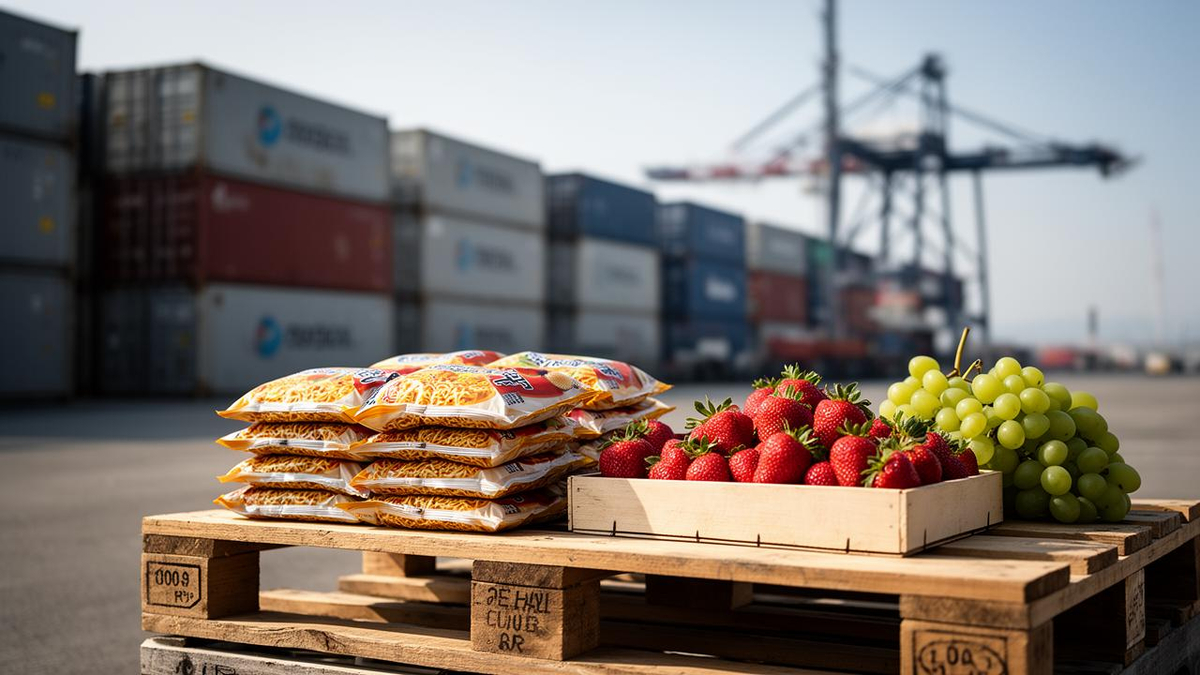
South Korea’s agri-food exports surpassed $10 billion (approximately 13.6 trillion won) in just 253 days this year — 19 days faster than the previous record. The milestone reflects a broadening global consumer base for K-food, with growth spanning not only processed products like ramen and seasoned laver but also fresh produce such as strawberries and grapes.
According to data released by the Korea Agro-Fisheries & Food Trade Corp. (aT) on the 14th, this year’s agri-food exports crossed the $10 billion threshold at a faster pace than the same period last year. Since first surpassing the $10 billion mark in 2021, the achievement date has been moving earlier each year.
By country, the United States — South Korea’s largest export destination — recorded $1.81448 billion (approximately 2.5 trillion won), up 12.9%, while China reached $1.66966 billion (approximately 2.3 trillion won), up 14.0%. Growth in emerging markets was particularly striking. Exports to the United Arab Emirates surged 49.9% to $331.71 million (approximately 450 billion won), and the Netherlands rose 14.4% to $229.55 million (approximately 310 billion won).
By product category, ramen posted the largest growth, climbing 27.2% year-over-year to $1.3076 billion (approximately 1.8 trillion won). The increase is attributed to a combination of factors: the global spread of Korean content, growing interest in Korean-style spicy flavors, and expanded local distribution networks.
Fresh produce also showed remarkable momentum. According to Korea Agricultural Trade Information (KATI) data, strawberry exports reached $59.74 million (approximately 81 billion won) in the January–July period, up 15.8%, while grapes and Korean melons rose 34.4% and 7.0%, respectively. Strawberries gained added value through premium varieties, while grapes expanded overseas demand led by the Shine Muscat variety.
On an annual basis, strawberries rose 15.5% to $60.98 million (approximately 83 billion won), and grapes surged 64.6% to $45.18 million (approximately 61 billion won). In seafood, seasoned laver — dubbed the “black semiconductor” — increased 8.0% to $462.65 million (approximately 630 billion won), while oysters rose 8.2% to $65.6 million (approximately 89 billion won).
Export performance by major product is as follows:
ProductExport ValueYoY GrowthRamen$1.3076 billion27.2%Seasoned Laver$462.65 million8.0%Strawberries (annual)$60.98 million15.5%Grapes (annual)$45.18 million64.6%Oysters$65.6 million8.2%
Note: Strawberries and grapes are on an annual cumulative basis; ramen, seasoned laver, and oysters are on a year-to-date basis.
The South Korean government and aT plan to continue second-half support policies aimed at achieving record export performance this year. They will identify strategic products tailored to regional consumption characteristics in markets such as the United States and ASEAN, and support expanded exports of fresh grapes. Logistics infrastructure will also be strengthened through a multi-purpose logistics center in Vietnam and a joint cold-chain logistics initiative in the Middle East.
Efforts to address non-tariff barriers are also underway. In preparation for the European Union’s packaging regulations and Indonesia’s mandatory halal certification, a one-stop export support system involving 15 relevant agencies will be operated.
“This early achievement of $10 billion demonstrates that K-food exports are growing,” said Jeon Ki-chan, aT’s Export Food Director. “We will expand export products and markets so that interest driven by the popularity of Korean content translates into repeat purchases by local consumers, rather than remaining a temporary phenomenon.”
Overseas consumer interest in K-food continues to grow in tandem with the spread of the Korean Wave. According to the “2026 Overseas Hallyu Survey” released in March by South Korea’s Ministry of Culture, Sports and Tourism and the Korean Foundation for International Cultural Exchange, 69.7% of 27,400 people across 30 countries who had experienced Korean cultural content responded positively. Respondents identified food (55.1%) as the most popular Hallyu category in their countries. The proportion who had actually tried Korean food stood at 78.0%, surpassing film (77.9%), drama (72.9%), and music (71.9%).
AloJapan.com