

Vertexforce.jp
On September 11, Anime News Network confirmed that Vertex Force, the original mecha anime from Strike Witches director Kazuhiro Takamura, will make its broadcast premiere on October 3, 2026, at 11:30 p.m. JST on Tokyo MX, BS11, Gunma TV, and Tochigi TV, with streaming to follow on U-NEXT and other Japanese services. The announcement confirmed the full main cast alongside a second promotional video. The premiere is 22 days away.
What has received less attention is what the show’s production materials already imply about what kind of anime Vertex Force actually intends to be — before a single episode has aired. The evidence is in the credit designations, the setting, the tagline, and a specific worldbuilding departure from every other entry in the “cute girls plus mecha” genre. Together, they describe a production that is doing something structurally unusual: using a genre associated with entertainment spectacle to encode a set of biological, historical, and philosophical arguments whose supporting evidence is already sitting in the research literature.
The show’s official tagline is: “The correct answer will destroy the world.” That is not a mystery-box tease. It is a thesis statement delivered before Episode 1 airs.
Vertex Force: What the Show Is Actually About
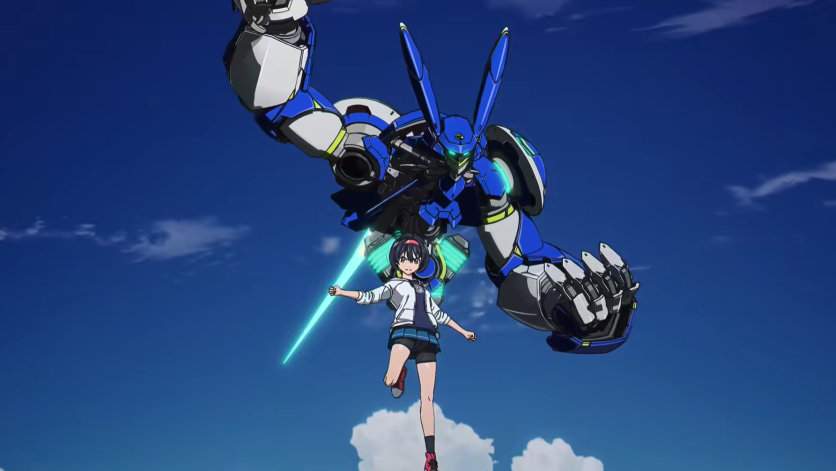
Akira Tōdō is a 13-year-old boy living a quiet life in northern Okinawa alongside his older sister Haruka and their mother, who runs a café. The family carries a secret. Haruka, 16 and described in official promotional materials as guileless, energetic, and physically gifted, has inherited a power called “Engine” from their father — a force she conceals from the world. Akira did not inherit it. He carries an inferiority complex that goes to the show’s emotional core: always needing to be protected by his older sister, in possession of a strong sense of justice and no equivalent capability. Then an unknown enemy — ENIA — begins appearing around the world, and the fate of the universe tilts toward the siblings in Okinawa who have been carrying this secret.
What “Engine Designer” vs. “ENIA Design” Actually Means
Most mecha anime list one or two mechanical designers and move on. Vertex Force lists two — with different credit titles that signal two distinct design ontologies rather than a division of labor on the same vocabulary.
Kanetake Ebikawa is credited as “Engine Designer.” Ebikawa’s career spans Mobile Suit Gundam 00, where he designed the GN Drive units — machines whose power source was framed as exotic physics rather than conventional propulsion — through to Mobile Suit Gundam: The Witch from Mercury. JNTHED holds the separate credit “ENIA Design.” JNTHED’s most recent prominent work was the Gundam Aerial in The Witch from Mercury, a unit specifically designed to imply quasi-emotional bonding between machine and pilot through the GUND-format interface — a system framed in that show as biological integration rather than mechanical piloting.
The credit division tells the reader something before any episode airs: Ebikawa’s grammar is hard mass and physical grounding; JNTHED’s is organic hybrids and implied intimacy between system and user. Protagonist units in one visual language; enemy units — or a separate mecha category — in the other. When a production assigns separate designers to separate categories rather than distributing the work of a single unified vocabulary, it is indicating that the two things do not share the same nature. The ENGINE and the ENIA are not the same kind of thing.
Biology Is the Weapon: Epigenetics and the ENGINE’s Inheritance
Most mecha anime solve the problem of who gets to be special through hardware: the right machine, the right training, the right cockpit. Vertex Force eliminates that solution at the premise level. The ENGINE is not a vehicle Haruka wears. According to the official synopsis, it was transmitted to her by her father. Her brother did not receive it. The power was latent until crisis arrived.
This is a precise fictional analog for what biologists call transgenerational epigenetic inheritance (TEI) — the transmission of epigenetic information across generations, surviving the meiotic reprogramming event that normally wipes the slate between parent and offspring. Epigenetic changes alter gene expression without altering the underlying DNA sequence — through mechanisms including DNA methylation, histone modification, and non-coding RNA — and the standard model holds that these marks are reset during the formation of egg and sperm cells, so that each generation begins fresh. TEI occurs when this reset is incomplete.
Research has documented TEI in mammals across multiple experimental frameworks. Studies in rodents have shown stress-induced methylation changes, dietary exposure responses, and fear-conditioned associations persisting across multiple generations. A 2023 Cell study tracked an engineered epigenetic mutation across four generations of lab-bred mice, finding evidence of the alteration in each subsequent generation. Evidence in humans includes cohort studies of the Dutch Hunger Winter and Holocaust survivor offspring, which documented multi-generational physiological and psychological effects with epigenetic signatures in descendants.
The ENGINE’s selective expression in Haruka but not Akira is consistent with a mechanism called sex-limited penetrance: a trait encoded at the epigenomic level in both biological sexes, but phenotypically expressed only in one, because expression requires interaction with an X-chromosome modifier region. Under this model, Haruka (XX) carries two copies of the modifier allele and crosses the activation threshold; Akira (XY) carries one copy and does not. X-linked modifier systems governing trait penetrance are documented in humans and model organisms. The show has made its fictional genetics coherent without making them mundane.
The worldbuilding consequence is significant. A system that is biological rather than technological forecloses the standard mecha resolution: Akira cannot train harder, find a different unit, or acquire the right equipment. The exclusion is physiological. His inferiority complex is not a failure of will — it is an accurate perception of a constitutive biological fact. That is a darker and more honest premise than most entries in the genre allow.
The External Engine: Why Its Spatial Position Matters to the Brain
Promotional visuals and the design credit structure indicate that the ENGINE does not encase Haruka in a cockpit. It manifests externally, in the space behind and around her body. The show’s production team has reportedly compared this to the “Stand” combat system from Hirohiko Araki’s JoJo’s Bizarre Adventure — spiritual or psychic manifestations that project into combat space from within the user’s immediate spatial zone.
The spatial specificity — behind the body, in the immediately surrounding zone — is, from a neuroscientific standpoint, precise.
Human brains do not model the body as stopping at the skin. The peripersonal space — the zone extending approximately arm’s length in all directions from the body’s surface — is represented in multisensory neurons in the premotor and parietal cortices that fire to stimuli near the body as if they were stimuli on the body. This zone is treated as an extension of the self: threats entering it trigger defensive responses earlier and more automatically than threats at farther distances.
Matthew Botvinick and Jonathan Cohen’s 1998 paper in Nature established the Rubber Hand Illusion as the canonical experiment for body schema plasticity: when a person observes a rubber hand being stroked at exactly the same time as their own hidden hand, they adopt the rubber hand as their own within minutes. More recent work has documented that this incorporation is limited by peripersonal boundaries — the illusion breaks down when the fake hand is moved too far from the body, because it exits the zone the brain treats as self.
Brain-computer interface research has extended these findings: between 15 and 30 percent of users cannot achieve effective BCI control regardless of training duration, and this variation correlates with heritable differences in cortical architecture — including gray matter volume in sensorimotor areas and the capacity to modulate sensorimotor rhythms. The phenomenon is called BCI inefficiency, and its neurophysiological basis is increasingly understood as constitutive rather than trainable. Multiple peer-reviewed studies document this finding, including BCI research published on arxiv and subsequent work in specialist journals.
An ENGINE that emerges from behind Haruka and operates in her peripersonal zone is not a remote vehicle. Under the show’s fictional logic, it would be represented by the brain as part of the self — something the motor system manages rather than operates. Akira’s inability to access the ENGINE is the narrative analog of BCI inefficiency: the absence of a specific neurological substrate, not a failure of character.
Okinawa Is Not a Backdrop: Setting as Structural Argument
Every Takamura anime before Vertex Force has been set in an abstracted or fictionalized geography. Strike Witches occupies a parallel-history WWII Europe with altered nation names; Vividred Operation takes place in a future Japan that is specifically not contemporary Okinawa. The choice to anchor Vertex Force in northern Okinawa — a specific, named real location — marks a significant shift in Takamura’s worldbuilding methodology, and it is not a neutral one.
Northern Okinawa sits within a prefecture that comprises approximately 0.6 percent of Japan’s total land area yet hosts over 70 percent of U.S. military facilities in Japan. Kadena Air Base, located on the island’s central plateau, is the largest U.S. air installation in the Indo-Pacific. Yonaguni, Okinawa Prefecture’s westernmost island, is approximately 110 kilometers (68 miles) from Taiwan — positioning the prefecture as the forward edge of any Indo-Pacific security contingency.
Before Okinawa was Okinawa, it was the Ryukyu Kingdom — an independent maritime trading state that maintained simultaneous tributary relationships with Ming China and the Japanese Satsuma domain from 1609 onward, then was formally annexed by the Meiji government in 1879. The annexation — the Ryūkyū shobun — imposed assimilation policies that suppressed the Ryukyuan language (Uchinaaguchi), the noro shamanic religious tradition, and other cultural practices. In 1945, the Battle of Okinawa produced a civilian death toll estimated between 40,000 and 150,000 — one of the highest civilian casualty rates of any Pacific War campaign. American occupation ran from 1945 to 1972, when administrative control returned to Japan while the military presence remained and expanded.
University of Connecticut historian Alexis Dudden, who has written extensively on Okinawan colonial history, has described the current situation this way: “The question of who’s occupying whom right now is really at the fore in Okinawa today.”
A secret power transmitted as a family inheritance across generations of suppression — hidden from dominant institutional structures, preserved privately, becoming legible as a critical capability at the moment of civilizational threat — is structurally parallel to Ryukyuan cultural memory. A distinctive inherited capability, preserved through families under successive occupying structures, now needed by the very entities that displaced those families. Whether Takamura intends this parallel explicitly, it is operative in the premise. Vertex Force is, structurally, the first Takamura production that cannot be politically neutralized by relocating to a fictional geography. The setting is the argument.
“The Correct Answer Will Destroy the World”
The tagline 「”正解”は、世界を壊す」 is not a promotional hook. It is a formally stated tragic dilemma — a scenario in which the course of action that satisfies all available rational and moral criteria nonetheless produces catastrophic harm.
The philosophical tradition behind this structure is old and specific. Bernard Williams analyzed it in “Moral Luck” (1981), arguing that constitutive luck — what kind of person you are, what capacities you were born with — is morally relevant in ways that Kantian ethics cannot accommodate. Martha Nussbaum extended this in “The Fragility of Goodness” (1986), reading Greek tragedy as a sustained argument that a well-lived life is structurally vulnerable to external forces that no rational planning can eliminate. The tragic figure is not weak-willed or confused; they are structurally incapable of honoring all legitimate claims simultaneously.
In anime, the structure was deployed most influentially by Neon Genesis Evangelion (1995): Shinji Ikari’s “correct” action of piloting Unit-01 is simultaneously the cause of Third Impact. The show told its audience what the price was going to be and then charged it anyway.
Vertex Force announces its thesis before a single episode airs. The tagline commits the writers to a resolution that cannot be fully satisfying — any resolution will cost something real. This is a different structural commitment from a show that merely involves difficult choices.
In Okinawa, this has not been hypothetical. The “correct answers” of successive security architectures — Allied liberation in 1945, American basing from 1945 to 1972, the U.S.-Japan mutual defense treaty maintained continuously since — have each imposed costs borne specifically and disproportionately by Okinawa’s population: civilian death in the Battle, land seizure during occupation, noise pollution and incident exposure from base operations extending to the present. A show set in northern Okinawa, structured around a tragic dilemma in which the correct answer destroys the world, is not making an abstract philosophical argument.
Confirmed Cast and Premiere Details
Premiere: October 3, 2026, at 11:30 p.m. JST on Tokyo MX, BS11, Gunma TV, and Tochigi TV. Streaming on U-NEXT and other services in Japan.
Director: Kazuhiro Takamura (Strike Witches, Vividred Operation), who also designed the characters and is co-composing the series scripts alongside Masashi Suzuki (Lord of Vermilion: The Crimson King).
Assistant Director: Gorō Kuji (Chained Soldier, Peleliu: Guernica of Paradise).
Engine Designer: Kanetake Ebikawa (Mobile Suit Gundam 00, Mobile Suit Gundam: The Witch from Mercury).
ENIA Designer: JNTHED (Mobile Suit Gundam: The Witch from Mercury, 2022 Urusei Yatsura).
Chief Animation Director: Masahito Onoda (Brave Witches, Strike Witches: Road to Berlin).
Music: Nobuaki Nobusawa (Clevatess, Astra Lost in Space).
Animation Studio: SMDE.
Main Cast:
Makoto Koichi as Akira Tōdō (13 years old; described in official promotional materials as having a strong sense of justice, does not inherit the ENGINE)Kaede Hondo as Haruka Tōdō (16 years old; ENGINE bearer, hides the power from the world)Ami Koshimizu as Eleanor Northbrook (American-born; described as competitive and hardworking)Megumi Han as Lala Zudenstein (Swiss-born; described as calm, aspires to become a watchmaker)Rie Takahashi as Yōko Nishina (from Hokkaido; described as kind-hearted, carrying undisclosed trauma)Frequently Asked QuestionsWhat is the ENGINE in Vertex Force, and why does only Haruka have it?
According to the official synopsis, Haruka inherited the ENGINE from her father; her brother Akira did not. The show does not explain the mechanism before Episode 1 airs, but the inheritance pattern — transmitted biologically, not through training or hardware acquisition, expressed in one sibling but not the other — maps precisely onto what biologists call sex-limited epigenetic penetrance: a heritable trait encoded in both individuals but phenotypically active only in one, due to differences in modifier gene interactions. Whether the show pursues this logic explicitly remains to be seen after October 3.
Is Vertex Force a typical entry in the “cute girls plus mecha” genre, or is it doing something different?
The genre credentials are real — Takamura directed Strike Witches, the paradigm case — but the structural departures are significant. The ENGINE is biological, not technological hardware, which forecloses the usual resolution path (train harder, find a better unit). The male sibling protagonist’s exclusion is constitutive rather than temporary. The official tagline announces a tragic dilemma rather than a heroic journey. And the show is set in a real, historically overdetermined geography for the first time in Takamura’s career, which means the premise’s implications about inherited capability and the cost of planetary defense are not politically neutral the way they would be in a fictionalized setting.
Does setting the show in Okinawa carry political weight, or is it just a picturesque location?
Northern Okinawa carries approximately 600 years of layered sovereignty history: independent Ryukyu Kingdom until 1879, Meiji colonization, the Battle of Okinawa (with an estimated 40,000–150,000 civilian deaths), U.S. occupation until 1972, and a continuing military presence that accounts for more than 70 percent of U.S. facilities in Japan on 0.6 percent of Japan’s land. A story set there about an inherited secret power that a family has concealed across generations — which becomes critical to planetary defense at the moment of civilizational crisis — is, structurally, a story about Ryukyuan cultural memory. The setting is doing work that a fictional location would not do.
Who are the mechanical designers, and why does it matter that two different people hold different credit titles?
Kanetake Ebikawa holds the credit “Engine Designer” (protagonist mecha); JNTHED holds “ENIA Design” (the enemy or opposing mecha category). Ebikawa’s background in Gundam 00 and Gundam: The Witch from Mercury produces hard-surface, physically grounded mecha that read as real machines. JNTHED’s Gundam Aerial was explicitly designed to imply emotional bonding between the unit and its pilot — biological integration rather than mechanical control. The fact that the two designers are given separate credits for separate design ontologies suggests the ENGINE and ENIA are not the same kind of thing, which may bear directly on the show’s stated theme of a correct answer that destroys the world.
AloJapan.com