
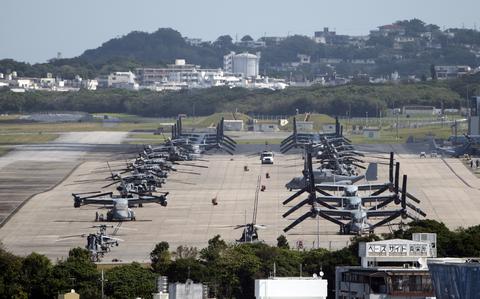

Marine Corps Air Station Futenma is seen from a park in Ginowan, Okinawa, on Feb. 26, 2026. (Keishi Koja/Stars and Stripes)
The U.S. military did not confirm or deny a report that American officials identified two U.S. airfields on Okinawa as likely sources of PFAS contamination, while Japanese officials declined to discuss details of the reported exchange.
The Okinawa Times, citing unnamed government sources, reported Tuesday that the U.S. military told the Japanese government in December 2023 that firefighting foam containing PFAS used at Kadena Air Base and Marine Corps Air Station Futenma was likely responsible for contamination detected nearby.
The Japanese government did not disclose that assessment to the public, according to the newspaper, which has a history of reporting and editorials that strongly oppose the heavy concentration of U.S. bases on the island.
PFAS — per- and polyfluoroalkyl substances — are a group of long-lasting chemicals linked to health and environmental concerns.
U.S. Forces Japan spokesman Air Force Col. John Severns did not address the report directly when asked about it on Thursday but called PFAS “a shared concern” associated with military and civilian industrial activity across Japan “regardless of nationality.”
“We remain committed to protecting the health of our personnel, their families, and the surrounding communities in which we live and serve,” he said by email.
Severns added that USFJ continues to comply with all agreements and procedures established with the Japanese government.
If accurate, the report would raise questions about the explanation given in December when Japan’s Ministry of Defense announced that USFJ had denied Okinawa prefecture access to Kadena, MCAS Futenma and Camp Hansen to collect water and soil samples.
At the time, the ministry said the U.S. military cited insufficient evidence linking the installations to the contamination.
Chief Cabinet Secretary Minoru Kihara — speaking to reporters Tuesday in Tokyo — acknowledged the Times report but said the U.S. response “aligns with the information the Ministry of Defense provided to the prefecture last December.”
He declined to provide details of discussions between the two governments “out of consideration for our relationship with the U.S. side.”
Defense Ministry spokesman Kimihito Aguin also declined Tuesday to discuss details of those talks.
“We recognize that substances such as PFOS have historically been used for various purposes within Japan,” he said at a regular news conference. “Consequently, our position remains unchanged. At this time, it is difficult to make a definitive statement regarding a causal link between the U.S. military and PFOS detected near U.S. military facilities and areas.”
PFOS and PFOA — two types of PFAS — were commonly used in aqueous film-forming foam, a fire suppressant used by U.S. and Japanese forces. USFJ said in 2024 that it had incinerated its remaining stockpiles of the foam.
But PFAS are also widely used for waterproof and nonstick coatings, including those found in carpets, cookware and food packaging.
Okinawa prefecture has sought access to U.S. bases four times since 2016, when elevated PFAS levels were first reported near the three installations.
The prefecture has carried out twice-yearly PFAS surveys since 2017 and island-wide surveys since 2024.
A survey released in April found elevated levels at 28 of 40 sites sampled near MCAS Futenma in July, October and December 2025. Prefectural officials said the results pointed to the airfield as the likely source.
The highest concentration — 3,000 parts per trillion — was detected at Ijunga, an underground spring downstream of MCAS Futenma.
Japan’s water-quality limit for PFAS is 50 parts per trillion.
AloJapan.com