
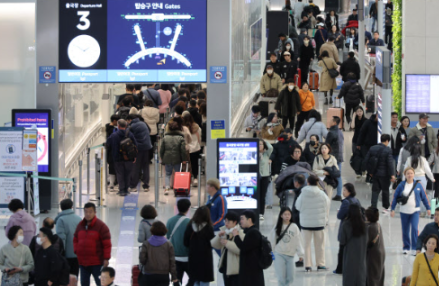
 Incheon International Airport. Yonhap News
The Japanese yen has slid to its weakest level against the Korean won since November 2023, driving a marked surge in demand for flights to Japan. Because the exchange rate directly reduces travel costs, a sense that delaying a trip means losing money is spreading quickly among Korean travelers.
The won-yen exchange rate fell to as low as 854.13 won per 100 yen in intraday trading in the Seoul foreign exchange market on the 2nd, according to Hana Bank. That marks a drop of more than 12% in less than three months from this year’s high of 974.62 won recorded on June 5. The yen is also trading in the 159-per-dollar range against the U.S. dollar, extending its weakest stretch in 40 years.
Saving 120,000 Won on a 100,000-Yen Exchange
The currency effect is immediate. Exchanging 100,000 yen cost about 970,000 won in early June, but at current rates it can be done for around 850,000 won. Spending the same amount in Japan now saves roughly 120,000 won on the exchange rate alone — comparable to a one-way low-cost carrier fare between Incheon and Tokyo.
Skyscanner data shows the average round-trip airfare from South Korea to Tokyo this year is about 360,000 won, with some low-cost carriers including Eastar Jet offering promotional one-way fares in the 110,000-won range. The weak yen is acting as a catalyst that pushes travelers to book sooner.
The demand is already visible in the data. A cumulative 6.5698 million South Koreans visited Japan from January through July this year, up 20.3% from a year earlier, according to the Japan National Tourism Organization (JNTO). In July alone, 894,700 Koreans traveled to Japan, a 31.9% increase from the same month last year and the largest figure ever recorded for the month of July.
JNTO attributed the rise in Korean visitors to extended holidays created by newly added public holidays, summer vacation and an increase in airline seat capacity, adding that the decline in the won-yen exchange rate also helped lower travel costs.
Foreign tourist arrivals in South Korea over the same period also hit a record high. A cumulative 12.8 million foreign visitors came to South Korea from January through July, up 21.3% from a year earlier, according to the Ministry of Culture, Sports and Tourism and the Korea Tourism Organization.
Japan Triples Departure Tax, Adding 110,000 Won for a Family of Four
The outlook is not entirely favorable, however. The Japanese government has tripled its international tourist departure tax to 3,000 yen per person from the current 1,000 yen, effective July 2026. The measure is aimed at addressing overtourism and expanding tourism infrastructure. Related tax revenue for fiscal 2026 is projected to swell to 130 billion yen, or about 1.2 trillion won, 2.7 times the previous year’s level.
For itineraries departing Japan on or after July 1, 2026, the 3,000-yen rate applies depending on when the ticket is issued. A family of four traveling together would face an additional 12,000 yen, or about 100,000 won, in departure tax alone. Dual pricing systems that charge local residents and tourists different rates are also spreading in parts of Tokyo and Kyoto.
Tourism industry experts said Japan’s tourism policy is shifting from a phase focused on attracting more foreign visitors to one that asks the arriving crowds to share the costs of congestion and preservation.
How long the weak yen will persist is another question. The Bank of Japan is increasingly expected to raise interest rates in September amid concerns over the weak currency and import-driven inflation. If a rate increase materializes, the yen could rebound and the current exchange rate advantage could shrink quickly.
Travel industry officials said the current window — with the benefits of a weak yen and the departure tax increase overlapping — may actually be advantageous in cost-effectiveness terms, but advised travelers to watch for changes in Bank of Japan monetary policy when timing their bookings.
AloJapan.com