

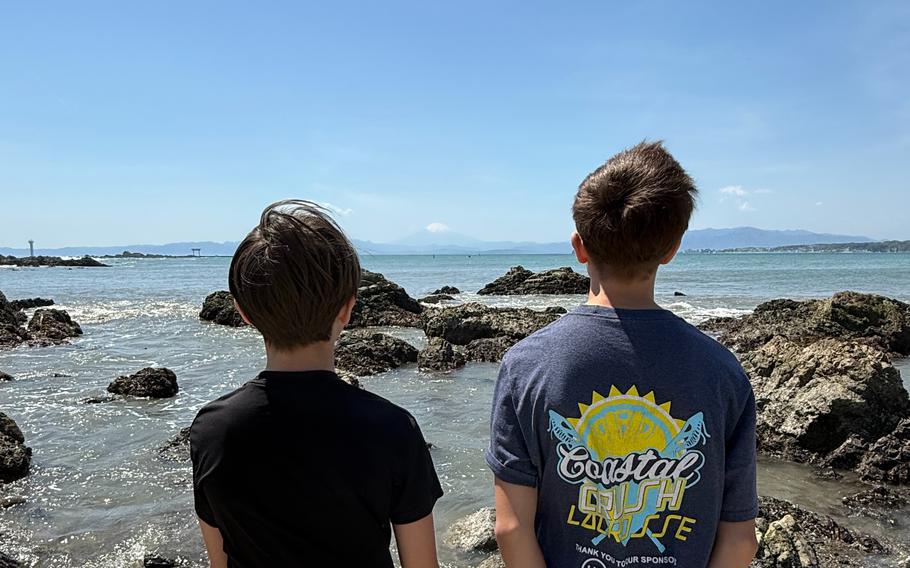
My sons take a moment to view Mt. Fuji from afar before climbing on rock formations on the Morito Coast. (Photo by Maria Pia Oelrich/Stripes Japan)
Paradise is where you make it, at least it is for me, for us. We are a family of four, and while my husband is out at sea, my sons and I make a point of visiting places around the area. We conduct pre-surveys to determine what we want to explore before we take Dad there. In our case, we are consistently running around between hockey and school commitments while trying to adjust to our new life here in Yokosuka, Japan.
While we conduct these surveys to find paradise for Dad, we focus on finding magical places near us. These magical places must be an hour away at most, a paradise within the chaos of daily life. During this spring, and out of those chaotic days, we found one, the Morito coastline in Hayama.
Morito Coast

(Photo by Maria Pia Oelrich/Stripes Japan)
The Morito Coast is located about a 30-minute drive from Yokosuka Naval Base. Starting from the main base, go to the national Route 16 to Yokohama Rd./Honcho Yamanaka toll. We recommend taking this road, as it has a small toll fee (200 yen) and showcases the beauty of the peninsula. While driving across the peninsula, one can enjoy the picturesque views along the road that immerse you in the daily life in these fishing towns.
The national road connects you to more everyday areas, while bringing you back to a familiar joy, Starbucks. The famous coffee chain has a branch in Hayama that is about midway to the coastline. This place is a marvel of engineering where the light hits just right, and it feels like you are in heaven, and if you are extremely lucky, they might still serve one of their specialty drinks.
The juxtaposition of this drive helped us recognize that Japan is more than a place or a moment in time. It is a space where ancient beauty is a marker between the old and the new, where technology makes you feel like you’re a thousand light years ahead, yet encapsulated in a time where Japan’s cultural identity is preserved.
Visit to Morito Daimyojin Shrine
As you continue the drive to the Morito Daimyojin Shrine, be prepared for the road to slowly narrow down. The best place to park is to follow the directions to the shrine and prepare to wait between cars passing. At one point, the road can only take one car at a time.
As you walk in, remember to clean your hands one at a time and then rinse your mouth at the Chōzuya. As soon as you pass the Chōzuya, you will notice a small shrine with knotted white pieces of cloth. These knotted wraps are designed to resemble thunderbolts, which symbolize prosperity. Prosperity is significant because this shrine is one of the seven sacred shrines (Nanasebari) from the Kamakura period, according to Japan Travel site. At Morito Daimyojin, visitors can pray for the prevention of disasters and request for lovely weather, the Japan Travel article about the shrine said. In addition to prayers, one can also pray for good health and fortune.
Though my boys and I were at first puzzled by how to pray properly according to local tradition, we formed a short line behind Japanese visitors and closely observed how they prayed.
As the line moved, soon it was time for the group of three in front of us to take a turn. We noticed that they lined up parallel to the building, standing perfectly still. Then, they bowed and went on to clap three times, in perfect synchronization.
They open their hands on the third clap in an oran’s stance that slowly but surely becomes their hands joined in prayer, as we would do in church. With their hands joined, they stood there praying. In reality, it must have been less than a minute. The minute was something that captivated us while we reflected and whispered about what we saw amongst ourselves about our unspoken mentors. After they had that minute, they bowed once more and walked to the left of the shrine.
30 seconds of mindfulness

(Photo by Maria Pia Oelrich/Stripes Japan)
Then, it was our turn. The boys and I tried it to do as the group before. At the moment, we were not sure what each of us was praying, but we knew we had found a moment where each of us contemplated the silence within, in an introspective way, what it feels like to enjoy paradise. I know that the moment I stood across the shrine. Praying to a foreign entity, to a deity that wasn’t mine, but I visualized my own prayer, my own god, my own thoughts, stuck in a moment. We experience our own paradise. The boys attempted to find their own way to make sense of the moment. Once we were done with our own 30 seconds of mindfulness, we bowed and followed to the left of the path.
One of the shrine buildings to the left had a small store where visitors can purchase goshuin, a shrine stamp or hand-drawn calligraphy made in your own book or card provided by the shrine. At the counter, with a small donation, you can have your own goshuin from the Morito Daimyojin Shrine.
Continue your walk to paradise, following the pathways to the right to get to the beach’s coastline. As you walk through, you will see two activities where you can gamble, with the prospect of learning about your possible luck or attaining a small souvenir. Make sure to have cash for donations to participate! Once you finish, continue straight to the coastline.
Japanese Elvis

Monument for Yujiro Ishihara, known as the “Japanese Elvis.” (Photo by Maria Pia Oelrich/Stripes Japan)
Right before you reach the coastline, take a moment to contemplate the scenery where you’ll likely see the monument for famous Japanese actor, singer and producer Yujiro Ishihara.
The monument is strategically located on the entrance to the beach behind the Morito Daimyojin Shrine because it is a poetic love tribute to Ishihara by the sea. Known as Japanese Elvis, Ishihara was a teen idol and, according to the Los Angeles Times, he passed away in 1987. His monument can be admired before turning to the left and going down the steps to the beach.
While you are there, if it is sunny enough, you can see Mt. Fuji in the distance, and the Najima Torii Gate, the halfway point between the coastline and Mt. Fuji. The boys stood right in front of Mt. Fuji to contemplate the distance between them and the view of such monumental places beyond our reach. After they did that, because my small surveyors are 11 and 13 years old, they went on with their urge to climb each and every rock that they could find in the area. We found an enormous rock formation, where the boys played for about a good 45 minutes. They looked for critters.
Once the boys were done playing at the shore, we made our way back up the stairs. At the top, there is a path for a short hike, which takes you to a view of the coastline surrounded by a monument. The boys and I enjoyed this very much, took selfies and relished the moment. We slowly made our way to the car and thought it was our piece of paradise that we will share with Dad when he’s back home with us.
Speakin’ Japanese
Let’s take a drive.
Doraibu wo shimasho.
The Morito coastline is beautiful.
Morito Kaigan wa kireidanaa.
Let’s visit the shrine.
Jinja ni ittemimasho.
We should pray for good health.
Kenko wo inoranakucha.
Let’s take a selfie.
Jidorishite mimasenka.
I wish dad was here.
Otosanga isshonara yokattanoni.
AloJapan.com