

Around 2 AM on August 23, a magnitude-5.9 earthquake struck Ibaraki, Saitama, Chiba and Tokyo. The Japan Meteorological Agency said the epicenter was in southern Ibaraki Prefecture, at a depth of 68 kilometers.
The agency urged people to remain alert for earthquakes registering up to lower 5 on Japan’s seismic intensity scale over the following week, particularly during the first two to three days.
At this level, most people are frightened and feel the need to hold onto something. Dishes on shelves and books on bookshelves may fall.
 Employees remove foam with cardboard and buckets of water outside a store where fire suppressant was accidentally released after the earthquake in Adachi Ward, Tokyo, on the morning of August 23. (©Sankei/Mariko Hasegawa)
Injuries and Damage
According to local fire departments, a teenage boy and a woman in her 70s suffered arm and shoulder injuries in Saitama.
In Kawasaki, three people ranging in age from their 30s to 60s were injured in falls, suffering injuries to their faces and hands. In Sagamihara, a woman in her 60s fell down the stairs at home and injured her head.
In Tokyo’s Koto Ward, a water pipe burst. The Tokyo Metropolitan Bureau of Waterworks is investigating whether the damage was caused by the earthquake.
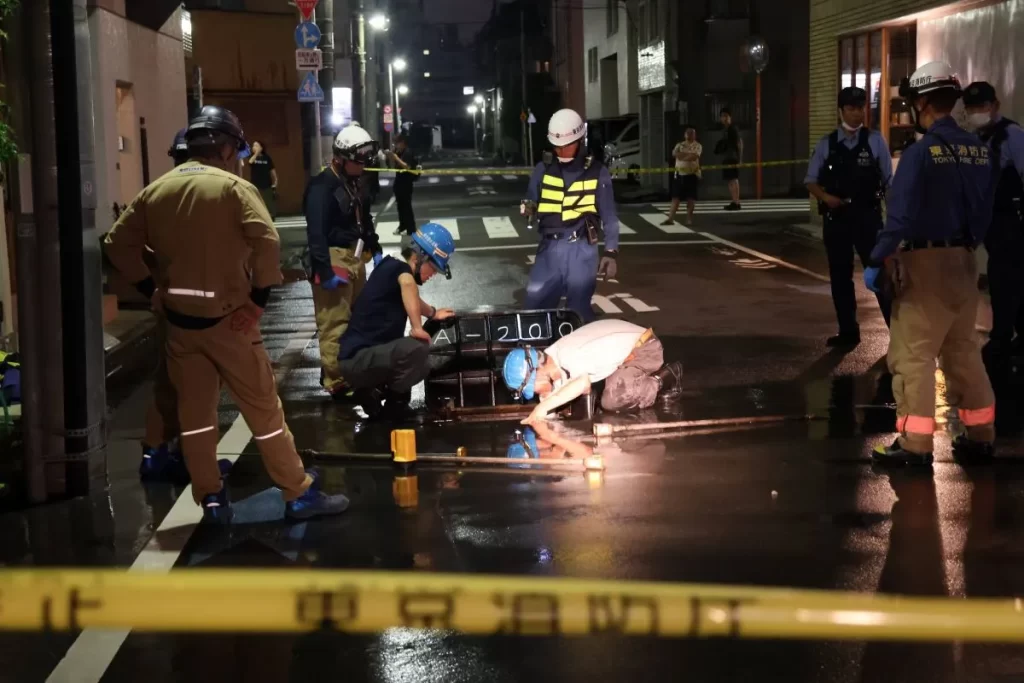 Tokyo Fire Department firefighters respond to a burst water pipe in Koto Ward, Tokyo, in the early hours of August 23. (©Sankei/Ryu Kajiwara)
The quake rattled residents across the affected areas in the middle of the night. As dawn broke, some described the shaking as almost as powerful as that of the 2011 Great East Japan Earthquake, while others voiced concern about further tremors.
The quake also disrupted public transportation, with JR East and other operators suspending services on multiple lines from early morning, throwing Sunday travel plans into disarray.
Residents Recount the Shaking
Naoko Ishizaki, 57, of Kawaguchi, Saitama Prefecture, was asleep when an emergency earthquake alert jolted her awake. She said she was immediately hit by violent shaking.
Still groggy from sleep, she took shelter with her husband and two sons in a hallway near the entrance and waited for the shaking to subside. She later found that the dishwasher, which had not been secured, had moved, and that some windows had opened.
“It was a major jolt, like the Great East Japan Earthquake. I learned that you can’t react quickly in the moment, so I’m going to check my emergency supplies again,” she said.
Kento Nakamura, 45, of Tokyo’s Adachi Ward, was taking a bath when the strong shaking struck. The water in the bathtub surged, while disaster-prevention announcements warning residents echoed from speakers outside his open bathroom window, he said.
Fortunately, figurines and other items in his room did not fall because he had recently secured them with anti-tip adhesive strips.
“I had already been on heightened alert because there had been a series of earthquakes,” he said.
At a supermarket in Adachi Ward, an alarm system malfunctioned, triggering the release of fire suppressant. According to a nearby police station, the discharge was stopped at around 2:45 AM. The store nevertheless delayed its opening by an hour.
A 38-year-old woman from the ward, who said she usually shops at the store as soon as it opens on holidays, decided to wait outside until it opened.
“There could be another earthquake, so I’m going to buy extra water and emergency food,” she said.
The earthquake also disrupted train services. At Omiya Station in Saitama, a busy hub for families and other travelers, signs informed passengers that services had been suspended on some sections of the network.
(Read the related article in Japanese.)
Author: The Sankei Shimbun
Continue Reading
AloJapan.com