

KEY POINTSRED-ONION securely transfers sensitive research data over a 100-Gbps-class network.The platform connects with SQUID, OCTOPUS and mdxII for AI processing and simulation analysis.Trial operations will begin in October 2026, including support for a government-backed biomolecular sequencing project.
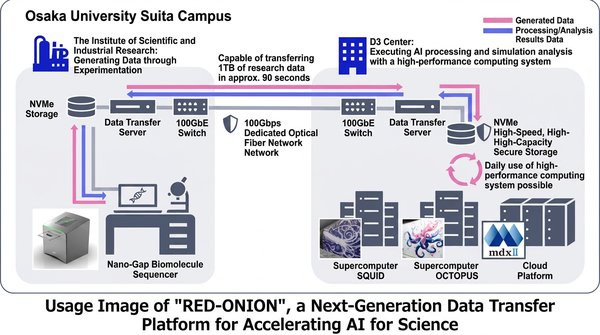
Osaka University and NEC launch the RED-ONION high-speed data transfer platform. Note: Japanese text in the original image from press release has been translated into English by our editorial team.
NEC
Osaka University and NEC have developed RED-ONION, a next-generation platform for transferring sensitive research data over a 100-Gbps-class network, with trial operations scheduled to begin in October 2026, according to an August 21 release.
The platform was built by Osaka University’s D3 Center, its Institute of Scientific and Industrial Research, and NEC. It is designed to securely transfer large volumes of data, including genomic and medical data and related analysis results, in both directions between the two university facilities on the Suita campus.
RED-ONION, short for Research EnhanceD Osaka university Next-generation Infrastructure for Open research and innovatioN, uses a dedicated optical fiber network to transfer sensitive data generated at the institute to an on-campus data center operated under stringent information security measures.
The platform connects securely with high-performance computing systems at the D3 Center, including the SQUID and OCTOPUS supercomputers and the mdxII cloud platform. This allows research data to be used for AI processing and simulation analysis before the results are returned to the institute.
Osaka University and NEC said the platform is intended to provide infrastructure for AI for Science projects involving sensitive data.
RED-ONION enables disk-to-disk transfers of large datasets between the two sites. A dedicated engine centrally controls data processing across the network and servers, while multiple processes run in parallel to accelerate transfers.
On the dedicated 100-Gbps-class network, the platform is expected to transfer 1 terabyte of research data in about 90 seconds.
The platform will support projects including research led by Masaki Taniguchi, a professor at the Institute of Scientific and Industrial Research, to develop a nanogap biomolecular sequencer.
The research was selected under Japan’s Cabinet Office K Program, a government initiative to foster critical technologies linked to economic security. It aims to develop technology for the high-precision, high-speed analysis of biomolecules.
Under the project, large datasets generated by scientific instruments and research activities can be transferred immediately and securely to high-performance computing systems for routine analysis and the development of AI-based services.
Research institutions are handling increasingly large datasets, particularly in life sciences and medicine, where experimental equipment and computing systems are often located in separate facilities. RED-ONION builds on research by Osaka University and NEC into ultra-high-speed data transfer technology.
NEC said the underlying technology has been established as the NEC Ultra-high-speed Data Transfer System, or NEC UDTS. The company has also been strengthening research information infrastructure for scientific applications of AI under its BluStellar value-creation model.
AloJapan.com