

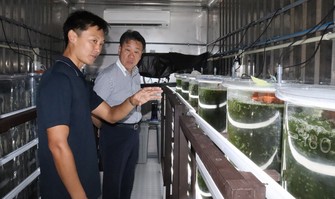
Goki Hirata, left, explains the sea grape cultivation process to Isahaya Mayor Yukishige Okubo inside a dedicated container lined with tanks for growing the products, in the Konagaicho area in the city of Isahaya, Nagasaki Prefecture, on July 30, 2026. (Mainichi/Nobutoshi Kubota)
ISAHAYA, Nagasaki — A fisherman in this southwestern Japan city has become the first in Nagasaki Prefecture to take up land-based cultivation of sea grapes, a specialty of Okinawa Prefecture, and has started full-scale shipments.
The producer is 37-year-old Goki Hirata, who farms oysters and clams in the Konagaicho district of Isahaya. He turned his attention to sea grapes because they can be grown during the summer off-season and have a short cultivation period of about one month.
Hirata began experimental cultivation three years ago in a warehouse at his home. Last year, with subsidies from the Nagasaki Prefectural Government and the Isahaya Municipal Government, he built a dedicated facility and began raising seedlings in May this year. Since early June, Hirata has been selling the sea grapes for about 400 yen (around $3) per 60-gram container at the Konagai direct sales store operated by the Isahaya Bay fisheries cooperative and at the “251 Iimori Jaga Road” roadside rest stop. The grapelike seaweed is also being used at sushi restaurants in the city of Nagasaki.
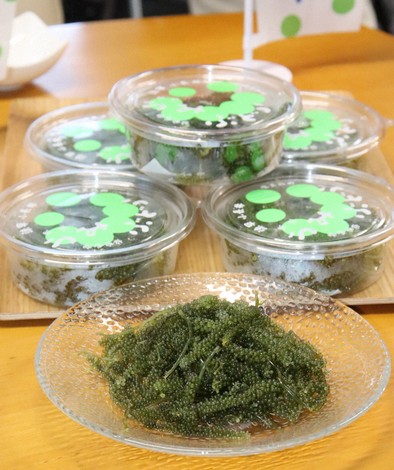
Sea grapes being sold in the Konagaicho area in the city of Isahaya, Nagasaki Prefecture, on July 30, 2026. (Mainichi/Nobutoshi Kubota)
The roughly 30-square-meter dedicated facility houses 24 cylindrical tanks, each measuring 140 centimeters high and 42 cm in diameter, filled with seawater from the Konagaicho area. The water temperature is maintained at 26 to 30 degrees Celsius. LED lights are generally kept on 24 hours a day, but Hirata says it is difficult to adjust the lighting time to prevent diatoms, a type of algae, from multiplying.
On July 30, Isahaya Mayor Yukishige Okubo visited the facility. Okubo, who buys sea grapes whenever he visits Okinawa, sampled the locally grown product and commented, “The crisp, popping texture is great. It’s delicious because it’s fresh.”
Hirata aims to ship 200 kilograms a month through the end of October. “I hope we can increase production and make sea grapes a new specialty of Isahaya, something people associate with the city in summer,” he said.
(Japanese original by Nobutoshi Kubota, Isahaya Resident Bureau)
AloJapan.com