

The lion paused, tilted its head curiously from side to side, then padded toward a group of smiling children as the steady beat of taiko drums and the high notes of a bamboo flute urged it forward.
One by one, visitors bowed their heads. The lion responded with a playful nibble — sometimes on a head, sometimes an arm or hand — spreading what tradition says is good fortune before moving on to its next admirer.
The Shishi Mai lion dance was just one of many traditions shared Saturday during Rhythm of Renewal: A Celebration of Japanese Culture, hosted by the Peña Adobe Historical Society at Peña Adobe Park. Through music, storytelling, demonstrations, and hands-on activities, the event celebrated the Japanese families who helped shape Vacaville while honoring the many cultures whose stories intersect on the historic grounds.
“Every place has a story. Today we’re gathering in a place where many stories meet,” said Heidi Varian as she welcomed visitors.
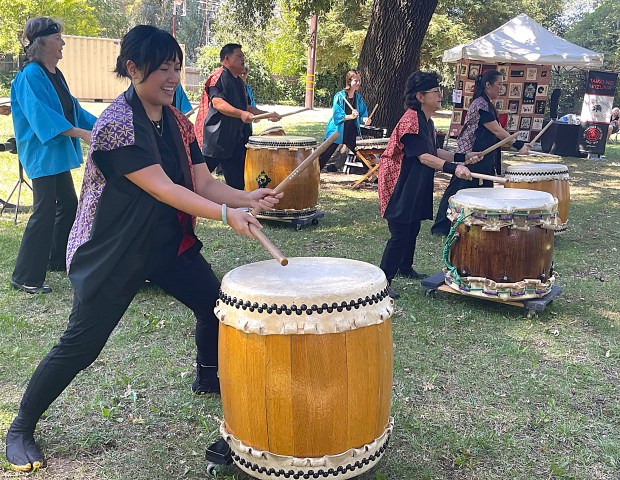 Kashinoki Taiko drummers perform during the Rhythm of Renewal: A Celebration of Japanese Culture at the historic Pena Adobe on Saturday. (Robin Miller/The Reporter)
She reflected on the history of the land, noting that Native Americans were its earliest caretakers before Spanish settlers and later Japanese immigrants came to the region, established businesses, worked local farms, and became part of the community.
Varian also explained the meaning behind kashinoki, the Japanese word for oak trees.
“Like an oak tree, we come and put down roots and grow steadily and provide shade for people,” she said. “That’s what people do, too. They bring traditions from far-off places, and they come together.”
She said the gathering was both about preserving history and creating connections.
“This day exists because of the generations that came before,” she said.
As visitors settled onto blankets and lawn chairs, Varian performed a Norito, a traditional Shinto prayer. It calls upon dragons to circle three times, bringing good luck and good fortune to those gathered.
Moments later, members of Kashinoki Taiko took their places behind an array of drums, some towering over the performers and others small enough to carry. The powerful rhythms echoed across the park, transforming the afternoon into a celebration of Japanese tradition.
The event also offered opportunities to reflect on more difficult chapters of history.
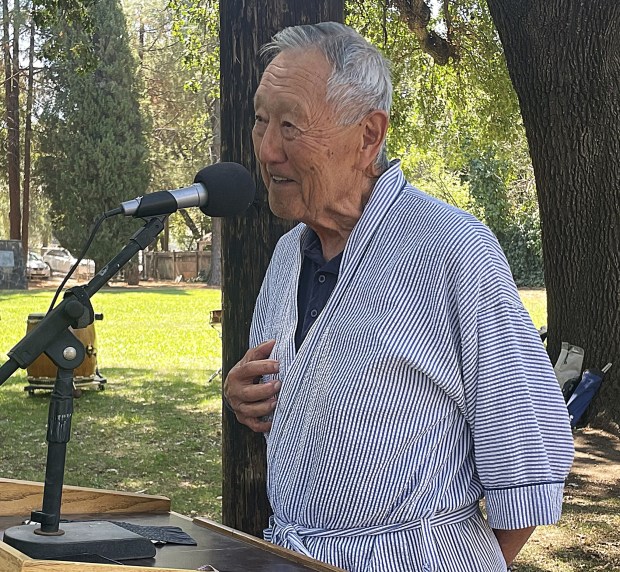 John Takeuchi, a retired military pilot, shares his family’s experience during World War II after Japanese Americans were forced into internment camps. (Robin Miller/The Reporter)
John Takeuchi, a retired military pilot, shared his family’s experience during World War II after President Franklin D. Roosevelt’s Executive Order 9066 forced Japanese Americans living on the West Coast into internment camps.
“My grandparents came to America because it was the land of opportunity for those willing to work hard,” Takeuchi said.
His family was sent to an internment camp in Arkansas, about 10 miles from the Mississippi River.
“We arrived in July of 1942, and I turned 5 that month,” he said.
Despite the circumstances, he remembers the adults doing everything possible to give children a sense of normalcy.
“There were a lot of kids in camp, and the adults took care to make sure it was as normal as possible,” he said. “We had Boy Scouts, crops, celebrated the Fourth of July and Easter, and we played baseball.”
His family left the camp in 1944 after his grandmother secured work in Chicago. After spending time there and later with family in Hawaii, they eventually returned to California, where Takeuchi attended UCLA before his military career, serving 28 years.
Reflecting on the day’s celebration, he reminded the audience of the importance of remembering the past.
“There’s an old saying that you don’t know who you are unless you know where you came from,” he said. “We are all immigrants in America. It’s a place people come to for opportunity, if they’re willing to work hard.”
Throughout the park, visitors explored history exhibits highlighting Native American heritage, Vacaville’s early Japanese community, and the city’s once-thriving Japantown, which stretched around the Dobbins and Main Street area.
At another booth, David Gonzalez introduced children to the history and symbolism of the Shishi Mai lion dance before donning the elaborate costume himself.
“The Shishi Mai is designed to bring luck and good fortune,” he explained. “So if the Shishi Mai comes to you, you bow, and he’ll give you a little nibble on your head.”
Later, he did exactly that, delighting children and adults alike as the lion made its rounds through the crowd.
Among those enjoying both the presentation and the blessing were 10-year-old Vacaville friends Sophia Welch and Nivea Lord.
 A group of local youth listen as lion dancer David Gonzalez explains the Shishi Mai lion dance, during the Rhythm of Renewal: A Celebration of Japanese Culture event at the historic Pena Adobe on Saturday. (Robin Miller/The Reporter)
“I think this is really cool,” Sophia said.
“It’s good for the Japanese culture,” Nivea added.
Nearby, 13-year-old Lily Vandergraaf of Vacaville patiently taught visitors how to fold origami flowers, boxes, and other shapes.
Pearl Cooper, 8, of Suisun City admired the flower she created with Vandergraaf’s help.
“It’s pretty,” she said.
Cricket Kanouff of the Peña Adobe Historical Society said Vacaville was home to a large Japanese community beginning in the late 1800s and became a regional center for Japanese culture.
“They even had a place of worship and a place to celebrate their customs and traditions,” she said.
Saturday’s celebration invited visitors to experience some of those traditions firsthand while touring the historic Peña Adobe, talking with descendants of the Peña family, enjoying taiko drumming, traditional drum-making demonstrations, lion dancing, and cultural exhibits.
AloJapan.com