
 Nvidia CEO Jensen Huang. AP-Yonhap News
Jensen Huang, the CEO of Nvidia who sparked a “Japan passing” controversy by visiting Korea and Taiwan in succession while skipping Japan, has decided to visit the country. The trip marks the 30th anniversary of Nvidia’s partnership with Sega, the Japanese video game company that helped the chipmaker through a management crisis in the 1990s.
On the 10th, Nvidia’s Japan office announced it will hold an event on the 15th in Akihabara, Tokyo, to commemorate the 30th anniversary of its partnership with Sega. Executives from both companies, including CEO Huang and Sega CEO Haruki Satomi, will attend to look back on their 30-year history and unveil next-generation AI processors and the latest graphics processing units (GPUs) in person. Former Sega President Shoichiro Irimajiri and Yu Suzuki, famous as the developer of “Virtua Fighter,” will also attend.
The event will feature a session reviewing the two companies’ history along with an exhibition of the latest technology. According to Japanese IT outlet “Business+IT,” Huang plans to unveil the next-generation PC AI chip “RTX Spark” and the “Nvidia DGX Spark,” a personal AI supercomputer equipped with a 20-core Arm processor. A raffle for the latest graphics card, the “GeForce RTX 5090 Founders Edition,” will also be held for invited guests. These are the same as the AI ecosystem Huang announced at Computex 2026 in Taiwan in May and the products he unveiled in Korea last month.
Sega’s ‘Decision’ That Prevented a Small Graphics Card Company’s Collapse
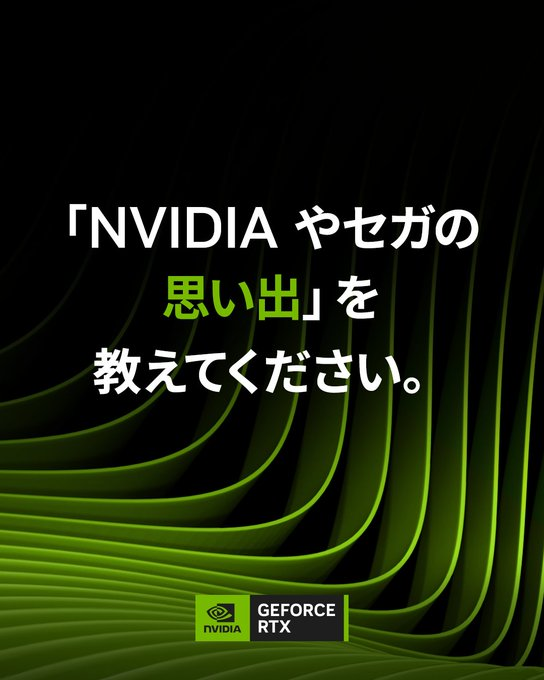 A poster soliciting user episodes to mark the 30th anniversary of the Nvidia-Sega partnership on the 15th. Photo=Nvidia Japan X
The relationship between Nvidia and Sega began in 1995 with the launch of Nvidia’s first graphics chip, the “NV1.” The chip was developed with the aim of enabling Sega games to be played on PCs, featuring a port that could connect the controller of the Sega Saturn console. Building on this, the two companies also began joint development of the “NV2” graphics chip for a next-generation console, but the project was halted after prolonged development difficulties.
At that point, Huang is said to have visited Irimajiri, then Sega’s vice president, to acknowledge his error in judgment and to request that the 5 million dollars (about 7.5 billion won) he was contractually due to receive be converted into an unlisted stock investment so he could redesign the chip from scratch.
Highly valuing Huang’s sincerity, Vice President Irimajiri persuaded the board to proceed with a rescue investment. Based on these funds, Nvidia developed the “RIVA 128,” the first consumer integrated 3D acceleration graphics card, in 1997 and achieved commercial success. Nvidia, which succeeded in its initial public offering (IPO) in 1999 after a narrow escape, went on to grow into a leading AI infrastructure company in the 2020s.
Huang also expressed his gratitude to Sega during a visit to Carnegie Mellon University’s commencement in May. In his commencement speech, he said, “In the early days of founding Nvidia, I wanted to build a new computer that could solve problems ordinary computers could not, but the first technology did not work properly,” recounting the circumstances that forced him to accept funds from Sega despite the contract’s non-fulfillment, in order to keep Nvidia alive.
“It was truly embarrassing and humiliating, and it was one of the hardest things I have experienced in my life,” Huang recalled, expressing his thanks by saying, “Thanks to Mr. Irimajiri’s approval, I realized early on that the position of CEO is not about power but about the responsibility of keeping the company alive.”
Sega sold its stake for about 15 million dollars shortly after Nvidia’s listing, recovering three times its investment. Huang has also recalled that if Sega had held onto that stake until now, it would have been worth 1 trillion dollars.
Only the Sega commemorative event has been disclosed for Huang’s schedule during this Japan visit. However, the industry is watching whether Nvidia will use this trip to Japan to broaden its points of contact with the country’s semiconductor ecosystem.
![[CAPTIONS]
Nvidia CEO Jensen Huang (center) and SK Chairman Chey Tae-won pose for the press after a meal at Ganbu Chicken's Samsung branch in Gangnam-gu, Seoul, on the 7th of last month. Reporter Lee Seok-jin - Seoul Economic Daily International News from South Korea](https://www.alojapan.com/wp-content/uploads/2026/07/news-p.v1.20260607.4c58464e26734ff3a005da23fa77d771_P1.jpg "Jensen Huang, After 'Japan Passing' Row, to Visit Japan Over Sega Ties") [CAPTIONS]
[CAPTIONS]
Nvidia CEO Jensen Huang (center) and SK Chairman Chey Tae-won pose for the press after a meal at Ganbu Chicken’s Samsung branch in Gangnam-gu, Seoul, on the 7th of last month. Reporter Lee Seok-jin
Nikkei: “Japan Could Fall Behind in the AI Revolution”… Will Japan Dispel Concerns and Save Face?
Attention is focused on whether Huang’s visit to Japan on the 15th will become an opportunity to expand partnerships. Right after Huang’s Asia visits to Korea, Taiwan and other countries last month, the Nihon Keizai Shimbun noted, “Huang visited China, Taiwan and Korea in succession but did not visit Japan,” adding that this “suggests the risk that not only is Japan’s competitiveness in the semiconductor industry weakening, but that Japan could also fall behind in the AI revolution.”
Nikkei cited as the reason Huang did not visit Japan that while Japan has strengths in semiconductor materials, parts and equipment, there are few companies that cooperate directly with Nvidia or that compete in the global AI supremacy race. Last year, Huang visited Japan and announced joint development of AI semiconductors with Fujitsu, and industrial robot maker FANUC is also cooperating with Nvidia to develop AI-equipped robots, but only to a limited extent.
By contrast, Nikkei argued that Korea and Taiwan, which are broadening the base of their cooperation with Nvidia, are being elevated to the status of partners rather than mere suppliers, saying, “Whether they can become true partners of a leading company like Nvidia in the AI revolution too is an important variable that will determine Japan’s national wealth going forward.”
AloJapan.com