
“Japanese Women Photographers: From 1950s to Now,” at The Photographers’ Gallery in London, opens with a question rather than a thesis. What would happen if the history of Japanese photography were told through its women? For a medium so often narrated through a handful of male names – Moriyama, Araki, Domon – the question sounds almost provocative in its simplicity. Yet walking through the exhibition’s three floors, what emerges is not a corrective footnote to that history but something closer to a parallel one: 27 photographers spanning seven decades, each insisting on being seen individually rather than absorbed into a single collective narrative.
The exhibition reaches London with a history of its own. Originally curated by Lesley A. Martin, Takeuchi Mariko and Pauline Vermare for Aperture, alongside the 2024 publication I’m So Happy You Are Here, and organised with Les Rencontres d’Arles, it has been reworked at The Photographers’ Gallery by its curator Taous Dahmani. “My worst fear would have been to flatten the celebration of their work,” she says. That concern shapes the installation: oversized wall texts naming each photographer, quotations placed alongside the images, and a refusal to let 27 distinct practices collapse into a single story about “women in Japan.” Rather than speaking for these photographers, the exhibition repeatedly lets them speak for themselves.

Untitled, 2003; from the series Liquid Dreams. © NINAGAWA Mika. Courtesy Tomio Koyama Gallery, Tokyo, and Aperture
Dahmani’s own route into the material is worth pausing on. “I’ve never been to Japan, I don’t speak Japanese,” she says. She came to the project as a feminist art historian interested in photography’s missing chapters rather than as a specialist in Japanese photography. That outsider’s perspective becomes one of the exhibition’s strengths. Rather than presenting a definitive history, it openly acknowledges the work of looking, learning and reframing that brought the show into being.
That approach registers in the show’s additions for London: a commissioned timeline, built with two American scholars, laying out the legal and social history of women’s rights in Japan alongside the parallel history of Japanese photography. It did not exist in the original iteration. A photograph is rarely just a photograph here – it sits against postwar occupation, a women’s liberation movement most Western visitors will know nothing about, an equal employment law passed only in the late 1980s.
That history is nowhere more legible than in Yamazawa Eiko, born at the end of the nineteenth century, who trained under the American photographer Consuelo Kanaga in California before returning to Japan to open her own studio and school, hiring only women. Dahmani calls her a proto-feminist who “wouldn’t have used that word,” yet Yamazawa’s own wall text pushes back against that caution: “There can be no liberation of women while they are hired by men and always work in worse conditions than men.” The language still feels startlingly contemporary.
The room devoted to Kawauchi Rinko is perhaps the show’s gentlest moment. Her pastel, diaristic images of insects, light and small domestic incidents have long been described as poetic almost to the point of cliché, but text drawn from Kawauchi herself gives that poetry a sharper edge: “Part of why I make photographs is to confirm my existence. That liminal space is what feels closest to how I experience reality.” Seen alongside photographers who spent decades fighting for institutional visibility, that liminality reads less as delicacy than quiet insistence.

Untitled, 2004; from the series the eyes, the ears. © KAWAUCHI Rinko. Courtesy the artist and Aperture

What I Am Doing No. 77, 1986 © YAMAZAWA Eiko. Courtesy Third Gallery Aya, Osaka, and Aperture
Elsewhere, the exhibition finds its quiet emotional centre in Ushioda Tokuko’s photographs of her refrigerator – part of the domestic world she recorded while her photographer husband enjoyed the recognition she largely never did. “I have always worked as a record keeper,” her text reads. “It’s very interesting to see how the world changes through the camera.” Dahmani goes further: “Her husband took all the light.” Ushioda was only rediscovered later, once those decades of ordinary domestic attention were finally recognised as a serious, sustained body of work.
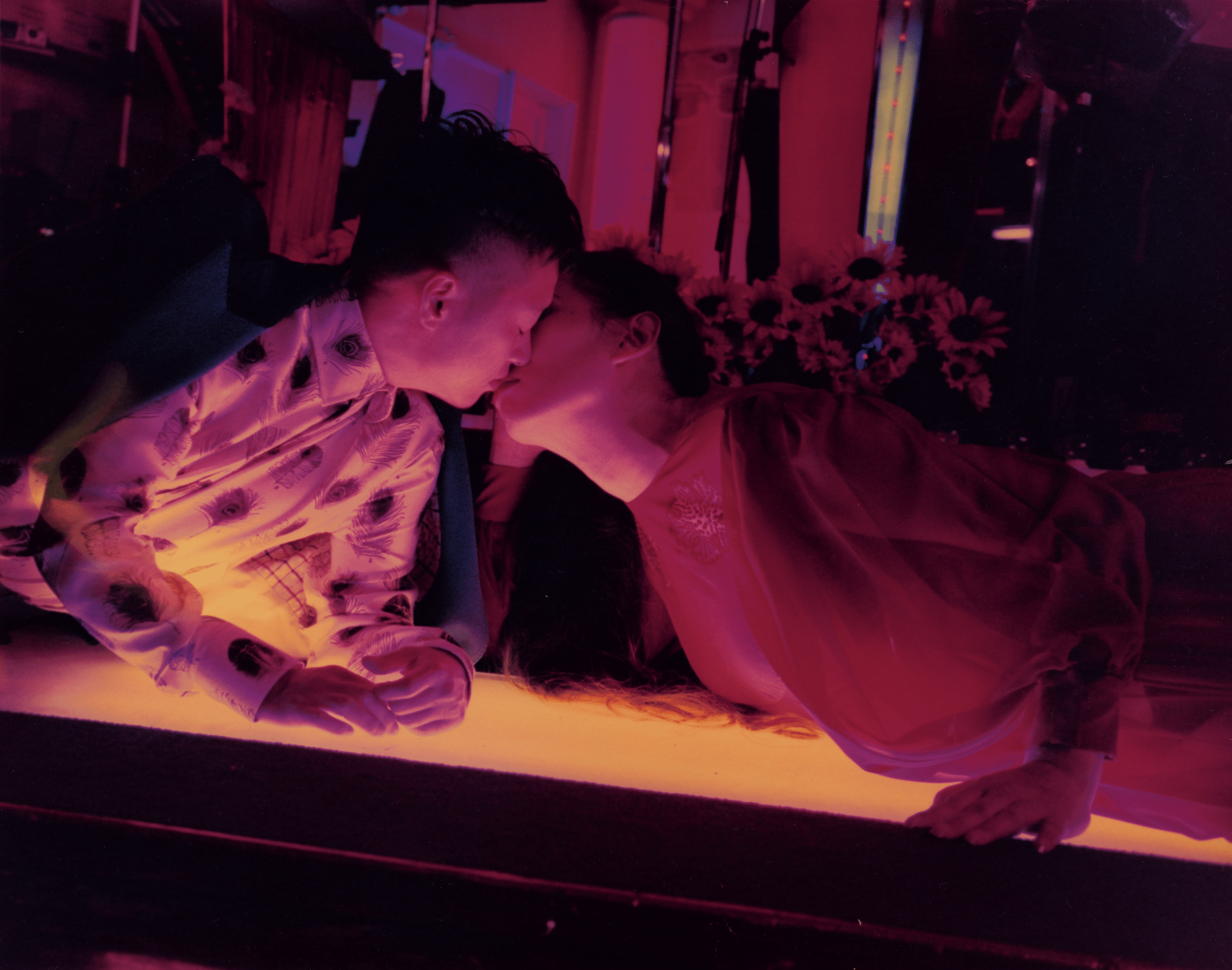
A generational shift runs through the later rooms. While earlier photographers largely look outward – to labour, society and the aftermath of war – from the late 1980s onwards, the camera turns inward. Ninagawa Mika’s saturated colour photographs grew from anger rather than decoration (“I was furious about the inequality between men and women”), while Nagashima Yurie’s nude self-portraits with her family become, in her words, “a way of taking action against the historical roles of the male and female in photography.” Dahmani describes it simply as “not apologising for who they were.”
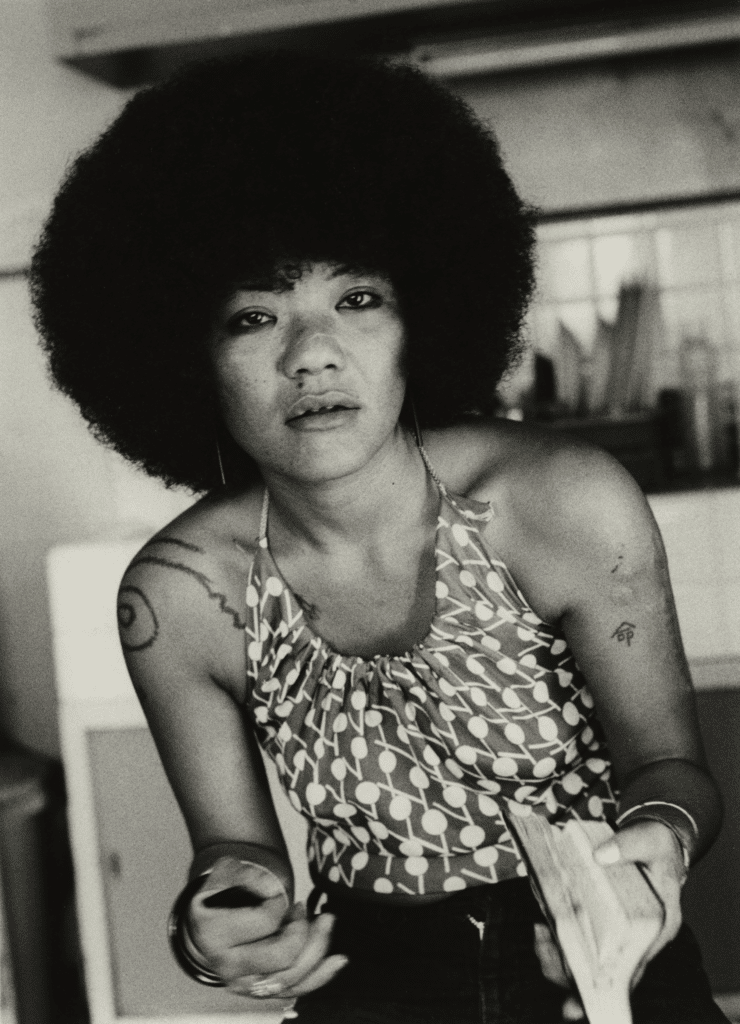
Untitled, 1997; from the series Hiroki. © NOMURA Sakiko. Courtesy the artist; Akio Nagasawa Gallery, Tokyo; Galerie. Écho 119, Paris and Aperture

Untitled, 1997; from the series Hiroki. © NOMURA Sakiko. Courtesy the artist; Akio Nagasawa Gallery, Tokyo; Galerie. Écho 119, Paris and Aperture

Full-figured, yet not full-term, 2001 © NAGASHIMA Yurie. Courtesy the artist, Maho Kubota Gallery, Tokyo, and Aperture
The final gallery belongs to Komatsu Hiroko, a former noise musician who came to photography late and spent a year staging monthly shows of her own work in a rented Tokyo shop, flooding the space with black-and-white images of construction and demolition. “A single photograph is not enough to make sense,” she said. “When you put together multiple photographs… a meaning emerges.” Restaged floor-to-ceiling here, it is the most overwhelming installation in the show. Individual photographs begin to dissolve into rhythm rather than sequence; demolition sites become almost abstract, a city perpetually remaking itself.
“Japan is not just incredible food and incredible cinema and incredible music and art,” Dahmani says. “It is also the stories of these women who fought to exist as artists.” There is no single image meant to stand in for Japanese women’s photography, no representative voice. Instead there is Yamazawa’s studio, Kawauchi’s liminal light, Ushioda’s refrigerator, Nagashima’s self-portraits and Komatsu’s ruins: distinct practices connected less by style than by their refusal to collapse into a single history. The exhibition resists the temptation to manufacture one. Instead, it lets the work accumulate until it becomes impossible to overlook.
The exhibition “Japanese Women Photographers: From 1950s to Now” runs at The Photographers’ Gallery, in London, from June 24 to September 27, 2026. The book is published by Aperture and available for $75.

Untitled, 2020; from the series Ilmatar. © OKABE Momo. Courtesy the artist and Aperture
AloJapan.com