


Wood ear mushrooms are cultivated in plastic tunnels beneath solar panels in Fukuchiyama, Kyoto Prefecture, on June 30, 2026. (Mainichi/Manabu Niwata)
FUKUCHIYAMA, Kyoto — An “agrivoltaic” project that enables farming and electricity generation on the same land plot has begun cultivating wood ear mushrooms beneath solar panels in this western Japan city as part of efforts to create a zero-carbon city.
The initiative aims for a city with effectively net-zero carbon dioxide emissions. The electricity generated will be supplied to municipal public facilities, and the wood ear mushrooms will be shipped as an ingredient for plant-based egg alternatives.
The first harvesting of wood ear mushrooms was shown June 30 at a solar power facility in Fukuchiyama, Kyoto Prefecture. Agricultural corporation Sasaki, based in Higashihiroshima, Hiroshima Prefecture, is cultivating the mushrooms. Under the solar panels, rows of wood ear mushroom substrate blocks are covered with plastic tunnels. Irrigation hoses run alongside the blocks to provide moisture.

Wood ear mushrooms grown on substrate blocks beneath solar panels are seen in Fukuchiyama, Kyoto Prefecture, on June 30, 2026. (Mainichi/Manabu Niwata)
Because they are grown outdoors, the mushrooms grow from around June to October. Each substrate block can yield 2 kilograms of wood ear mushrooms. The power generation facility currently has 200 substrate blocks across about 2,000 square meters and expects to harvest 400 kilograms a year.
Sasaki wants to increase the number of substrate blocks by improving cultivation methods and taking other steps. The alternative egg product, which will use wood ear mushrooms as one of its ingredients, is targeted at people with egg allergies and those seeking nonanimal foods.
The agricultural corporation plans to eventually cultivate 20,000 substrate blocks in Fukuchiyama and harvest 40 metric tons of wood ear mushrooms a year. Since last year, it has also been cultivating 1,600 wood ear mushroom substrate blocks under solar panels in Kyotamba, Kyoto Prefecture. It has set a goal of cultivating 100,000 substrate blocks nationwide.
Combining farming and power generation
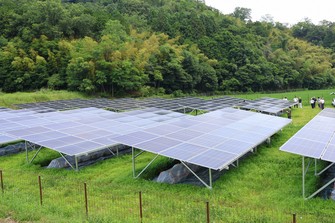
A solar power facility where wood ear mushrooms are cultivated is seen in Fukuchiyama, Kyoto Prefecture, on June 30, 2026. (Mainichi/Manabu Niwata)
According to the Fukuchiyama Municipal Government, this agrivoltaic facility covers 3,831 square meters and began supplying electricity last December. Its annual output is 200,000 kilowatt-hours, equivalent to the yearly power consumption of about 51 households, and is supplied through the local energy company Tantan Energy Co. to municipal elementary and junior high schools and other facilities.
To achieve a zero-carbon city by 2050, Fukuchiyama established a sustainable energy and environmental co-creation platform in 2024, bringing together residents, organizations, companies, universities and the municipal government. The cultivation of wood ear mushrooms beneath solar panels is the platform’s first initiative combining farming and renewable energy generation.
(Japanese original by Manabu Niwata, Fukuchiyama Local Bureau)
AloJapan.com