
Japan News|Published 1 hour ago

Hiroshige Yazawa
Visitors to the Katsura Imperial Villa in Nishikyo Ward, Kyoto, can find themselves guided along pebble-paved paths, stepping stones and nobedan stone pavement, while being enveloped by the charm of a well-maintained garden with diverse plants, including pine, maple and azalea trees.
The garden’s pond reflects the lovely surrounding scenery, and the harmonious beauty is enjoyable with every step and across the changing seasons.
This renowned garden has been carefully maintained by successive generations of specialist officers from the Kyoto Office of the Imperial Household Agency.
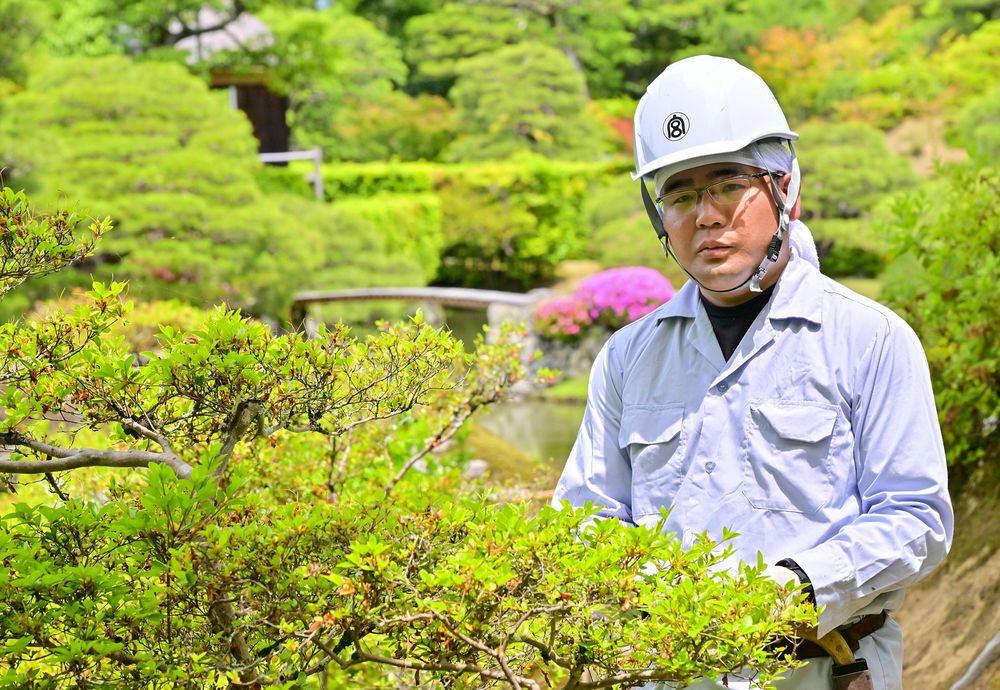
Yoshiaki Takami, 32, who is in his 15th year with the agency, has worked at the Katsura Imperial Villa for a total of more than six years.
There are nine field specialist officers assigned to the Kyoto Office, including Takami. They studied agricultural engineering, architecture, environmental studies and related subjects in high school and college. They also rigorously train at the Kyoto Imperial Palace and Shugakuin Imperial Villa, in addition to the Katsura Imperial Villa.
Takami walks through every section of the about 7-hectare Katsura Imperial Villa, building up mental images of the condition and origin of every plant, from the trees’ branch patterns and the luster of the flowers and leaves to even the moss at his feet.
“No matter who visits and when, it must remain the same, unchanged,” he said, gazing out over the lush green garden of the season.
Takami is aware that even a little extra work can completely change the landscape. “I often find myself in a cold sweat when I ask myself if the result is really the same as before,” he said.
Only one of its kind
The Katsura Imperial Villa was constructed over about 50 years in the early Edo period (1603-1867) by Prince Toshihito and his son, Prince Toshitada, of the then Hachijo-no-miya Imperial family branch.
The stroll-type landscape garden features traditional Japanese buildings, such as refined residences and chaya teahouses, each with its own unique architectural design. It has a one of a kind landscape that reflects the elegant world of “The Tale of Genji.” However, the detailed history behind the garden and buildings’ construction remain unknown.
Takami is a native of Kumamoto. He studied agricultural engineering at an agricultural high school and passed the national civil service exam. A son of a salaried worker, he was unfamiliar with gardening. He was hired with virtually no prior knowledge of the Katsura Imperial Villa and the Kyoto Office.
“At that time, I just wanted a job, rather than wanting to do something special,” he said with a shy smile.
After doing clerical work, he was assigned to the Katsura Imperial Villa in his fourth year. Initially, everything was new to him.
He was paired with a more experienced colleague and learned through instruction and hands-on practice how to care for pines and azaleas, mainly using a hand-pruning technique essential for the Imperial Palace and villas. He also learned how to repair hedges made with plants. The Kyoto-based gardeners contracted to work at the Katsura Imperial Villa are all masters of their field, so he has the heavy responsibility of providing them with proper instruction.
Although there are past management records and documents, “It’s difficult to learn the nuances through photos, drawings or text alone,” Takami said.
While workers in this field need to learn and remember a lot, teaching someone who is starting without preconceived notions can lead to more easily passing down the way of thinking for this work, Takami says.
Ryusei Miyatani, 31, has been paired with Takami for the past year. He appreciates the strength of the partnership, saying: “We sometimes take flexible approaches, such as trying out efficient and safe methods or testing new materials and specifications. It’s so interesting.”
Changing vegetation
Over nearly 400 years of the garden’s history, plants have naturally experienced periods of both growth and decline. Despite meticulous care, prominent trees would die. Beautiful flowers in an artificial hill would be replaced with a grove of Japanese cypress trees. Sometimes, a new shoot would naturally sprout from the stump of a tree that was unfortunately cut down. At other times, invasive species would be promptly removed upon discovery.
The Katsura-gaki, a hedge at the villa made by weaving hachiku bamboo trees growing from the ground, faces an uncertain future due to abnormal growth. The availability of the branches of kuromoji trees used to make fences is similarly uncertain.
“Perhaps only the stones have remained unchanged since the beginning,” Takami said. “To preserve the garden’s unchanged appearance, we maintain the status quo while also making changes.”
His work requires flexibility and balance. In recent years, the staff’s primary concern has been the rapid advance of global warming. As the effects of the dry ground and intense sunlight have become more serious, the mosses – which symbolize the Katsura Imperial Villa – are gradually losing their luster.
Masahiko Imai, 54, who also works at the garden, quietly explores solutions through various approaches, such as transplanting, soil preparation, planting shade trees and conducting cultivation experiments.
“Sometimes mosses take root in an unexpected place. Their delicate and mysterious nature may have been one of the Katsura Imperial Villa’s charms,” he said.
There was also some surprising good news. Last October, the Emperor visited the Katsura Imperial Villa for the first time in 45 years. He paid attention to the area where the specialist team had managed to grow mosses, saying, “This is so wonderful.”
Takami said, “The Emperor saw it in its best condition, right after the rain.”
Takami and his colleagues continue their hard work, so that 50 or 100 years from now, the garden will still be as beautiful as it is today. | Japan News
AloJapan.com