

Japan refuses to fit into a box (ETV Bharat)
Japanese Prime Minister Sanae Takaichi’s first official visit to India, culminating in the 16th India-Japan Annual Summit with PM Narendra Modi, focused on defence cooperation, investment and the future of one of Asia’s most important partnerships. But diplomacy also has an unexpected side effect: Every country making headlines is also someone’s holiday destination. Japan may be one of the finest examples of this.
It is a country that manages to be 1,400 years old and permanently under construction. It reveres ancient temples while inventing toilets that appear to possess engineering degrees. It can produce trains that arrive on the dot with astonishing punctuality and cherry blossoms that ignore schedules altogether. Above all, Japan is a country that constantly challenges your expectations.
 Travelling through Japan (ETV Bharat)
 Fun facts about Japan (ETV Bharat)
 Overview of the country (ETV Bharat)
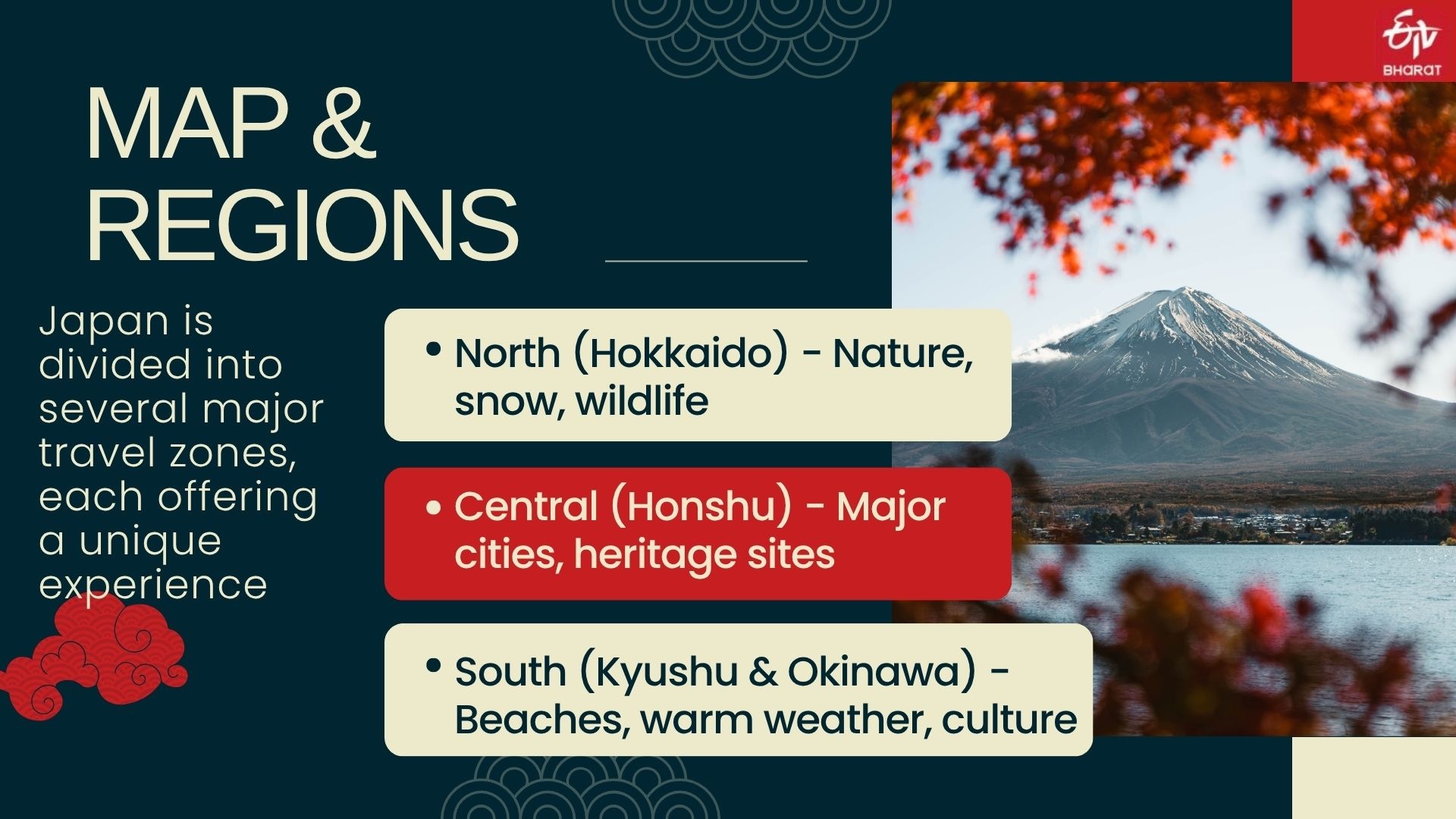 Major travel zones (ETV Bharat)
Changes Every Few Hundred Kilometres
One of Japan’s greatest tricks is that it refuses to be just one thing. Head north to Hokkaido and you’ll find volcanic mountains, alpine lakes, flower fields in summer and snow in winter. Travel south through Honshu (the country’s largest island) and the landscape shifts from dramatic coastlines and forests to bustling cities, castle towns and sacred mountains.
Further south, Kyushu bubbles with volcanic hot springs and steaming valleys, while Okinawa feels less like mainland Japan and more like a tropical island nation that wandered into the Pacific and decided to stay there. Few countries pack so many different climates and landscapes into such a compact geography.
 Major cities (ETV Bharat)
 Food and culinary culture (ETV Bharat)
 Festivals in Japan (ETV Bharat)
 Natural landscapes (ETV Bharat)
Tokyo: The Future, Delivered Yesterday
Tokyo has a peculiar effect on first-time visitors. You expect sensory overload. Instead, what surprises you is how astonishingly organised the chaos is. Millions of people move through railway stations with remarkable efficiency.
Neon-lit districts like Shibuya and Shinjuku pulse with life, while quiet shrines hide behind office towers as though they’ve simply decided not to participate in modernity today. Tokyo contains Michelin-starred restaurants, tiny ramen shops seating six people, cat cafés, anime stores, peaceful gardens and vending machines.
Kyoto: The Japan Everyone Dreams About
If Tokyo is tomorrow morning, Kyoto is yesterday afternoon. Ancient wooden streets, Zen temples, bamboo groves, geisha districts and meticulously designed gardens combine to create the version of Japan that has lived in travellers’ imaginations for generations.
This is the city where tea ceremonies still matter, shrines are hidden beneath forests and every season seems to receive its own celebration. Visit during cherry blossom season and Kyoto transforms into something almost impossibly beautiful. Visit in autumn and the maple leaves compete fiercely with the blossoms for photographic attention.
Osaka: Japan’s Happiest Appetite
Osaka has a simple philosophy. Life is better after eating. Known as “Japan’s Kitchen,” the city wears its culinary reputation proudly. Street food isn’t merely available—it is practically a civic responsibility.
Takoyaki, those irresistible octopus-filled balls of batter, disappear as quickly as they’re cooked. Okonomiyaki, often described as a savoury pancake but deserving of a far more flattering description, appears in countless variations. People in Osaka seem genuinely enthusiastic about feeding visitors. It is a wonderfully difficult enthusiasm to resist.
A Country That Celebrates The Seasons
Some countries have festivals. Japan appears to have festivals for the weather. Spring belongs to hanami, the centuries-old tradition of cherry blossom viewing. Families, friends and colleagues gather beneath blooming sakura trees to picnic, chat and admire flowers. Summer brings fireworks festival hanabi where riversides become gathering places for enormous pyrotechnic displays. People dress in colourful yukata, food stalls appear as if by magic and entire cities pause to watch the night sky explode into colour. Autumn replaces blossoms with brilliant red and golden leaves, transforming temple gardens into masterpieces.
Then winter arrives, and cities illuminate themselves with millions of lights. Tokyo, Osaka and countless smaller towns embrace dazzling winter illumination festivals, while snowy regions host extraordinary events such as the Sapporo Snow Festival, where giant sculptures of snow and ice briefly transform ordinary streets into open-air galleries.
Nature Is Never Very Far Away
Despite its reputation for dazzling cities, Japan remains connected to nature. Mount Fuji rises above the landscape with such perfect symmetry that it occasionally appears too elegant to be real. National parks cover mountains, forests and volcanic landscapes. Hiking trails weave through cedar forests.
Cranes dance in snowy wetlands. Macaques soak in steaming hot springs while looking more relaxed than most office workers. The coastline stretches for nearly 30,000 kilometres, offering dramatic cliffs, hidden beaches and fishing villages where the day’s catch still determines the evening menu. Nature, in Japan, isn’t separate from everyday life but woven into it.
Cuisine That Became A Global Language
Japanese food has travelled the world. Yes, there’s sushi. But there is also ramen, tempura, soba, udon, yakitori, kaiseki dining, fresh seafood, delicate desserts, regional specialities and convenience stores that somehow produce meals better than many restaurants elsewhere. Every region proudly insists its version of a dish is the correct one. The traveller’s sensible response is to eat all of them.
The first visit to Japan is usually spent seeing famous landmarks. The second is about discovering neighbourhood cafés, mountain villages, local festivals and tiny railway stations where nothing much happens except life. Somewhere between a bowl of ramen in Tokyo, a temple bell in Kyoto, street food in Osaka and cherry blossoms drifting across a river, you begin to understand why Japan inspires such affection.
Prime Minister Sanae Takaichi’s visit to India is about strengthening ties between two nations that already share a deep friendship. For Indian travellers, it is also a timely reminder that one of Asia’s most endlessly fascinating countries is waiting just a few hours away, a place where every journey feels familiar one moment and delightfully unexpected the next.
 Japan welcomes travellers (ETV Bharat)
Also read:
PM Modi’s Seychelles Visit Is The Perfect Excuse To Discover This Tropical Paradise So Close To IndiaVisual Explainer: Nature-Based Tourism Goes Beyond Sightseeing To Greener PasturesTravel Guide To Vietnam, A Country Built for WanderersThree Days, Zero Planning: 5 Indian Destinations Made For Spontaneous Gen Z Group Trips
AloJapan.com