
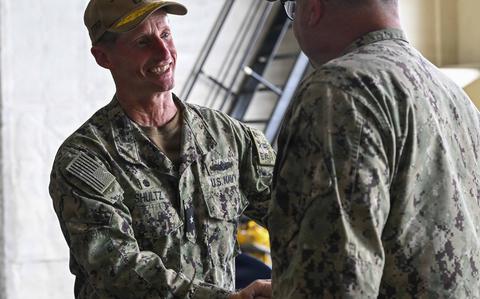

Rear Adm. Tom Shultz, outgoing commander of Expeditionary Strike Group 7, is relieved by Rear Adm. Brian Mutty during a change of command ceremony aboard the expeditionary mobile base USS John L. Canley, off Singapore, June 15, 2026. (Jacob Woitzel/U.S. Navy)
A former amphibious assault ship commander took charge Wednesday of the U.S. 7th Fleet’s expeditionary command, which oversees amphibious operations in the Pacific.
Rear Adm. Brian Mutty assumed command of Expeditionary Strike Group 7/Task Group 76 during a ceremony aboard the expeditionary sea base USS John L. Canley off the coast of Singapore. He took over from Rear Adm. Tom Shultz, according to a news release Wednesday from the strike group.
Mutty also assumed responsibility for Task Force 78, which helps coordinate military, interagency and international partners across the Indo-Pacific.
“I am excited to join this exceptional team of Sailors and Marines and to build upon the culture of excellence Rear Adm. Shultz established,” Mutty said in the news release. “I look forward to working side-by-side with the Sailors and Marines from the premier expeditionary strike group in the Pacific Fleet.”
The strike group gives the 7th Fleet its amphibious capabilities in the region, including integrated operations between the Navy and U.S. Marine Corps assets.
Its fleet includes the amphibious assault ship USS Tripoli and its expeditionary strike group and is responsible for missions that include humanitarian and disaster relief, training and combat, according to its website.
The Tripoli deployed in March to the Middle East under Central Command with 2,500 Marines of the 31st Marine Expeditionary Unit in support of Operation Epic Fury, the war against Iran. The USNI ship tracker on Monday placed the Tripoli in the Arabian Sea.

Rear Adm. Brian Mutty, incoming commander of Expeditionary Strike Group 7, delivers remarks during a change of command ceremony aboard the expeditionary mobile base USS John L. Canley, off Singapore, June 15, 2026. (Jacob Woitzel/U.S. Navy)
Under Shultz, who took command in April 2025, the task force oversaw three patrols by the America and Tripoli Expeditionary Strike Groups and several training exercises, including Talisman Sabre in 2025 and Iron Fist in February.
Shultz praised the task force’s sailors and Marines as “the most important weapons systems” in the command.
“We are the forward-deployed expeditionary fighting force for the theater,” Shultz said in the news release. “The men and women of CTF-76 and CTF-78 are committed to maintaining peace, stability and security in the region. It is those servicemen and women, along with support from our network of allies and partner, who give us an asymmetric advantage that our adversaries cannot match.”
Shultz will next head to Stuttgart, Germany, where he’ll serve as the director of operations at U.S. European Command headquarters.
Mutty, of Portsmouth, Va., most recently served as assistant chief of staff for operations at Joint Force Command Naples, Italy.
He first enlisted in 1992 and commissioned through Officer Candidate School in 1995. He later earned a master’s in National Security Affairs from the Naval Post Graduate School.
He’s since served in numerous roles, including as the first officer to “fleet up” from executive officer to commander of the guided-missile destroyer USS Fitzgerald, according to his official Navy biography.
While commanding the amphibious assault ship USS Essex in 2018, Mutty oversaw the first combat deployment of the F-35B Lightning II stealth fighter.
Ashore, he’s been deputy director of the Integrated Air and Missile Defense Division of the Naval Surface and Mine Warfighting Development Center and commander of the Surface Warfare Schools Command.
AloJapan.com