
KEY POINTSTOPPAN and the University of Tokyo open a five-year Quantum Dot Innovation Lab from July 1Lab combines university research in epitaxial and colloidal quantum dots with TOPPAN nanoparticle synthesis and application developmentResearch targets photonics devices and nanomaterials while supporting researcher training through June 2031

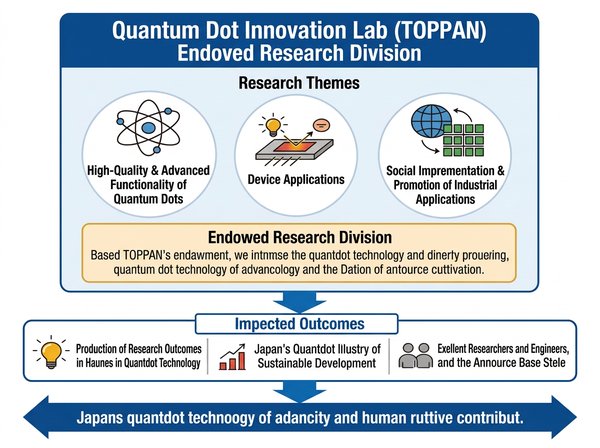
TOPPAN and the University of Tokyo launch the Quantum Dot Innovation Lab. Note: Japanese text in the original image from press release has been translated into English by our editorial team.
TOPPAN
TOPPAN Corp and the University of Tokyo’s Research Center for Advanced Science and Technology have opened an endowed research division, Quantum Dot Innovation Lab (TOPPAN), for five years starting July 1 to advance basic research and talent development in quantum dots and other nanotechnologies, TOPPAN said on July 1.
The lab was established through a donation from TOPPAN to promote industrial applications of quantum dot technology and create innovation. The term runs from July 1, 2026, to June 30, 2031.
The project combines the University of Tokyo’s academic knowledge in epitaxial quantum dots and colloidal quantum dots, as well as quantum optical measurement technology, with TOPPAN’s nanoparticle synthesis capabilities centered on colloidal quantum dots and its application development know-how. Research will focus on core technologies and applications for nanomaterials and nanostructures including quantum dots.
The lab will also draw on research led at the university by specially appointed professor Yasuhiko Arakawa in epitaxial quantum dots, professor Toru Tachima in colloidal quantum dots, and professor Yasuyuki Ozeki in quantum optical measurement. Research at the division will center on control of quantum dot properties, new quantum photonics devices and optoelectronic integration technologies, while also training researchers in the field.
Quantum dots are already being deployed in next-generation displays, quantum dot lasers and high-sensitivity sensors. TOPPAN said the importance of colloidal quantum dots is rising for next-generation high-performance photonics components and devices because they can be produced at lower cost. The announcement also cited technical issues including improving material quality to meet environmental regulations, suppressing defects through surface ligand control and securing stability in air.
The partners aim over the five-year period to deepen systematic understanding of quantum-dot-related science and technology and advance foundational research that could support future industrial applications of colloidal quantum dots and related nanomaterials. The initiative is also intended to contribute to the creation of new industrial fields based on colloidal nanomaterials.
In Japan, an endowed research division is a university research unit funded by outside donations, typically to support specific academic fields for a fixed term. The new lab is intended to support progress in education and research at the University of Tokyo while helping TOPPAN establish next-generation device implementation technologies and strengthen its nanoparticle applications business.
AloJapan.com