
ITOMAN, Okinawa Prefecture—Large-scale memorials, including the Himeyuri Cenotaph, dot the cityscape of Itoman, the site of some of the fiercest fighting during the 1945 Battle of Okinawa.
Tour buses pass through city, bringing visitors to these remembrance facilities.
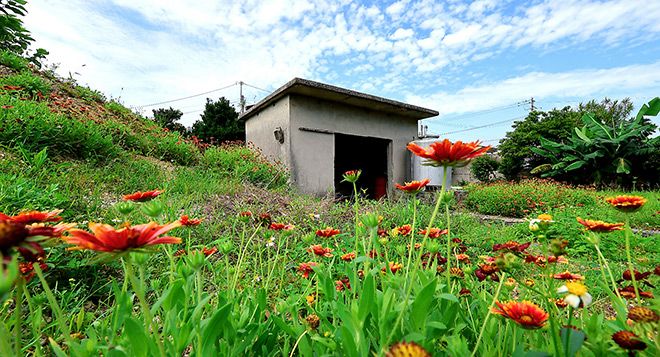
In contrast, in Itoman’s Komesu district, fairly hidden memorials exist on plots of land surrounded by stone walls built before World War II.
These plots once held the homes of families whose members all died during the Battle of Okinawa. After the war ended, relatives and locals preserved these sites to pass down memories of the wiped-out families.
The complete loss of a family, locally called “chineedori” (a household falling), was a common occurrence in the battle that killed more than 200,000 people, both military personnel and civilians.
On one such site, a small structure built from stacked concrete blocks and containing memorial tablets and incense burners stands in the center of an overgrown lot in Komesu.
“Since all of the family members passed away and no one remained to inherit the home, we set up the altar so that relatives and local residents can come and pray,” Hiroshi Kubota, 85, a resident of the community, explained.
According to a local history document, 62 of the 257 households in the community suffered chineedori in the Battle of Okinawa 81 years ago.
1,062 FAMILIES LOST ALL MEMBERS
In early June 1945, Japanese forces retreated to southern areas of the main island of Okinawa under pressure from advancing U.S. troops. These places, including Itoman, were transformed into chaotic battlefields where civilians were drawn into the fighting.
Kubota was 4 years old at the time.
His father had been conscripted into a local defense unit, and Kubota took refuge with his remaining family members in a nearby natural cave.
On June 20, his father returned, and the family headed to the coast where fresh spring water was available. The following day, June 21, they were captured by the U.S. military.
On that same day, in the cave where the family had been hiding, Japanese soldiers resisted calls to surrender from U.S. troops.
The U.S. soldiers set fire to the cave, and an estimated 159 local residents and soldiers died there.
After the war ended, reconstruction of the community began. But the homes of families that had been entirely wiped out remained untouched.
Relatives and community members built altars on the sites of those homes so that the dead families would not be forgotten.
“We inscribed their names and offer prayers to at least let some trace of their existence remain,” Kubota said.
According to the Okinawaken Izoku Rengo Kai (Bereaved families association in Okinawa), all members of 1,062 families across the prefecture were killed in the battle, totaling 2,023 individuals. However, the full picture remains unknown.
Hiroaki Oshiro, 76, a photographer who previously worked for The Okinawa Times, has been documenting sites where such families once lived.
Born in Miwa village, now part of Itoman, Oshiro said the remains of destroyed households were a common sight in his childhood.
When he asked a neighbor about them, he recalls being told, “It breaks our heart and it is so pitiful.”
Since his student days, Oshiro has photographed traces of the Battle of Okinawa.
In particular, he has documented over 100 sites of destroyed households, seeing them as “symbols of the devastation of the Battle of Okinawa, where soldiers and civilians were caught up together in the fighting.”
He said the landscape has changed over time.
Fewer people are around who remember the families, and some relatives can no longer maintain the sites and have sold the land.
Sugarcane fields have been planted on some of the plots.
Even so, Oshiro said he still sees relatives who periodically clean the sites and offer incense.
“Until the war broke out, families lived here, laughing and talking together. The sites of these wiped-out households quietly tell us the cruelty of a war that took entire families from existence,” he said.
MEMORIAL TABLETS
Behind the continued offering of prayers at the sites lies Totome, an Okinawan ancestral practice centered on memorial tablets.
In Okinawa, it is considered important to enshrine and pass down ancestral tablets through generations.
However, another custom prohibits placing siblings’ tablets together on the same altar. This has made it difficult for relatives to take in the tablets of families whose members have all died.
In recent years, views have begun to change, and more cases are seen where tablets are taken in or relocated.
LANDOWNERS UNKNOWN
The deaths of entire families and lost registries have also left a problem that persists today: unknown land ownership.
According to the Okinawa prefectural government, as of March this year, such land in Okinawa covered about 980,000 square meters, equivalent to about 20 Tokyo Domes.
The prefecture and municipalities are responsible for maintaining the land, including clearing vegetation and conducting patrols.
Last year, on the 80th anniversary of the end of World War II, Okinawa Prefecture called on the central government to address what it described as unfinished postwar issues, including the recovery of remains, disposal of undetonated bombs and dealing with land whose owners remain unknown.
AloJapan.com