

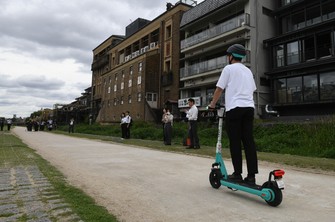
A Luup electric scooter approaches the banks of the Kamo River, a prohibited section for those vehicles, before being automatically brought to a stop by a newly introduced safety feature, in Kyoto’s Nakagyo Ward on June 23, 2026. (Mainichi/Satoshi Kubo)
KYOTO — Electric scooters operated by Luup Inc. will now automatically stop if riders attempt to enter the riverside along the Kamo River under a first-of-its-kind initiative launched in Japan.
Tokyo-based Luup began the program on June 23 in cooperation with Kyoto Prefecture and the police. The initiative covers the banks of the Kamo River, which runs north to south through the city of Kyoto.
The system uses onboard GPS to determine a scooter’s location. If a rider tries to travel along the riverside, the scooter automatically comes to a stop. According to the company, no similar measure has been introduced anywhere in the world to automatically stop e-scooters in areas not intended for motor-vehicle traffic.
Under Japan’s revised Road Traffic Act, which took effect in 2023, e-scooters are classified as “specified small motorized bicycles.” They are generally required to travel on roadways and are subject to a top speed limit of 20 kilometers per hour. Kyoto Prefecture does not permit e-scooters to operate on the riverside under a local ordinance.
However, according to Luup and the prefectural government, people continue to ride those scooters along the riverside despite the restriction. The area attracts large numbers of pedestrians, creating concerns about safety and possible disputes between riders and others including tourists and residents. Seeking to enhance safety and help preserve Kyoto’s historic landscape, the company decided to introduce the GPS-based riding-control function, marking the first practical use of such technology.
When a scooter enters the riverside, an audio message announces, “You are in a no-riding zone. The vehicle will stop,” before the vehicle gradually comes to a halt.
“The Kamo River attracts many tourists. Even when people are informed that the area is off-limits, some enter it without realizing it, while others do so intentionally. That’s why we introduced this feature to stop the vehicles automatically,” said Luup CEO Daiki Okai.
(Japanese original by Satoshi Kubo, Kyoto Bureau)
AloJapan.com