
Check the ‘Departure Tax’ When Traveling to Japan
Thailand Recently Raised Its Departure Tax Significantly
Australia and the UK Also Expanding Tourism Funding
Calls Grow in Korea to Realign the Departure Payment
The Japanese government will triple its International Tourist Tax—commonly known as the departure tax—levied on international departure passengers, including foreign tourists leaving Japan, from the current 1,000 yen (about 9,500 won) to 3,000 yen (about 28,500 won), effective July 1.
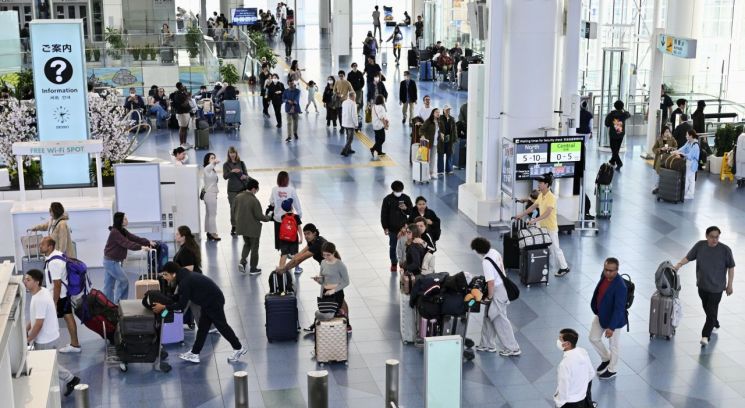
Travelers are heading to the departure hall at Haneda Airport in Tokyo, Japan. Photo is not related to the specific content of the article. Photo by Yonhap News.
View original image
According to Kyodo News on the 22nd, starting July 1, the Japanese government will use the additional revenue from the increased departure tax to expand tourism infrastructure, alleviate congestion at airports and tourist destinations, and implement measures against overtourism. In addition to raising the departure tax, Japan will also significantly increase foreign visa issuance fees. The single-entry visa fee will rise fivefold from 3,000 yen to 15,000 yen, and the multiple-entry visa fee will increase from 6,000 yen to 30,000 yen. However, countries such as Korea, Taiwan, and the United States have mutual visa waiver agreements with Japan, allowing visa-free stays of up to 90 days for short-term tourism, so the direct impact on these travelers will be limited.
On the other hand, the burden may increase for tourists from countries that require visas and for those seeking long-term stays. However, the higher tax will not apply uniformly to all passengers. Transit passengers departing within 24 hours of entry and infants under the age of two will be exempt. In addition, passengers who purchased their tickets before June 30 will continue to pay the existing departure tax, even if they depart after July 1. The Japanese government will also lower passport application fees to reduce the burden on its own citizens. The government aims to manage congestion and local complaints caused by the surge in foreign tourists, while at the same time minimizing any negative impact on Japanese citizens’ willingness to travel abroad.
Thailand, Australia, and the UK Also Expanding Departure Charges
The increase in departure taxes is not a movement exclusive to Japan. Since June 20, the Airports of Thailand Public Company Limited (AOT) has raised the Passenger Service Charge (PSC) for international departure passengers from 730 baht (approximately 34,000 won) to 1,120 baht (about 52,000 won), a 53.4% increase. The higher PSC applies to international departures at the six major airports operated by AOT: Bangkok Suvarnabhumi, Don Mueang, Chiang Mai, Chiang Rai, Phuket, and Hat Yai. The domestic flight fee remains at 130 baht (about 6,000 won).

The increase in departure tax is not limited to Japan alone. The Airports of Thailand (AOT) raised the passenger service charge (PSC) for international departing passengers from 730 baht (about 34,000 won) to 1,120 baht (approximately 52,000 won) starting from the 20th. The photo is not related to the specific content of the article. Pixabay
View original image
The Thai airport authorities emphasize that this increase is not a tax, but rather a source of funding for airport facility investments. The additional revenue will be used for airport infrastructure expansion, enhanced security systems, and the introduction of automated check-in systems. However, some have criticized the decision, questioning whether it is appropriate to increase departure costs amid declining foreign tourist numbers. Last year, the number of foreign tourists visiting Thailand was about 33 million, a 7.2% decrease from the previous year. In contrast, Vietnam saw a more than 20% increase, reaching a record high.
Australia and the UK also maintain high levels of departure-related charges. Australia imposes a 70 Australian dollar charge on passengers leaving the country, while the UK applies the Air Passenger Duty (APD), which varies by distance and seat class. In particular, the UK’s APD is structured so that the tax burden increases for longer distances and higher seat classes.
Why Is Korea Lowering Fees While the World Is Raising Them?
Contrary to the global trend of raising departure taxes, Korea reduced its departure payment from 10,000 won to 7,000 won in July last year, and expanded the exemption from children under the age of two to those under the age of twelve. At the time, the government cited the need to ease the financial burden on citizens. However, there are growing concerns among tourism industry and academic circles that this has weakened the stability of the Tourism Promotion and Development Fund, for which the departure payment is a core source of revenue.

On the 22nd, the office of Cho Gyewon, a member of the National Assembly’s Culture, Sports and Tourism Committee from the Democratic Party, and the Ministry of Culture, Sports and Tourism held a meeting titled “Why Now for Realizing the Departure Payment?” at the National Assembly Members’ Office Building. The event was co-hosted by the Korea Tourism Organization, the Korea Tourism Association, and the Korea Tourism Society. Korea Tourism Organization
View original image
To achieve the government’s goal of attracting 30 million inbound tourists by 2030, continuous investment is needed in regional tourism infrastructure, overseas marketing, and improving tourism readiness. However, after the reduction in the departure payment, the fund’s income has decreased, raising concerns that the financial foundation for mid- to long-term tourism policies may be undermined.
Within the National Assembly and the tourism industry, discussions on “realigning” the departure payment have resurfaced. Some argue that, whereas other major tourist destinations are raising departure and tourism taxes to cover congestion, environmental burdens, and infrastructure costs associated with increasing tourist numbers, Korea’s lowering of fees could weaken its tourism competitiveness. However, any increase in the departure payment is likely to face resistance, as it would directly raise costs for outbound travelers. Even though the fee is included in airline ticket prices and may not be immediately felt, it can be a sensitive issue for families or frequent travelers leaving the country.
Hot Picks Today

KOSPI Can’t Rise Forever Every Day… Securities Firm Says “It’s Actually an Opportunity”
Japan has justified its tax hike as a response to overtourism and for reinvestment in tourism infrastructure, while Thailand has highlighted airport expansion and security upgrades as the primary uses for its increased revenue. Similarly, it is argued that for Korea to enter the era of 30 million inbound tourists, the government must clearly present the necessity and intended uses of the departure payment in a way that is convincing to the public.
This content was produced with the assistance of AI translation services.
© The Asia Business Daily(www.asiae.co.kr). All rights reserved.
AloJapan.com