
KYOTO–A special exhibition featuring masterpieces created by artists of the Kano school, the largest and longest-lived school of Japanese painting in the country’s history, will be held at the Kyoto National Museum next year.
Sponsored by The Asahi Shimbun and other organizations, “The Great Kano School: Master Painters of Japan” will run from April to July 2027.
Celebrating the 130th anniversary of the national museum, it will be the first large-scale retrospective exhibition devoted to the renowned school since 1979 when a similar event was hosted by the Tokyo National Museum.
Members of the Kano school served for political elites, including the Ashikaga family of the Muromachi Shogunate (1336-1573), Oda Nobunaga (1534-1582), Toyotomi Hideyoshi (1537-1598) and the Tokugawa family of the Tokugawa Shogunate (1603-1867).
These Kano school members played a prominent role in Japan’s artistic circle for about 400 years.
About 150 pieces, including national treasures and important cultural properties, will be put on display for the two-part exhibition.
They include new discoveries, never-before-seen pieces and those brought back to Japan.
The first part titled “Muromachi to Momoyama Periods” will be held on April 20-May 30, while the second part, titled “Edo to Meiji Periods,” will take place on June 8-July 19 and replace all exhibits.
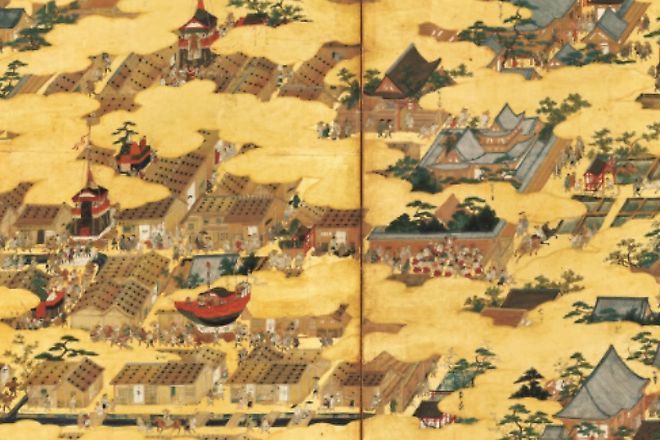
The first part will feature “Scenes in and Around the Capital,” a pair of folding screen paintings with national treasure status by Kano Eitoku, who portrayed the four seasons of Kyoto and the ancient capital’s customs and folkways in a detailed manner.
Works of Kano Masanobu and Kano Motonobu will also be included.
Another highlight is “Amusements at Higashiyama in Kyoto,” a recently discovered folding screen painting.
According to the Kyoto National Museum, it is believed to have been created by Kano Takanobu (1571-1618) or his associate in the Azuchi-Momoyama Period (1568-1600).
Put on display for the second part will be paintings by Kano Tanyu and Kano Naganobu, in addition to pieces by Hanabusa Iccho, Hashimoto Gaho and other artists.
“It will showcase artworks ranging from those found in textbooks to a newly discovered one,” said director Nobuyuki Matsumoto. “The event will indeed introduce the full scope of the Kano school.”
Yuya Fukushi, chair of the Department of Conservation Administration, who is in charge of the exhibits, added, “I want it to be an exhibition that makes spectators give fresh thought to what the Kano school is. It’s been hectic, but there is no other exhibition that is so exciting to prepare, so I have no doubt that spectators will enjoy it.”
AloJapan.com