
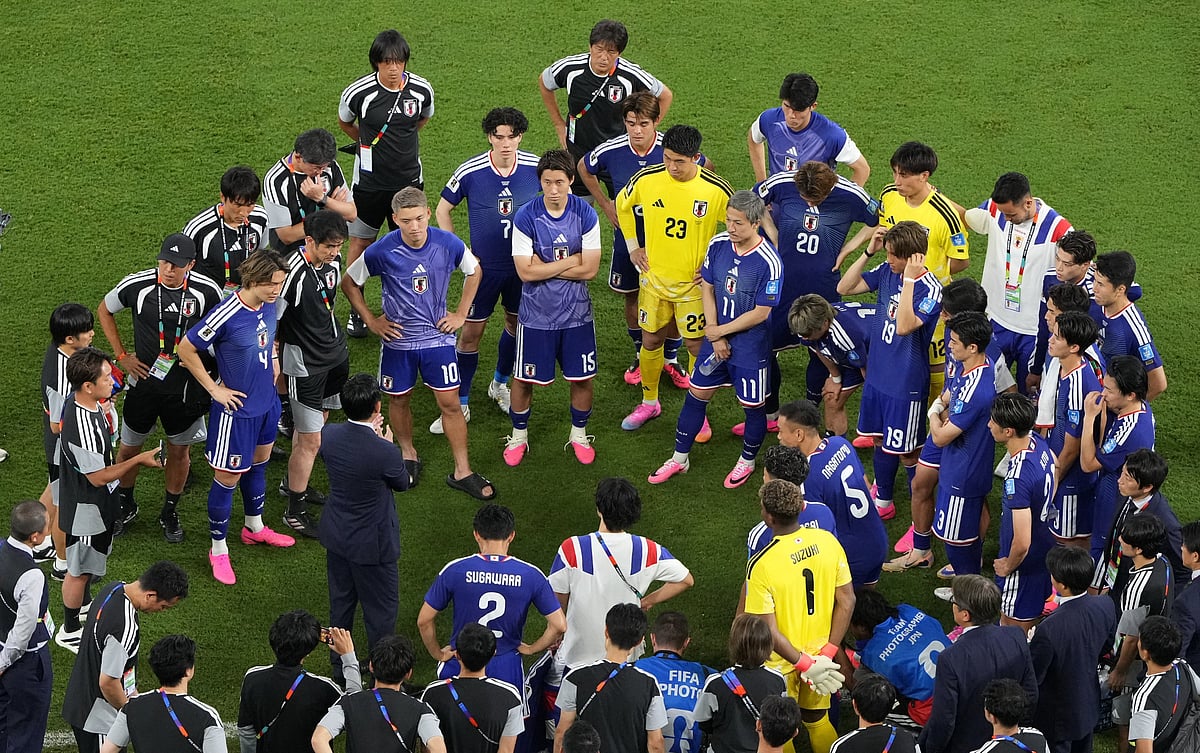
IT feels instructive to begin a piece on Japan’s victory over Tunisia by first talking about their culture. When they first began the J1 League in the early 1990s, they had put in place a 100-year plan. By 2090, they told themselves, they would win the World Cup. The people who wrote the document knew they themselves wouldn’t be around, but it was still important to commit to something. To an ultra-ambitious but still feasible goal.
In 2005, after seeing the progress they had made, that document received a fresh coat of paint. They would, they told themselves, try and win the World Cup by 2050.
“This is the culture of Japanese football, now and forever,” Tom Byer, the man who wrote the basic grammar of the sport in the country, tells The New Indian Express. “It’s actually, you can say, the culture of Japan.” On the day they became the first Asian nation to score four goals in a single match at the World Cup, they remain the standard-bearers for all countries part of the Asian Confederation.
****
What does football, especially at the elite level, have to do with culture? “Everything,” according to Byer. “It plays a big role. In Japan, we constantly talk about culture; it’s one of the most defining factors in sport development. The reason why I say that… at the very basic level, when a 6-7 year old is introduced to the game first, their parents will have to have that mindset of (seeing their kids) training multiple times every week. That same culture is how you get used to the idea that when kids go to junior high, they have to start training six to seven days a week with not much time for recovery. That’s a very cultural thing, and you have to understand that.
“They believe it’s a coaching problem. Between the ages of six to 12, coaching in Japan is no different. When these kids first start playing football, their first coaches are invariably their parents, and most of them are very inexperienced. But this is where cultural identity plays a big role. It creates discipline, repetition and commitment to mastery. Because people know that you have never really arrived in Japan. Let’s take the example of a baseball player; you would have practised catching a ball 10000 times. But even after 10000 sessions, there’s absolute commitment to keep working.”
Byer, an American by birth, had moved to Japan following a brief playing career. Since then, he has worn many hats within the sphere of player development in Japan. Here’s the former AFC technical advisor. “The success was thanks to systems put in place in 1993. People need to understand that. It doesn’t happen overnight. You have to realise that short-term thinking doesn’t get you far. There was a time when we wouldn’t even have dreamt of a player like (Takehiro) Tomiyasu (centre back who used to play for Arsenal a few years ago; he now plays for Ajax in the Eredivisie). We have (Ayase) Ueda, who was the leading goal-scorer in the Eredivisie. Japanese players are all over the world. We have technical skills development programmes running back three decades. It has taken us three decades to get here.”
Ueda netted twice against Tunisia.
From a very young age, Japanese kids are exposed to technical skills. As part of a pilot project, Byer, known as Tom-san for his influence within the broader football community in Japan, became a host of a children’s show. He also used to get two full pages every month in one of the country’s leading comic books (KoroKoro Komikku) to do skills demonstrations. It went to over a million Japanese households on a monthly basis.
He also played a role in establishing football schools up and down the country (there are more than 100 schools). Throughout all of these programmes, Byer used to emphasise the technical nature of the sport.
Multiple players at the World Cup have been a part of these football schools.
It’s why, at the current World Cup, Japan’s technical level is a cut above. It’s fluid, they can interchange at pace and the rotations can cause all sorts of problems to their opposition.
****
Over the last 12 months, Japan have beaten both England and Brazil, two of football’s aristocrats. Those results have naturally created a sort of halo around this time, but Byer is cautiously optimistic.
“This is a team without (Wataru) Endo, (Kaoru) Mitoma and (Takumi) Minamino,” he says. “But I think they will be okay. One of the strengths of Japan is the strength in depth; there’s a deep pool of players. Anything is possible… a quarterfinal or a semifinal will be a massive boost.”
The World No. 16 haven’t officially qualified for the knockouts. However, even if they lose to Sweden in their last group match, they will likely go through as one of the eight third-place teams. Irrespective of who plays them in the Round of 32, the Samurai Blue will be waiting.
AloJapan.com