

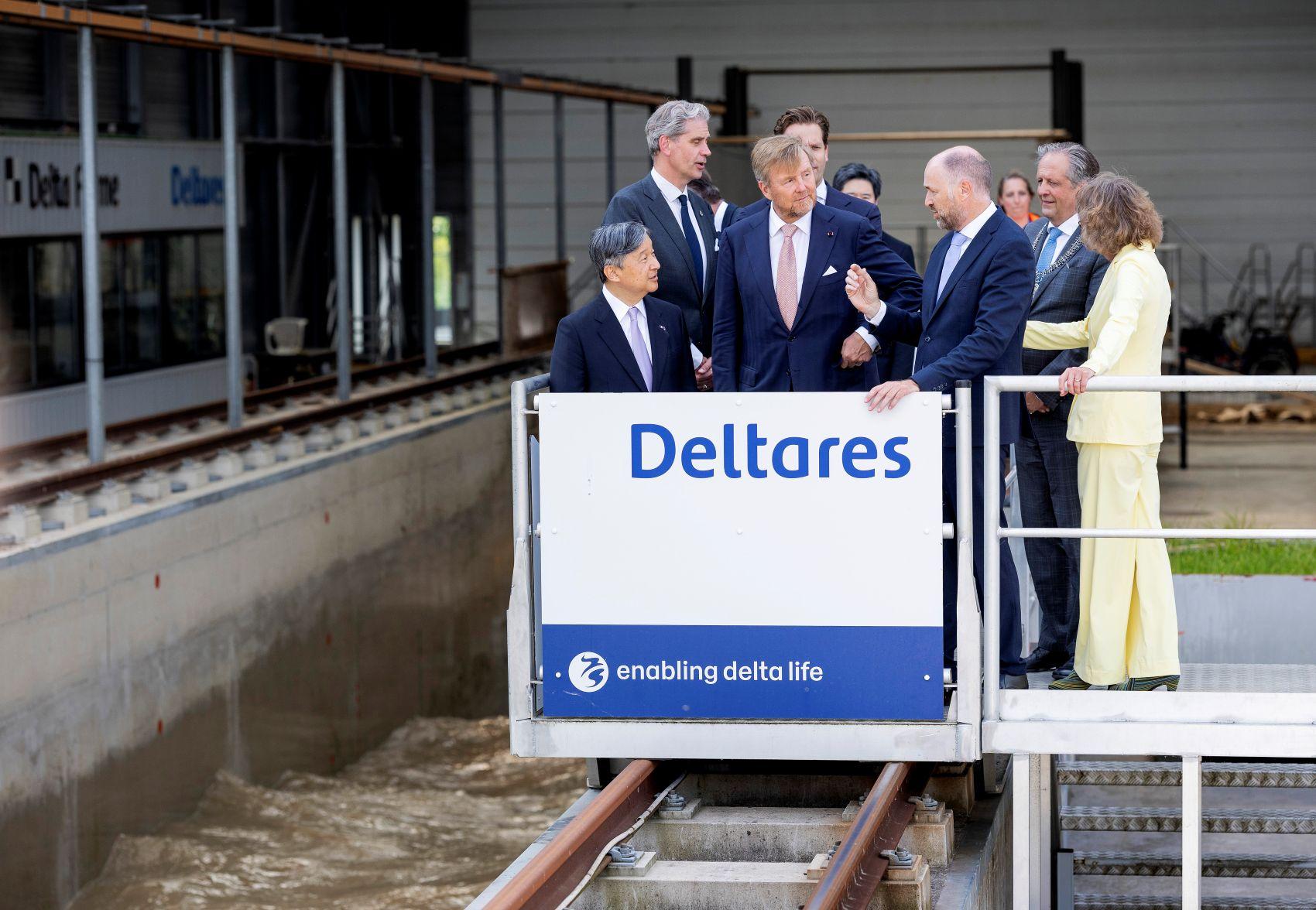
The visit took place during the state visit of Japan to the Netherlands and focused on knowledge exchange and collaboration. It is precisely in the field of water management that both countries have much to learn from one another.
From sharing knowledge to learning together
Minister of Infrastructure and Water Management, Vincent Karremans, opened the programme and reflected on the long-standing relationship between the two countries. Whereas knowledge was once transferred, the emphasis now lies on learning together. Both the Netherlands and Japan face complex challenges such as rising sea levels and more extreme weather conditions.
Annemieke Nijhof, Managing Director of Deltares, demonstrated how the institute contributes to long-term solutions. She emphasised the strength of combining different types of knowledge:
The combination of experimental facilities, digital innovation in data and models, human intelligence, and knowledge of water and the subsurface forms the unique strength of Deltares.
From fighting water to working with it
Bregje van Wesenbeeck, Scientific Director of Deltares, explained how thinking about water is evolving. Whereas water management has long focused on control and rapid drainage, there is growing awareness that we need to work more in harmony with natural systems.
She outlined how the Netherlands is now facing not only flooding, but also drought and land subsidence. This requires a different approach, giving more space to water and natural processes—such as retaining water, making better use of rivers and floodplains, and strengthening the role of nature.
Bregje also drew a link with Japan, where there is a longer tradition of integrating technology, landscape, and society, for example through open dyke systems and coastal forests that provide protection against wind and waves. “Effective solutions stand with one foot in the past and one in the future,” she noted.
According to her, both countries are moving towards a similar approach, where nature and technology come together. Her conclusion: to meet future challenges, we must shift from controlling water to harnessing its natural power.
The Emperor’s personal engagement
Emperor Naruhito’s interest in water is deeply personal and dates back many years. During his studies at Oxford, he researched water management on the River Thames, focusing on the relationship between water, the economy, and society. Since then, he has spoken internationally about water, climate change, and disaster risk.

Research in practice
During a tour of the experimental facilities, the delegation gained insight into how Deltares translates knowledge into practical applications.
Delft-FEWS
The visit began with an explanation of Delft-FEWS, an open-source platform used in more than seventy countries for water management and forecasting. The system combines real-time measurements, such as rainfall and water levels, with models and weather forecasts.
The Emperor was also presented with the joint research in Hokkaido, where Delft-FEWS will play a role. This region in Japan has been heavily affected by climate change and experienced major flooding in 2016. Dutch and Japanese partners, including Deltares, HKV, TU Delft and Rijkswaterstaat, are working together to better understand and predict flood risks.
Oosterschelde Barrier
In addition, scale model research on the Oosterschelde storm surge barrier was presented. Using a scale model, Deltares—commissioned by Rijkswaterstaat—investigated the effects of sea level rise and heavy wave loads on the barrier, to better inform maintenance and future decisions. Rijkswaterstaat also explained what the research means for the management and upkeep of the structure.
Atlantic Basin
At the Atlantic Basin, the wave and current flume for offshore research, attention was given to offshore wind farms and related research conducted by a consortium including the Japanese company Kajima.
Deltares Delta Flume
Finally, the delegation witnessed a test on the erodibility of clay dikes in the Deltares Delta Flume. In this research, the Brabantse Delta Water Authority, Deltares, Fugro and Arcadis are collaborating to better understand how grass-covered clay dikes respond to extreme wave loading.
For this purpose, clay blocks taken from an existing dike were reconstructed into a dike in the Delta Flume and subsequently exposed to high waves.
AloJapan.com