
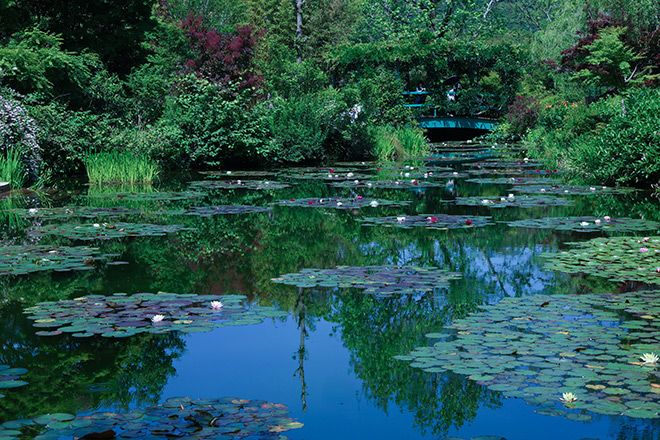
KITAGAWA, Kochi Prefecture—The only place outside France allowed to call itself “Monet’s Garden” is undergoing a facelift, with preparations designed to make visitors still feel like they have entered a painting of the French impressionist.
Gardeners at Monet’s Garden Marmottan in Kitagawa Village here are preparing to mark its 30th anniversary, which is less than four years away.
They invited Jean-Marie Avisard, head gardener of the Monet’s in Giverny garden in northern France, to see how the renovation was proceeding.
“I am convinced that the gardeners here have the skills and passion to get the work done,” Avisard said.
Monet’s in Giverny is located in Normandy, where Claude Monet (1840-1926) lived much of his life.
Monet’s Garden Marmottan was built to resemble Monet’s in Giverny. And the “Marmottan” in the name comes from the Marmottan Museum in Paris, which boasts of one of the world’s largest collections of Monet’s paintings.
Masatoshi Wada, director of a joint public-private venture that manages the 3-hectare garden in Kitagawa Village, likened it to a “three-dimensional Monet painting.”
“My favorite scenery of the garden is when light rain hits and bounces back from the water,” he said, referring to the Water Garden, one of three parts of the facility.
The other parts are the Flower Garden and the Bordighera Garden.
The French Academy of Fine Arts, which manages the artist’s home and garden, gave permission to the garden in Kitagawa to use Monet in its name.
Monet was deeply inspired by Japanese aesthetics, including ukiyo-e woodblock prints, paintings and gardens.
He painted more than 300 “Water Lilies” after his garden in France was built like a Japanese garden. It included a pond, an arched footbridge, water lilies in various hues, wisteria trellis, weeping willow trees and many other plants.
In mid-April, several recently bloomed water lilies in red floated in a garden pond at Monet’s Garden Marmottan. The water reflected wisteria trellis covering the footbridge and new green leaves.
A month later, the garden took on a new look. Leaves turning deep green and aquatic irises joined the reflections in the pond. Dragonflies hovered over countless water lilies, making the garden brim with life.
Officials recommended people visit the garden in the coming months to view the blue water lilies.
Monet had wished to see them bloom in his garden but temperatures in Normandy were too low for the tropical plant to grow.
FIRST IMPRESSIONS
Kitagawa, a village of 1,150 people, is located in the eastern part of Kochi Prefecture on the main island of Shikoku.
Monet’s Garden attracts about 90,000 visitors a year.
The hilly area hosting the garden was once considered a possible site for a winery using yuzu, a Japanese citrus fruit now famous around the world. The village is a major producer of yuzu.
But in the end, local officials settled on a project to replicate Monet’s garden.
Officials flew to France in 1996 to see the garden in Giverny. They also pitched the idea of creating a Japanese replica to the chief gardener of Fondation Claude Monet, which was in charge of the artist’s estate at the time.
The chief gardener was also invited to Kochi Prefecture to teach Japanese about the art of landscape gardening.
Monet’s Garden Marmottan in Kitagawa Village opened in 2000.
The central concept of the garden is to create harmony with colorful flowers.
“Like Monet’s characteristic brushstrokes of dabbing, we dot colors here and there in the garden,” said Yuka Machida, chief gardener.
The color of flowers begins with white and shifts gradually to pale yellow and yellow, just like paints on an artist’s palette.
“We also arrange flowers of complementary colors across the pond to create a sense of depth,” she said. “If we have purple flowers in the foreground, orange and yellow flowers are planted in the back.”
Machida said she came to understand Monet’s worldview through the job.
“I am now ready to take it further to the next level,” she said. “My ties with the gardens are getting deeper.”
The gardeners in Kitagawa Village rarely use agricultural chemicals. They also try to make the best use of flower seeds that have fallen to the ground and even some weeds that grow naturally.
Avisard, the head gardener in Giverny, visited the Kitagawa garden in February.
At the new Flower Garden, he commended the switch from square flower beds to five long, rectangular beds, like the ones in Giverny.
Other key challenges include building walking paths around the pond to allow visitors to view water lilies at close range and replacing soil for weeping willows.
The branches of the willow were expected to droop like those in Giverny, but the soil used in Kitagawa does not seem to suit the trees.
(This story was written by Tomoko Saito and Hiyori Uchiumi)
AloJapan.com