

HATMACHIDA shapes a MICRO-LANDMARK AS CIVIC INFRASTRUCTURE
Designed by Nikken Sekkei, Hatmachida is a 22.7-sqm community hub located along Haramachida Odori in Machida, a commuter city west of Tokyo. Conceived as a ‘micro-landmark,’ the project examines how a compact architectural intervention can support public activity within an automobile-oriented urban environment. Occupying a position between building, plaza, and streetscape infrastructure, the structure provides a place for gathering, rest, information exchange, and small-scale commercial activity.
The project emerged from a series of social experiments conducted in 2021 and 2022 that tested patterns of use, spatial configurations, planting strategies, and opportunities for public interaction. Findings from these studies informed the final design, shaping both its architectural form and programmatic organization. Four functions, information, takeout, shop, and spot, are integrated within the structure, establishing points of contact between residents, visitors, and local businesses. Rather than operating as a completed object, Hatmachida is intended as an evolving civic platform whose role develops through continued public use.

all images by Shota Hiyoshi unless stated otherwise
AN URBAN INTERVENTION BLURS THE BOUNDARIES OF PUBLIC SPACE
Hatmachida is situated along Haramachida Odori, a major boulevard originally planned around automobile circulation. While the street serves as an important piece of urban infrastructure, its scale and configuration have historically limited opportunities for pedestrians to linger and engage with the surrounding city center. Developed in collaboration with Machida City and the Machida Community Development Corporation, the project builds upon the presence of a privately operated police box that had long functioned as a local landmark. The intervention seeks to transform part of the boulevard from a space of passage into a place that supports gathering, conversation, and everyday interaction.
The structure, developed by Nikken Sekkei design studio, occupies an intentionally ambiguous position. Institutionally, it remains part of the roadway; spatially, it functions as architecture; programmatically, it operates as a public plaza. This overlap allows the project to accommodate a range of activities, including meeting, resting, shopping, and participating in community events. The resulting space introduces a civic layer into an otherwise transit-oriented urban condition.
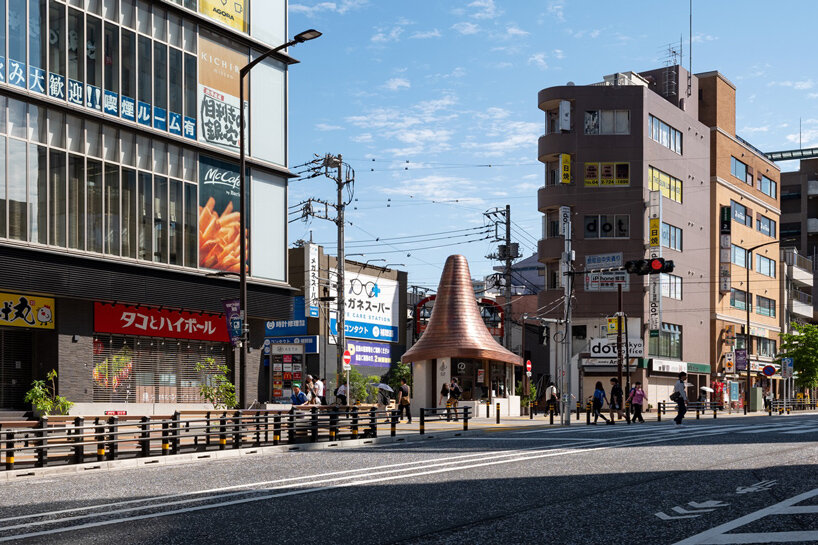
Hatmachida is a 22.7-sqm community hub designed by Nikken Sekkei
A HANDCRAFTED COPPER CANOPY defines THE PUBLIC pavilion
Hatmachida is identified by an eight-meter-high copper roof that rises above the surrounding streetscape. Open on all sides, the roof establishes a visible presence along the avenue while providing shelter for the activities beneath. Its broad profile contrasts with the smaller volume below, reinforcing the building’s visibility at the scale of the street while maintaining a human-scaled relationship to visitors. The roof was constructed using the traditional ichimonji-buki standing-seam technique and is designed to develop a natural patina over time. Its evolving surface introduces a temporal dimension to the project, allowing the material to register environmental change and aging.
Beneath the roof, the ceiling and soffit are formed by 2,923 individually shaped non-combustible plywood panels. Digital studies informed the geometry and placement of each component, while full-scale fabrication drawings guided their installation. Craftspeople assembled the panels on site with a consistent five-millimeter spacing, combining digital fabrication methods with manual construction techniques.
At ground level, six continuous counters ranging from 430 to 880 millimeters in height provide surfaces for information, signage, sales, and informal gathering. Integrated lighting concealed within steel pipe elements illuminates the structure after dark, transforming the pavilion into a visible landmark within the streetscape.

Hatmachida supports gathering, rest, conversation, and local commerce
A COMPACT HUB by Nikken Sekkei SUPPORTS THE CITY’S PUBLIC LIFE
The project incorporates four primary functions that support interaction between people and place. Information serves as a point of contact where staff from the Machida Community Development Corporation provide directions, event information, and recommendations for local businesses. Takeout offers space for local food vendors and emerging entrepreneurs to operate small takeaway businesses. Shop introduces products made by local businesses and craftspeople, presenting goods alongside information about their makers. Spot provides seating, planting, and flexible space for informal use, workshops, and community events. Together, these functions create a framework for everyday activity rather than a collection of isolated services. The process of testing, adapting, and refining these uses over nearly eight years has become part of the project’s development, positioning the structure as an ongoing urban experiment.
Hatmachida is conceived as the first element in a wider strategy for activating public space along Haramachida Odori. The project proposes that small-scale interventions can generate connections across the city, linking individual destinations into a broader network of civic activity. Future expansion to additional locations could establish a series of similar hubs distributed throughout the district. At the same time, businesses supported through the shop, takeout, and community programs may eventually establish permanent locations elsewhere in the city center, extending the project’s impact beyond its physical footprint. Through its compact scale, civic programming, and prominent copper roof, Hatmachida explores how a small architectural intervention can contribute to broader urban transformation while supporting everyday public life.

the project introduces a micro-landmark along Haramachida Odori in Machida

the expansive roof contrasts with the human-scaled volume beneath
AloJapan.com