
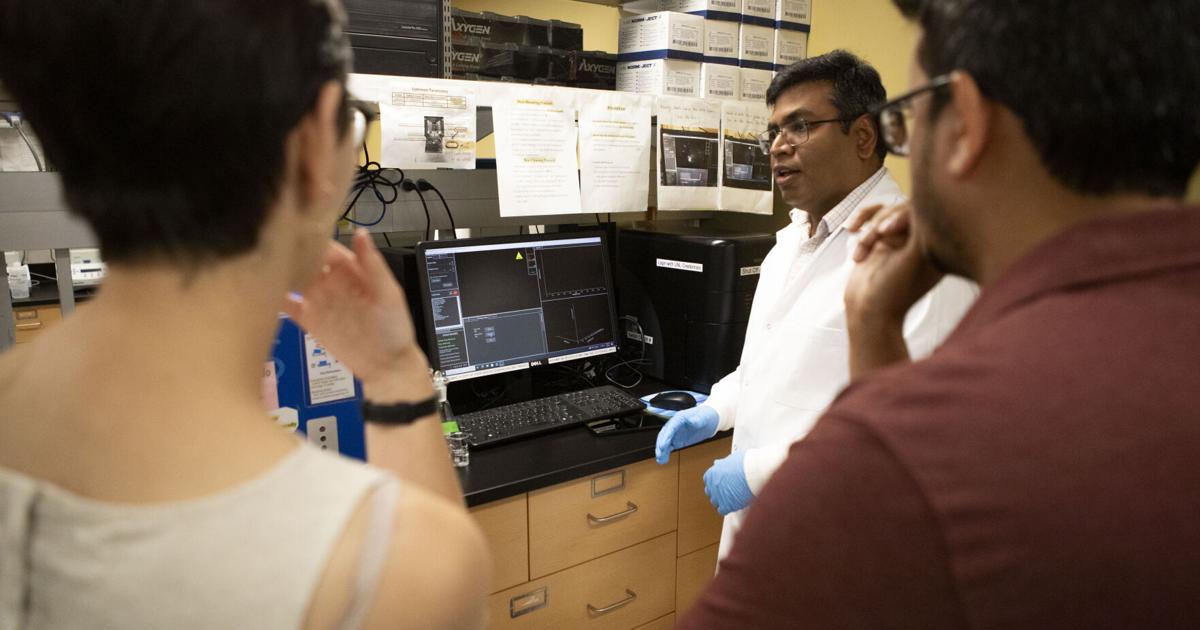

Muhammad Saiful Islam (middle) during a Nanoparticle Tracking Analysis demonstration for Shannon Osaka (L) and Dr. Kazi Albab Hussain (R) on Monday, June 8, 2026, at the Biomedical and Obesity Research Core Lab in Leverton Hall on East Campus.
Photo by Fisher Madsen
Plastic is everywhere in modern society, from containers and water bottles to clothes. However, a research team at the University of Nebraska-Lincoln is discovering that the convenience of plastic comes with consequences.
The research drew national attention as Washington Post climate reporter Shannon Osaka visited Nebraska to learn more about it and how plastic particles can end up in food and water.
From L-R: Muhammad Saiful Islam, Dr. Kazi Albab Hussain, Dr. Yusong Li, UNO Vice Chancellor for Research and Innovation Dr. Jennifer Nelson, Shannon Osaka, Dr. Changmin Yan.
Courtesy of Changmin Yan
Osaka visited UNL and the University of Nebraska at Omaha on June 8 and 9 to see the research firsthand, as she works on a book about microplastics.
Kazi Albab Hussain, a UNL graduate engineering student, showed Osaka a discovery he made in 2023. Billions of nanoparticles are released from plastic containers when microwaved. Researchers can track the number of particles at the Biomedical and Obesity Research Core Lab in East Campus’ Leverton Hall using laser technology.
Osaka noted its size and interdisciplinary strength during her tour.
“As I was talking to them, I realized, ‘oh, there’s so much more,’” Osaka said. “They’re doing animal experiments. They’re doing laser production of the particles, so it was really exciting to learn that I could see many more things than I initially thought I would be able to.”
Yusong Li, a professor in UNL’s College of Engineering, leads NU’s multiple colleges at UNL, UNO and the University of Nebraska Medical Center. Changmin Yan, a UNL advertising professor, said that there are around eight total labs and 12 faculty involved with microplastic research between UNL and the medical center.
“The good thing is we can collaborate differently,” Yan said. “This is spanning from the basic science research, you understand the mechanism, how it works to the impact on human health, why it matters.”
The interdisciplinary focus and size set UNL’s microplastic research department apart from the rest, Osaka said.
“I’ve visited an individual PI (principal investigator), like an individual professor with maybe like a few students,” Osaka said. “Maybe they’re collaborating with, like, one or two other professors in the university, but I have not to this point seen such a big group where they’re all collaborating together across a dozen faculty.”
One demonstration involved microwaving a small polypropylene-based container filled with water for three minutes and depositing the water onto a filter paper. Polypropylene is a plastic used in takeout cartons and home-use food containers. The demonstration was similar to Hussain’s original discovery that microplastic particles were released by a microwave.
Filter paper with microwaved water (L) and non-microwaved water (R), showing the amount of microplastic particles.
Courtesy of Changmin Yan
“I read those results and I read, (that) it’s like millions of particles,” Osaka said. “But I think like seeing it yourself, seeing it with your own eyes is very different and disturbing in a new way.”
UNL’s research goes far beyond experiments involving the effect of microwaves on plastic containers. While the long-term health impacts of microplastics aren’t fully understood, researchers at UNL are working to find answers.
Osaka said she became interested in microplastics after covering climate-related topics for years. However, unlike other fields of study, scientists don’t completely understand the long-term effects of microplastic exposure on the human body.
Muhammad Saiful Islam (middle) preforms a Nanoparticle Tracking Analysis demonstration for on Monday, June 8, 2026, at the Biomedical and Obesity Research Core Lab in Leverton Hall on East Campus.
Photo by Fisher Madsen
“We know some, and we are still working more,” Hussien said. “It can pass through the brain, but we don’t know how it’s passing through the brain or how much is passing through, which particles are passing through? And even if it’s in the brain, what effects are having in the brain? We know a little bit, but we don’t know a lot.”
While long-term effects aren’t totally understood, Li said there are concerns and direct evidence that humans should avoid as much exposure to microplastics as possible. One of the ways to do so, Li explained, is to avoid using plastic in the microwave and to avoid leaving plastic water bottles in the hot sun.
Meanwhile, Osaka said that she’s become mindful of the clothes she buys. Polyester is a synthetic, plastic-based material used in clothing to cut costs and is prevalent in everything from t-shirts to blankets. She explained that fast fashion, a business model used by companies like Shein, which focuses on quickly manufacturing clothing to follow trends, produces polyester waste that doesn’t degrade.
“I’ve been to places like in India where they had all this fast fashion waste coming to that one city,” Osaka said. “You sort of can’t unsee that.”
Dr. Kazi Albab Hussain explains a Nanoparticle Tracking Analysis demonstration to Shannon Osaka (L) on Monday, June 8, 2026, at the Biomedical and Obesity Research Core Lab in Leverton Hall on East Campus.
Photo by Fisher Madsen
Osaka said her book will be divided into two halves: one focusing on how plastic became prevalent in modern society, and the other on how plastic degrades and its health implications.
“I want people to come away understanding the science and probably shifting their lifestyles a little bit of trying to avoid some of these risky behaviors,” Osaka said. “But also appreciating how much work and effort goes into these findings and how important it is to do the science right so that we can have those answers and they can be robust. In order to do science right, you do need to think outside the box and also do interdisciplinary research.”
In the future, the University of Nebraska will host a Microplastics and Nanoplastics Summit from May 9 to 12, 2027, focusing on microplastic detection, policy and environmental and health impacts.
news@dailynebraksan.com
AloJapan.com