
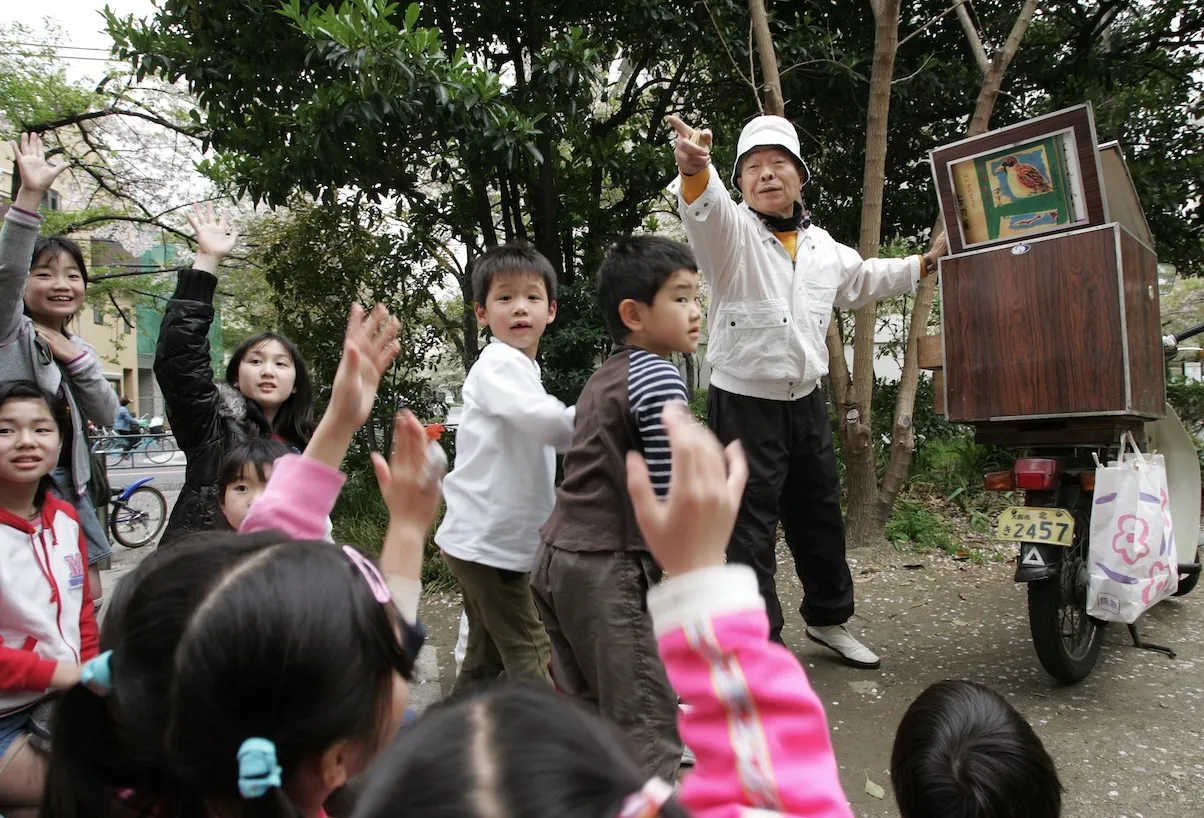
My uncle, Tadashi Sugiura, said to be the last professional Japanese picture-card storyteller (kamishibaishi) in Japan, passed away on May 28 at the age of 95. He was featured in numerous media outlets throughout his life and was even invited to perform one of his original works in the United States.
Tadashi’s funeral was held on May 31 in Tenroku, an old downtown neighborhood of Osaka where he had spent decades performing for children. Beside the memorial altar stood the wooden clappers he used to announce his kamishibai shows, along with his trademark hat.
“He devoted his life to kamishibai,” recalled his eldest son, Kenichi. “I’m sure he’s performing in heaven, too.”
 Tadashi Sugiura telling stories at a park. ( (©Sankei/Fumie Oyama)
 Children eating sweets such as milk crackers filled with mizuame (starch syrup) and tenkasu (tempura bits). (©Sankei/Fumie Oyama)
A New Career at 48
Tadashi was born in Hakui, Ishikawa Prefecture, on the Noto Peninsula, an area that was struck by major earthquakes in 2024. At 20, he moved to Osaka in search of work, and it was there that he first encountered kamishibai.
“I’d always thought work meant sweat and hard labor. But here were storytellers drawing crowds of children and housewives with nothing but words. I wondered what kind of profession that could be.”
 Tadashi performs kamishibai at Hotel Ligare Kasugano in Nara City, July 13, 2019. (©Japan Forward/Saki Maehara)
While working at a dyeing company, my uncle kept returning to watch kamishibai performances. When the company went bankrupt and he lost his job at 48, he decided to make a living from kamishibai. Until then, he had only performed as a volunteer.
Street kamishibai performers traditionally earned their living by selling cheap sweets, such as mizuame (starch syrup candy), to the children who gathered to watch. At the art form’s peak, around 1955, Japan had roughly 50,000 kamishibai performers. But as television spread and children grew busier with school and cram schools, their numbers fell sharply.
Children eating sweets such as milk crackers filled with mizuame (starch syrup) and tenkasu (tempura bits). (©Fumie Oyama)
By 1980, when Tadashi turned professional, only 20 to 30 performers remained nationwide, and almost none were active in Osaka. Ironically, it was that very decline that drew him into the profession. His family strongly opposed the decision, especially since he was raising children who were then in junior high and high school.
Taking Kamishibai to America
Kamishibai is believed to have evolved from utsushi-e, an Edo-period entertainment that projected images onto screens by candlelight. The modern form took shape in the first half of the 20th century, with performers narrating stories while pulling 10 to 20 illustrated cards in sequence from a wooden frame.
Traditional kamishibai favored heroes and fairy tales, like Ogon Bat, also known as Phantaman (1931), a black-caped superhero with a golden skull face who fought evil. But my uncle also created original works of his own.
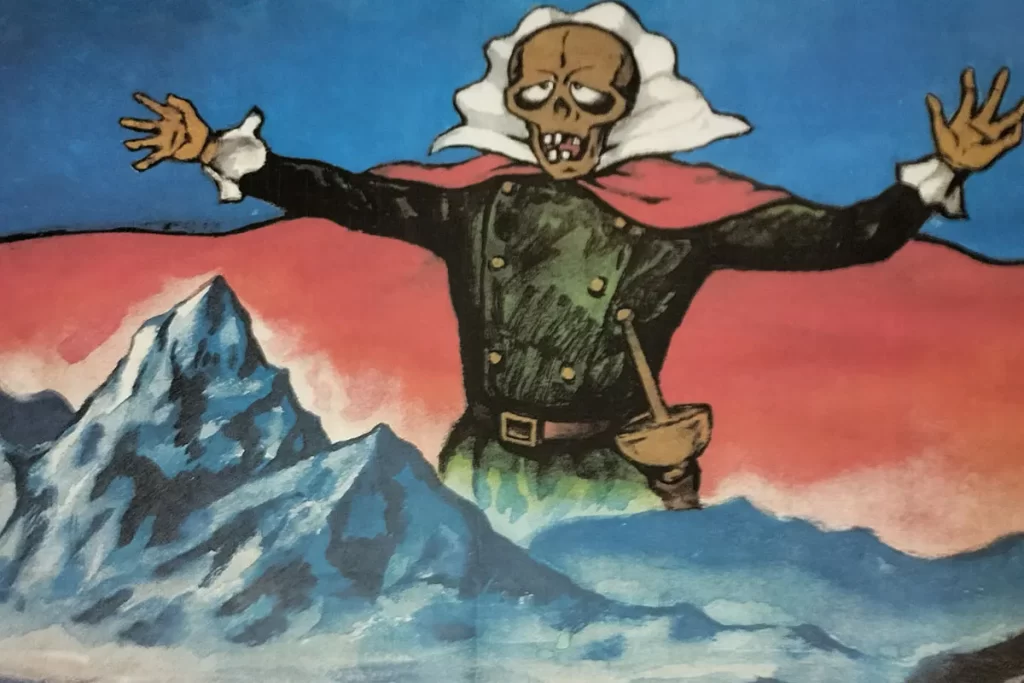 A kamishibai card from Ogon Bat. (Coutesy of Tadashi Sugiura’s family)
One was a story based on Choji Murata, the celebrated professional baseball pitcher who overcame serious injuries and became famous for his distinctive pitching style. Tadashi personally sought Murakami’s permission before completing the piece in 1988, and performances at baseball stadiums made it a major hit.
He also adapted the life of John Manjiro (1828–1897), the castaway rescued by an American whaling ship who became one of the first Japanese people to be educated in the United States. Manjiro went on to serve as a bridge between Japan and America as an interpreter.
The work earned my uncle an invitation to the Japan Festival in Boston in 1992, where he gave his first overseas performance.
 A picture card from the kamishibai about John Manjiro. (©Japan Forward/Mika Sugiura)

Kamishibai in Evacuation Shelters
As Japan’s only professional kamishibai storyteller, Tadashi often appeared in newspapers and on television, including The Sankei Shimbun, where I worked as a reporter. Yet I felt somewhat awkward about our family connection and kept my distance.
That changed the year after the 2011 Great East Japan Earthquake, when I was serving as bureau chief in Yamagata Prefecture. One day, my uncle called and said, “Mika, I’m going to the disaster area.”
After watching television footage of evacuees lining up for emergency food, he couldn’t sit still. He decided to bring survivors a new kamishibai based on Hayabusa, the Japanese space probe that had successfully returned samples from asteroid Itokawa to Earth in 2010, the first achievement of its kind in the world. The mission’s lead figure, Junichiro Kawaguchi, is from nearby Aomori Prefecture.
 Sugiura performing kamishibai about Hayabusa in May 2012. (©Japan Forward/Mika Sugiura)
Hoping to bring disaster victims a story of perseverance and hope, Tadashi spent eight months researching unfamiliar rocket terminology and creating the piece. He then set out alone, traveling to temporary housing complexes and community gathering places throughout the affected region.
I went with him to temporary housing sites in Miyagi and Fukushima prefectures. It was the first time I had ever covered my uncle as a journalist.
“Hayabusa, do you copy? Hayabusa, do you copy?”
My uncle’s deep voice echoed through a community hall filled mostly with elderly residents.
 Tadashi handing out crackers to survivors in August 2012. (©Japan Forward/Mika Sugiura)
He later told me, “I’m pretty old myself, but people younger than me have lost their spirit. After everything they’ve endured, I wanted them to lift their heads and look forward.”
My uncle was 81 at the time. Some survivors watching the performance were moved to tears, saying it brought back memories of their childhood.
 Survivors of the 2011 Great East Japan Earthquake watching Tadashi’s kamishibai performance, 2012. (©Japan Forward/Mika Sugiura)
Dedication and Discipline
Several days after the funeral, I visited my uncle’s home. Tens of thousands of kamishibai cards he had collected over the decades, along with vast amounts of research material for his original works, still filled the house. His sons Kenichi and Masakatsu were sorting through it all.
“It was my mother’s part-time work that made it possible for me to attend university,” Kenichi recalled.
The family endured many hardships. My uncle took on apprentices over the years, but none remained with him to the end. He demanded uncompromising dedication, and even his two sons chose not to immerse themselves in the world of kamishibai.
 A picture card from the kamishibai about John Manjiro. (©Japan Forward/Mika Sugiura)
My uncle could be very strict. If children misbehaved, he scolded them without hesitation, even in front of their parents. Yet children adored him and affectionately called him occhan (“uncle”). He also became a trusted advisor to parents struggling with raising their kids.
Tadashi kept performing on street corners until age 90, when the COVID-19 pandemic spread.
 Tadashi Sugiura of the Kamishibai Culture Association performs a kamishibai adaptation of the life of Hisako Nakamura at a junior high school in Miyakojima Ward, Osaka, November 2008).
One thing he often said has stayed with me ever since: “Kamishibai has the power to help people rise again. It is life itself. It gives people the strength to live. Kamishibai is a serious undertaking.”
He also never talked down to children or treated them lightly simply because they were young.
 Tadashi Sugiura telling stories at a park. (©Sankei/Fumie Oyama)
Legacy and Final Days
By coincidence, on the day of my uncle’s funeral, the first-ever release of the crested ibis on Japan’s main island was held in his home town, Hakui City in Ishikawa Prefecture. The bird is designated as a Special Natural Monument by the Japanese government. Once extinct in the wild in Japan, efforts are now underway to restore a self-sustaining population. It has also become a symbol of recovery for the region.
Had my uncle still been healthy, I am certain he would have created a hope-filled kamishibai story about the birds and traveled to visit survivors of the Noto Peninsula earthquake, just as he had done after the Great East Japan Earthquake.
Looking at the smiling portrait displayed at the funeral, I felt as though I could hear him striking his wooden clappers and calling out, “The kamishibai is about to begin!”
 The illustration and message Tadashi wrote 25 days before he passed away.
Twenty-five days before his death, on May 3, shortly after turning 95, he drew a picture and wrote a message in his own hand:
“To live is to die. My life is endless! I’ll live another ten years—to 105!”
Author: Mika Sugiura, the niece of Tadashi Sugiura
Continue Reading
AloJapan.com