

If a major earthquake were to occur directly beneath the densely populated Tokyo metropolitan area, it is expected to cause severe disruption to daily life, widespread casualties and displacement, and significant damage to critical infrastructure.
To prepare for such a disaster, the government is also taking into account the rising number of foreign visitors. Japan aims to reach 60 million inbound tourists annually by fiscal 2030, while Tokyo targets 30 million.
Language barriers and differences in culture and customs have repeatedly posed challenges in past disasters.
In June, the government revised its basic plan for countermeasures against a potential major earthquake directly beneath the Tokyo metropolitan area. The plan calls for stronger efforts to provide information to foreign residents and visitors.
During the 1995 Great Hanshin Earthquake, most information about the disaster situation and evacuation centers was issued only in Japanese and was not adequately communicated to foreign residents and visitors. Many had little knowledge or experience of earthquakes and were unfamiliar with disaster-related terminology.
The revised plan notes that inbound tourists are highly vulnerable to misinformation and the harmful effects of chaotic disaster conditions, and identifies accurate, rapid information dissemination as a key priority.
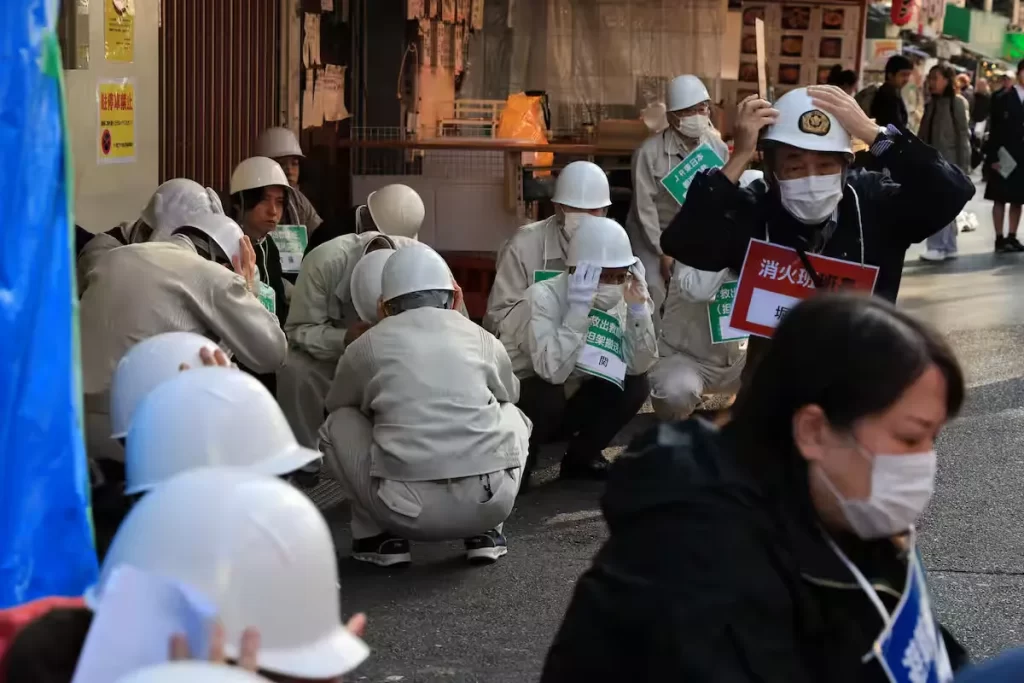 A fire drill at Ameyoko Shopping Street in preparation for an earthquake, November 2025, Taito Ward, Tokyo. (©Sankei/Hayato Narita)
Priority on Rapid Multilingual Communication
In the event of a disaster, the national government is expected to collect information on evacuation sites and repatriation support and share it through embassies and other diplomatic channels, supported by coordination and regular drills.
At the local government level, including Tokyo, key areas of focus include multilingual communication and the use of simplified “easy Japanese.” The plan also calls for cooperation between national and local authorities to train coordinators who can gather and relay the needs of foreign residents and visitors at evacuation shelters.
Evacuation Shelters
However, while various information-sharing measures are outlined, there are no clear numerical targets for securing evacuation shelters. A government official said the number of tourists fluctuates depending on the time of year and is difficult to predict, so setting fixed targets in advance may not be appropriate.
According to national estimates, immediately after the 2011 Great East Japan Earthquake, about 3.52 million people in Tokyo were unable to return home that same day.
The Tokyo Metropolitan Government disseminates disaster information in multiple languages via X and other platforms. It has also strengthened support for inbound visitors by introducing a system this year that uses GPS and other tools to guide stranded commuters in multiple languages. In an emergency, Tokyo will also establish a multilingual support center to dispatch interpreters to shelters and provide information to foreign nationals.
Concerns remain, however, that disruptions to communications infrastructure could hinder these planned countermeasures. At a press conference on June 12, Tokyo Governor Yuriko Koike noted that many inbound tourists also travel beyond Tokyo, and said the national government needs to strengthen the dissemination of disaster-related information.

RELATED:
(Read the article in Japanese.)
Author: The Sankei Shimbun
Continue Reading
AloJapan.com