


June 14, 2026 — 12:00am
Save
You have reached your maximum number of saved items.
Remove items from your saved list to add more.
AAA
This article is part of Traveller’s Holiday Guide to bucket-list places to eat. See all stories.
Solo travel is my guilty pleasure. I love travelling with my wife, my mates and, occasionally, my mum, but there is something about travelling alone that feels so liberating. I can be selfish, or lazy, and there is no one to bail me out from the mistakes that I happily make.
But if there is one part of the solo travel experience that I struggle with, it’s dining alone. Too many times, I’ve been to countries where the solo diner is treated like something to be shoved in the corner. I’ll have a great view of the bathroom as I wait for a meal designed to be eaten “family style”, before soldiering through 10,000 pieces of eggplant with everyone around me pretending I don’t exist.
 Illustration: Greg Straight
Japan is the exception. In Japan, I can go out for a meal without ever making eye contact with another human being. My order starts at a ticket machine, my ramen is delivered through a tiny curtain, and I eat it in a partitioned “flavour concentration booth”, which is about the most Japanese thing I’ve ever heard.
And while this might sound dystopian, it’s a reflection of “ohitorisama” culture, where there is no shame in a table for one.
Ohitorisama
Sign up for the Traveller newsletter
The latest travel news, tips and inspiration delivered to your inbox. Sign up now.
Ohitorisama is a polite way to say “one person”, using honorifics to transform one from the loneliest number into something worth celebrating. Historically, this word was used by waitstaff to greet solo guests, but it’s since become somewhat of a cultural movement, that gives people permission to enjoy themselves without the need to validate their experience with others.
To let the staff know that I’m dining alone, I’ll say “hitori” (one person without the honorifics), and they’ll take it from there, leading me into the restaurant where I’ll try to snag the best seat in the house.
 Counter seating is common in Japan.iStockKaunta-seki
Kaunta-seki (counter seating) is huge in Japan. Most restaurants have counters where you can sit, eat and watch as chefs slap together the best meal of your life. I love the way these seats make you feel like you’re invited to the party, not just looking at it through a window, and how you can rub shoulders with locals for whom it’s just another Tuesday night.
Related Article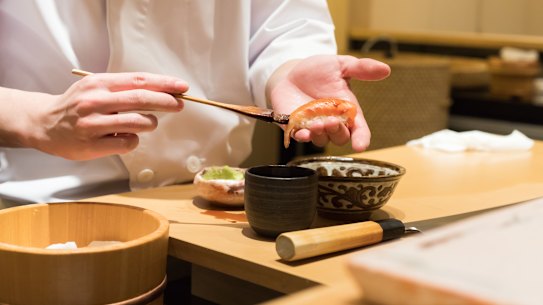
I’ll always ask for counter seating, which can be done as simply as saying “kaunta-seki?” with an upwards inflexion. The prevalence of these counter seats at kaiseki and omakase restaurants also makes it a lot less awkward to treat yourself to a high-end meal.
Tachinomiya
If sitting isn’t your style, you can always find a standing bar. These bars are perfect for making friends, as it’s hard not to interact with the people around you when you’re drinking in a bar the size of a broom closet.
The drinks are good, the conversations on Google Translate are oddly entertaining, but my favourite thing about these places are the tiny dishes known as otsumami (bar snacks). None of this “the menu here has been designed to share” rubbish. This is pure, selfish indulgence, where you can sample exactly what you want and put the “me” back in a meal.
Save
You have reached your maximum number of saved items.
Remove items from your saved list to add more.
 Paul Marshall is a Sydney-based travel writer who left his heart on the Banana Pancake Trail. With more than 10 years’ experience in the film, television, and video game industries, he now writes about his former life as a digital nomad and is always plotting his next escape. Whether it’s cycling across Korea or living in a Japanese fishing village, he loves a little-known destination and an offbeat adventure.Connect via email.From our partners
AloJapan.com